
US to launch new lunar programme Artemis 1
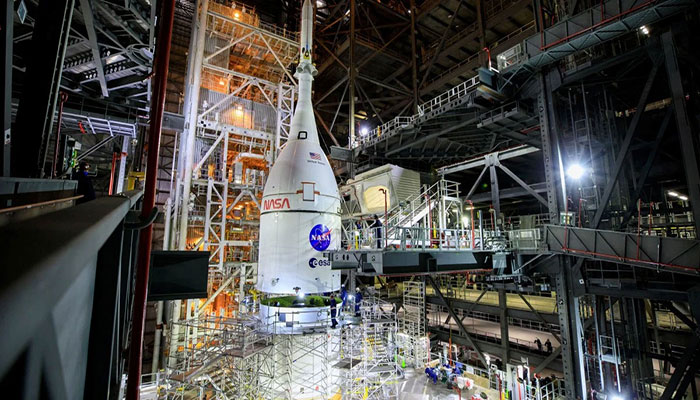
WASHINGTON: Nasa is aiming to launch its uncrewed lunar mission Artemis 1 in February next year, the space agency said late on Friday, the first step in America’s plan to return humans to the Moon.
The agency had initially hoped to launch the test flight by the end of this year, with astronauts set to walk on the Moon by 2024.
It achieved a major milestone on Wednesday when it stacked the Orion crew capsule atop its Space Launch System megarocket, which now stands 322 feet tall inside the Vehicle Assembly Building at Nasa Kennedy Space Centre in Florida.
After further tests, it will be wheeled out to the launchpad for a "wet dress rehearsal" in January, with the first window for launch opening in February, officials told reporters on a call.
"The February launch period opens on the 12th and our last opportunity in February is on the 27th," said Mike Sarafin, Artemis 1 mission manager. The next windows are in March and April.
These potential launch periods are dependent on orbital mechanics and the relative position of the Earth with respect to the Moon. The mission duration is expected to be four to six weeks.
Nasa will also deploy small satellites, known as CubeSats, to perform experiments and technology demonstrations.
Artemis 2 is then scheduled for 2023 and Artemis 3 for the following year, when humans will walk on the Moon for the first time since 1972. Both missions are now likely to be pushed back, however.
Nasa says the moonwalkers will include the first woman and first person of color to make the trip.
The space agency is seeking to establish a sustainable presence on the Moon as well as use the lessons it learns to plan a crewed trip to Mars in the 2030s.
Orion first flew into space in 2014, launched by a Delta IV rocket, making two circumnavigations of Earth and testing its heat shield on re-entry into the atmosphere.
But this time, Nasa’s Sarafin said, the capsule will travel much faster and the temperature will be much higher when it returns from the Moon.
Artemis 1 has several objectives: to demonstrate Orion’s ability to return from the Moon and operate in deep space where it is "much colder than in low Earth orbit," and to successfully recover the spacecraft, he added.







-
 King Charles, Princess Anne, Prince Edward Still Shield Andrew From Police
 -
 US Set To Block Chinese Software From Smart And Connected Cars
 -
 Carmen Electra Says THIS Taught Her Romance
 -
 Leonardo DiCaprio's Co-star Reflects On His Viral Moment At Golden Globes
 -
 SpaceX Pivots From Mars Plans To Prioritize 2027 Moon Landing
 -
 King Charles Still Cares About Meghan Markle
 -
 J. Cole Brings Back Old-school CD Sales For 'The Fall-Off' Release
 -
 GTA 6 Built By Hand, Street By Street, Rockstar Confirms Ahead Of Launch
 -
 Funeral Home Owner Sentenced To 40 Years For Selling Corpses, Faking Ashes
 -
 Why Is Thor Portrayed Differently In Marvel Movies?
 -
 Dutch Seismologist Hints At 'surprise’ Quake In Coming Days
 -
 Australia’s Liberal-National Coalition Reunites After Brief Split Over Hate Laws
 -
 DC Director Gives Hopeful Message As Questions Raised Over 'Blue Beetle's Future
 -
 King Charles New Plans For Andrew In Norfolk Exposed
 -
 What You Need To Know About Ischemic Stroke
 -
 Shocking Reason Behind Type 2 Diabetes Revealed By Scientists