
State plays an important role in development: Asad
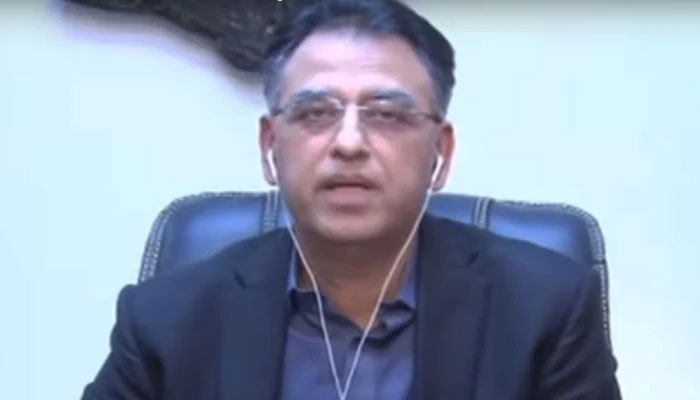
KARACHI: The State may play a pivotal role in owning and operating select companies in select areas of the economy as the private sector has remained shy of taking risk of making huge investments in many areas, Federal Planning, Development and Special Initiatives Minister Asad Umar said Saturday.
“I have been of the view, what I have seen in Pakistan and what I have seen around the world that this monster which has become very, very popular in Pakistan which is the government has no business of being in business is a nice catchy line but isn’t necessarily true,” he said at an online discussion on “role of the State in economic development”.
The discussion was organised by the Institute for Policy Reforms (IPR). He said it was his personal view not the official policy of the government of Pakistan.
He said he believes the state-owned enterprises (SOEs) can play an important role. The global energy landscape today is dominated by state-owned enterprises and very, very successful enterprises.
“We look at Dubai development and again these are, the point to highlight is these are interventions of the State in areas which were absolutely vital for development of that particular domain,” he said and added that for countries like Qatar or Saudi Arabia, obviously energy was the most vital thing for their development.
Dubai used the real estate that it has as the primary engine for that growth and who were the most successful players. There were mostly state-owned enterprises. In Singapore, the State has played a role in its success, he added.
Umar said he does believe the 21st Century economy should be private sector led and the real innovation, entrepreneurship that is going to come by and large in the larger economy is going to be led by the private sector.
“The State’s most important role is to create conditions where competitive behaviour takes shape where there is risk taking, where there is innovation and those who do innovative work in a marketplace and competitive…one succeed”.
The chair and CEO IPR Humayun Akhtar Khan said for over a quarter of a century, Pakistan has been borrowing excessively from abroad to meet all kinds of external shortfalls.
“We borrowed to meet Forex needs for imports. We borrowed to service the past debts, we even borrowed to meet current expenditures and only one thing of what we borrow actually goes to development expenditures,” he said. “That’s why debt is now out of hand and it’s continuing growing in every government for the last 25-30 years,” he added.
Akhtar said the country repaid principal and interest more than what it borrowed and this model led to almost permanent external account vulnerability.
He highlighted that the share of Gross Domestic Product (GDP) in the productive sectors like agriculture and manufacturing is on a slowdown. He said in developing economies the share of agriculture in the GDP usually goes down but it’s accompanied by an increase in the manufacturing sector. However, in Pakistan even the manufacturing sector is going down and the economic growth has basically come from the services sector and the part of the service sector is not exportable and the result is that the export to GDP ratio which was over 17 percent in the 90’s is now about 9 percent.
“We need the economy to grow, increase exports, create new jobs for the large number of young people entering our workforce and we feel that the State must play its role in achieving these objectives,” he said. At the minimum, it must ensure critical investment in infrastructure needed by the private sector. The labour productivity is lower therefore the State must also invest in the people of Pakistan.
“Our exports are not elastic to devaluation because we have not really moved our exports with the developments and technology internationally and even in years when Pakistan had no shortage of foreign capital when they were getting a lot of foreign aid and we did not make the necessary capital accumulation and structural transformation to build and upgrade manufacturing and that as we all know is the only way to compete in the global market”.







-
 ChatGPT Caricature Prompts Are Going Viral. Here’s List You Must Try
 -
 James Pearce Jr. Arrested In Florida After Alleged Domestic Dispute, Falcons Respond
 -
 Cavaliers Vs Kings: James Harden Shines Late In Cleveland Debut Win
 -
 2026 Winter Olympics Snowboarding: Su Yiming Wins Bronze And Completes Medal Set
 -
 Trump Hosts Honduran President Nasry Asfura At Mar-a-Lago To Discuss Trade, Security
 -
 Cuba-Canada Travel Advisory Raises Concerns As Visitor Numbers Decline
 -
 Anthropic Buys 'Super Bowl' Ads To Slam OpenAI’s ChatGPT Ad Strategy
 -
 Prevent Cancer With These Simple Lifestyle Changes
 -
 Air Canada Flight Diverted St John's With 368 Passengers After Onboard Incident
 -
 Experts Reveal Keto Diet As Key To Treating Depression
 -
 Inter Miami Vs Barcelona SC Recap As Messi Shines With Goal And Assist
 -
 David Beckham Pays Tribute To Estranged Son Brooklyn Amid Ongoing Family Rift
 -
 Jailton Almeida Speaks Out After UFC Controversy And Short Notice Fight Booking
 -
 Extreme Cold Warning Issued As Blizzard Hits Southern Ontario Including Toronto
 -
 Lana Del Rey Announces New Single Co-written With Husband Jeremy Dufrene
 -
 Ukraine-Russia Talks Heat Up As Zelenskyy Warns Of US Pressure Before Elections