
Pakistan’s tourism blindspot
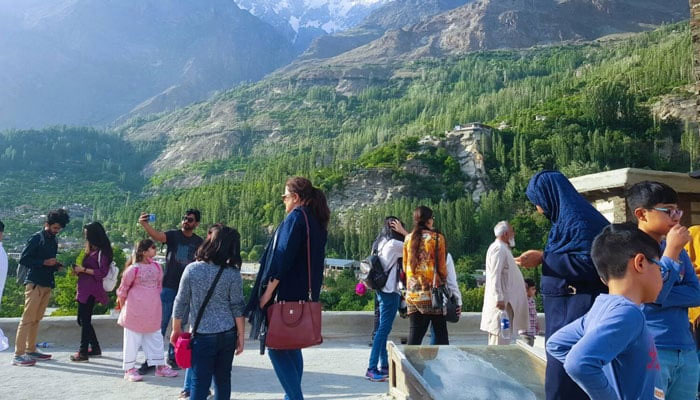
In the grand theatre of global travel, Pakistan is a well-scripted yet poorly directed character, rich in cultural depth and natural beauty, but rarely making it to the centre stage. Despite possessing one of the richest cultural and natural heritages in South Asia, the country’s tourism policy remains largely disconnected from real-time data, inclusive development and modern governance practices.
The World Economic Forum’s 2025 report, ‘Travel and Tourism at a Turning Point’, makes one fact resoundingly clear: the global travel economy is transforming fast, and only those countries that combine institutional agility with digital infrastructure will thrive. Pakistan, despite its rich heritage and natural assets, continues to operate in a policy vacuum, hindered by one critical shortcoming: the absence of reliable, real-time data.
In 2024, Pakistan welcomed around 965,000 international visitors, who spent a modest $738 million. These tourists stayed on average 6.2 days, a figure far below regional benchmarks. Contrast this with countries like Vietnam or Jordan, which receive millions more visitors annually, many staying longer and spending more per trip. Pakistan’s tourism sector contributes a meagre 1.9 per cent to GDP and 1.7 per cent to total employment, figures that speak more to untapped potential than genuine underperformance.
In 2022, the Pakistan Tourism Development Corporation (PTDC), with support from the World Bank, developed a Pakistan Tourism Competitiveness Development Index. The initiative was promising, intended to localise tourism benchmarking beyond global indices. But two years on, the platform remains unpopulated. Provincial departments have not fed it any real data. Internal coordination is weak and external data-sharing frameworks are non-existent. As a result, Pakistan makes travel and tourism policy in the dark.
Meanwhile, the rest of the world is racing ahead. The recent WEF report predicts that by 2034, tourism will contribute $16 trillion to global GDP and host 30 billion tourist trips annually. Emerging global trends include a dramatic rise in wellness and spiritual and faith-based tourism, sustainable travel, domestic rediscovery, and the use of AI and real-time analytics in visitor experience design.
One standout trend is the shift from volume to value: countries are focusing less on sheer numbers and more on longer stays, deeper experiences and per capita spend. Another is the centrality of digital. In high-performing economies, everything, from visa processing to ecosystem mapping, is being digitalised and fed into real-time dashboards for smart decision-making.
The WEF report identifies ten global “tension points” that will shape the next decade of the travel economy: infrastructure constraints, workforce and skills gaps, sustainability imperatives, data and technology integration, evolving traveller expectations, climate vulnerabilities, cost inflation, regulatory fragmentation, underutilised SMEs and uneven recovery momentum.
Pakistan finds itself entangled in at least six of these. It struggles with outdated infrastructure, especially in transport and public services; a largely informal and undertrained workforce; data fragmentation, which cripples smart decision-making; and technology lags that prevent the country from digitising its travel services.
The absence of climate-resilient planning and underutilisation of tourism-focused SMEs further stifles innovation and local entrepreneurship. Without targeted reforms in these critical areas, Pakistan risks deepening its marginalisation in an increasingly intelligent and competitive global tourism marketplace.
The country also lacks a destination management model, and its most iconic sites, such as Hunza, Taxila and Mohenjo-Daro, are strained by neglect or unmanaged visitor surges. The absence of sustainability planning means that many regions face environmental degradation without remedial strategies.
Pakistan holds immense untapped potential in cultural and spiritual tourism, with treasures like the Karakoram peaks, the Gandhara trail and the Indus Valley ruins. Sites such as the Hinglaj Mata Temple in Balochistan, one of the 51 Shakti Peethas, draw thousands of pilgrims annually, including from India. Other historic temples near Karachi, like Kalka Devi and Shivaharkaray, reflect a rich interfaith heritage. Yet without proper governance, preservation and access, this potential remains unrealised.
To build a responsible and inclusive tourism economy, Pakistan must address gender and human rights gaps. Women make up over half of the global tourism workforce but are often confined to low-paid, informal roles. In Pakistan, social and cultural barriers further limit their participation. Ensuring equitable policies, labour rights and safety for both workers and travellers is essential. By empowering women as entrepreneurs and guides, Pakistan can unlock its local economic potential and present a more inclusive, rights-based national image to the world.
To move forward, Pakistan must activate its dormant Tourism Competitiveness Index by mandating structured, anonymised data from all tourism stakeholders. This data should feed into a central National Tourism Intelligence System, allowing real-time tracking of trends and gaps. Without this foundation, tourism policy will remain aspirational rather than actionable.
Next, Pakistan should establish an independent Tourism Data Council to integrate data on mobility, spending, sentiment and sustainability. Collaborating with PTDC, the Ministry of Planning and NADRA, the council would facilitate smarter, predictive policymaking through coordinated analytics and real-time visitor insights.
Third, Pakistan must invest in destination management organisations (DMOs) at the local level. These bodies, already standard in Europe and East Asia, empower communities, standardise services and create curated visitor journeys. Without DMOs, Pakistan will remain vulnerable to over-tourism in some regions and underutilisation in others.
Fourth, the government must mainstream digital transformation in tourism services. This means online visa systems, e-ticketing for national sites, QR-based interpretation at cultural landmarks and user-generated data collection through visitor apps. Tourists today expect seamless, technology-enabled experiences, Pakistan must meet them where they are.
Lastly, Pakistan must reposition its tourism sector in global marketing. Instead of focusing on numbers, it must emphasise thematic offerings, faith tourism, wellness retreats, high-altitude trekking and Silk Road heritage. This would attract higher-spending, longer-staying visitors who value authenticity and experience over mere affordability.
Pakistan faces a clear choice: continue without data-driven direction or embrace insight and innovation to shape its tourism future. As the WEF warns, “the cost of inaction will outweigh the cost of disruption”. For Pakistan, that cost is already evident in lost opportunities and limited impact.
The country has all the right ingredients. What it lacks is clarity of direction, and the courage to digitise, decentralise and disrupt itself. Until it does, Pakistan will remain a spectacular destination hidden behind an institutional blindfold.
The writer is a public policy expert and leads the Country Partner Institute of the World Economic Forum in Pakistan. He tweets/posts @amirjahangir and can be reached at: aj@mishal.com.pk


