
NA passes budget with tweaks in tax laws, rates
National Assembly passed amended Finance Bill 2025 after key coalition partners reached an agreement
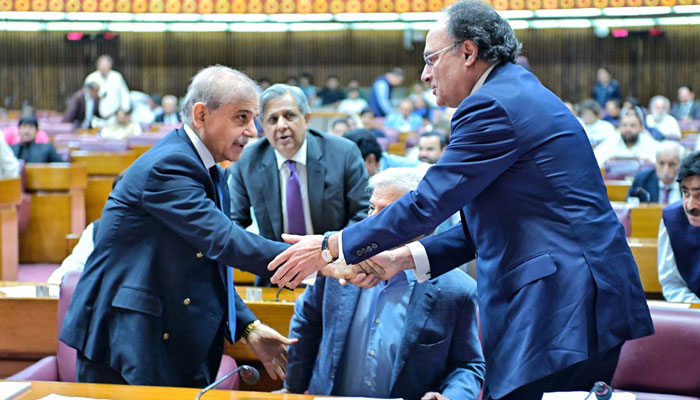
ISLAMABAD: The National Assembly on Thursday passed the amended Finance Bill 2025 after key coalition partners reached an agreement, making arrests for tax fraud a bailable offense while approving several tax exemptions and new taxation measures.
The approved bill granted tax exemptions to Beaconhouse National University, Federal Ziauddin University and Punjab Police Welfare Organisation, Lahore, while bringing the National Logistics Corporation (NLC) into the tax net. The NLC will now be subject to a three percent tax on gross payments and lease revenues for toll collection, with provisions ensuring this serves as minimum tax liability.
Deputy Prime Minister Ishaq Dar revealed to reporters in the Parliament House that negotiations with Pakistan Peoples Party (PPP) leadership had yielded an amicable solution regarding arrest powers for tax fraud. “We agreed that arrests wouldn’t occur at the inquiry stage,” Dar explained, confirming that while tax fraud remains a cognizable offense, it would now be bailable.
A notable dissent came from Federal Minister for Kashmir Affairs Amir Muqam, who opposed the imposition of 10 percent GST on erstwhile Fata/ Pata regions. “The PM granted GST exemption twice before. I request continuation for 2025-26 as ground realities haven’t changed,” Muqam argued on the assembly floor, though the reduced rate was ultimately approved.
PPP Chairman Bilawal Bhutto Zardari in his speech stated that the government increased the taxable ceiling from Rs0.6 million to Rs1 million at zero rate, and went on to say that it went to Rs1.2 million, but the Amended Finance Bill approved by the NA did not mention any change in the finance bill.
The bill introduced a two percent tax on digital payment intermediaries for locally ordered goods through online platforms. Notably, it granted broad exemption powers to the federal government, allowing it to exempt countries, goods/ services, or persons from taxation via official notification.
The legislation balances enforcement measures with taxpayer protections, reflecting the coalition’s negotiated compromises on economic policy. The changes particularly address PPP’s concerns about the Federal Board of Revenue (FBR) powers while maintaining the government’s revenue objectives through expanded taxation of digital commerce and specific organisations.
Speaking in the National Assembly, PPP Chairman Bilawal explained the party’s support for the federal budget, stating that many of PPP’s demands were accepted, with amendments incorporated as a result of their input. He noted that the government had increased the allocation for the Benazir Income Support Programme (BISP) by 20 percent. He criticised the previous Pakistan Tehreek-e-Insaf (PTI) government for attempting to undermine the BISP in every budget and commended the current prime minister for consistently increasing its funding since taking office. He further highlighted that the government had raised the income threshold for tax exemption from Rs600,000 to Rs1.2 million annually. Additionally, he pointed out that the tax on solar panels was reduced from 18 percent to 10 percent following objections raised by the PPP members.
Bilawal also welcomed the decision to curtail the arrest powers of the Federal Board of Revenue (FBR). Under the new policy, he said arrests in tax cases can now only be made in instances of proven fraud, not during the inquiry stage. Moreover, such offences have been declared bailable. “These are the reasons why the PPP is supporting this budget,” he concluded.
Earlier, Bilawal Bhutto Zardari chaired a meeting of the PPP parliamentary party in the Parliament House, attended by all PPP members of the National Assembly, including Aseefa Bhutto Zardari. Members briefed Chairman Bilawal on their proposals regarding the federal budget and informed him of the amendments secured due to PPP’s input. He was told that on PPP’s suggestion, the federal budget now includes a 10 percent increase in government salaries and a 7 percent rise in pensions. Another key achievement highlighted was the restoration of budgetary allocations for universities in Sindh.
The PPP chairman directed the party parliamentarians to vote in favour of the federal budget. Meanwhile, briefing the media after the parliamentary party meeting, PPP Parliamentarians Spokesperson Shazia Marri said, “The PPP has expressed partial trust in the government’s approach, and although some of our concerns have been addressed, others remain unresolved.”
She noted that when the budget was first presented, several aspects alarmed the PPP, particularly the proposed solar tax. Shazia Marri stated that the PPP had negotiated and submitted proposals, including demands for salary hikes and BISP expansion. She acknowledged that inflation had been somewhat controlled but stressed that economic hardships persist.
She confirmed the government had accepted most of PPP’s key demands, and the party would vote for the finance bill.
However, she expressed disappointment over the neglect of agriculture-related proposals and concerns about South Punjab’s budget allocation. “The share for South Punjab has been kept below 5 percent, whereas it should be closer to 40 percent. Chairman Bilawal Bhutto has demanded at least 30 percent allocation for the region,” she asserted.
Marri concluded by stressing the need for meaningful dialogue on unresolved issues. “Joint efforts always yield better outcomes,” she said.
Earlier, Minister for Finance and Revenue Muhammad Aurangzeb moved the motion for consideration of the Finance Bill 2025 to give effect to the financial proposals of the federal government for the year, commencing on July 1, 2025. The motion was passed with majority vote which led to the passage of Finance Bill-2025 after clause-by-clause reading and adopting amendments after due process of voting. All the amendments presented by the opposition were rejected.
During the proceedings, Aurangzeb presented the amendments to the Sales Tax Act 1990, including a provision granting the finance committee authority to order the arrest of traders involved in tax fraud exceeding Rs50 million. An earlier version of the proposal had sought to give this power directly to tax commissioners.
After incorporating amendments proposed by members concerning sales tax fraud provisions, the revised legislation, stipulates that arrest would be made in cases of sales tax fraud involving amounts of Rs50 million or more. Such arrests must be authorised by a committee composed of representatives from Customs Operations, Inland Revenue and Legal departments. The bill mandates that individuals detained for sales tax fraud offenses must be presented before a magistrate within 24 hours of arrest.
The legislation precisely defines sales tax fraud to encompass several specific violations. These include tampering with or altering tax records, issuing tax invoices without corresponding goods supply, manipulating sales tax documentation, engaging in fraudulent activities through tax invoices, and deliberately providing false information in tax returns. For corporate entities involved in tax fraud, the bill requires that the person/ company concerned be served three formal notices prior to any legal action being taken.
The amended Finance Bill 2025-26 introduces several key procedural modifications. Inquiries into sales tax fraud cases will no longer be conducted confidentially. Individuals who actively participate in the inquiry process will be exempt from arrest. However, the bill specifies that attempts to flee abroad to evade sales tax fraud charges, destruction of evidence related to sales tax fraud, or any efforts to escape investigation will result in immediate arrest. These provisions aim to strengthen enforcement mechanisms against tax fraud while maintaining procedural safeguards and due process requirements throughout investigations and legal proceedings. The amendments establish clear parameters for identifying sales tax fraud and create a structured framework for handling such cases effectively.
To combat smuggling, the legislation authorised the implementation of cargo tracking systems, an electronic BLT system, and the establishment of digital enforcement stations. These provisions form part of the government’s comprehensive approach to tax reform, combining enforcement measures with targeted exemptions and modernisation of customs procedures.
The Finance Bill 2025 also introduces a revised income tax structure for salaried individuals. Those earning up to Rs600,000 annually will continue to be exempt from income tax. Salaries ranging above Rs600,000 to Rs1.2 million will be taxed at 1 percent.
Likewise, individuals with annual incomes between Rs1.2 million and Rs2.2 million will pay a fixed tax of Rs6,000. Further, those earning between Rs2.2 million and Rs3.2 million will be taxed at Rs116,000. For annual incomes between Rs3.2 million and Rs4.1 million, the tax will be Rs346,000.
The National Assembly also considered amendments to the Salaries and Privileges of Parliamentarians Act, which were presented by members Nosheen Iftikhar and Zahra Wadood Fatemi. The Finance Bill 2025 introduced new provisions under Sections 4A and 4B, transferring the authority to determine parliamentary salaries and benefits from the Secretariat to the House Committee. Additionally, the amendments stipulate that federal ministers and ministers of state will receive salaries equivalent to those of regular parliament members. The finance minister endorsed these proposed changes.
As the government decided to go ahead with imposition of Rs2.5 per litre Carbon Levy on petroleum products, the same levy through an amendment in Clause 3 of the Finance Bill has now been renamed as ‘Climate Support Levy’.
The Finance Bill made restrictions on large asset purchases by undocumented individuals. However, following the PM’s direction, these restrictions would not apply to residential houses up to Rs50 million, commercial plots or properties up to Rs100 million, and purchase of vehicles worth up to Rs7 million. The capital gains tax will not apply to property sold after six years of purchase, provided it was acquired before July 1, 2024. However, it would be subjected to 4.5 to 6 percent withholding tax on purchase, which he said was generally returned on filing returns. The property in personal use for 15 or more years would be exempted from the withholding tax.
Meanwhile, Prime Minister Shehbaz Sharif lauded the entire economic team, particularly the finance minister for their hard work and dedication in preparing the federal budget. He also expressed gratitude to the federal cabinet and the allied political parties for their support in finalising the budget.
The total outlay of the federal budget for the fiscal year 2025-26 is Rs17.573 trillion. The budget outlines a comprehensive fiscal plan for building competitive economy focusing to enhance exports, improve foreign exchange reserves, reduce fiscal imbalances and encourage economic productivity.
The budget projected economic growth rate at 4.2 percent for the fiscal year 2025-26. The inflation is expected to remain at 7.5 percent, while the fiscal deficit has been estimated at 3.9 percent of GDP and the primary surplus is projected to reach 2.4 percent of GDP.
The revenue collection target by the FBR has been set at Rs14.131 trillion, showing an increase of 18.7 percent compared to fiscal year 2024-25. The federal excise duty has been calculated at Rs8.206 trillion while the non-tax revenues are project at Rs5.147 trillion.
The net income of the federal government would be Rs11.072 trillion whereas its expenditures have been estimated at Rs17.573 trillion, out of which Rs8.207 trillion would be spent on mark-up payments. The current expenditures of federal government were Rs16.286 trillion.
As many as Rs1 trillion have been earmarked for the Public Sector Development Programme while total Annual Development Plans (ADPs) exceeds Rs4 trillion.
During the National Assembly proceedings, PTI’s Ali Muhammad Khan and Iqbal Afridi came harsh on the government for extending tax network to erstwhile Fata saying government’s actions speak against its promises.
Barrister Gohar Ali Khan, while noting that the presentation of the federal budget is a constitutional responsibility, said it is 64 percent deficit budget which is disastrous for the country and the nation.
Meanwhile, speaking to the media outside the Parliament House along with other party leaders, former NA speaker Asad Qaiser said: “Our main demand is that there is no reason for levying tax in former Fata region. Tax should not be imposed until peace returns to the area.”
Public Accounts Committee Chairman Junaid Akbar condemned the federal government’s neglect of Fata, recalling that Rs100 billion was supposed to be allocated annually for development after the merger. “Instead, the people face extortion and unjust taxes while the wealthy have left the region,” he said and called the taxation policy cruel and unacceptable.
S# Taxable Income Rate of Tax
(1) (2) (3)
1. Where taxable income 0pc
does not exceed Rs600,000
2. Where taxable income 1pc of the amount
exceeds Rs600,000 but does exceeding Rs600,000
not exceed Rs1,200,000
3. Where taxable income Rs6,000 + 11pc
exceeds Rs1,200,000 but of the amount exceeding
does not exceed Rs2,200,000 Rs1,200,000
4. Where taxable income Rs116,000 + 23pc of
exceeds Rs2,200,000 but does the amount exceeding
not exceed Rs3,200,000 Rs2,200,000
5. Where taxable income exceeds Rs346,000 + 30pc of
Rs3,200,000 but does not the amount exceeding
exceed Rs4,100,000 Rs3,200,000
6. Where taxable income Rs616,000 + 35pc of the
exceeds Rs4,100,000 amount exceeding
Rs4,100,000


