
IBA roundtable discusses implications of India’s unilateral suspension of IWT
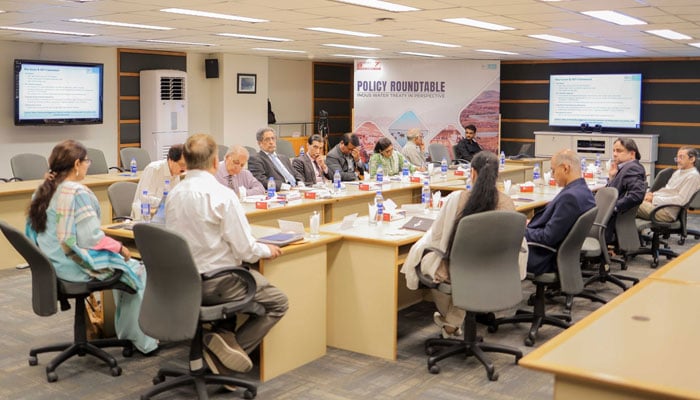
The IBA Karachi hosted at its City Campus a policy roundtable titled “Indus Water Treaty in Perspective” to discuss the implications of the India’s unilateral suspension of the Indus Water Treaty (IWT) in April 2025.
The event was organised by the Centre for Business and Economic Research (CBER) at SESS, said a press release issued by the IBA. Experts highlighted a critical lack of institutional capacity to engage and respond meaningfully with the treaty’s technical and legal dimensions on diplomatic fronts. While academic institutions in Pakistan teach water-related subjects, they emphasized the urgent need to strengthen expertise in international water law and transboundary water diplomacy.
Participants also discussed how prevailing media narratives about India’s “blocking water” have misguided public as such claims are technically unfeasible without large-scale infrastructure and serve more as political tools than realities.
Participants noted that the World Bank role is not clear regarding the resolution of this dispute, and without an institutional conflict resolution mechanism between the two countries, the treaty’s ability to adapt to new challenges remains limited. Some of the experts warn that building new dams is not a solution, as Pakistan lacks sufficient water stock and is facing long-term water flow decline.
In conclusion, participants called for the establishment of a multi-stakeholder working group under the umbrella of IBA-CBER that meets regularly to deliberate on national and regional water strategies and provide actionable recommendations to modernize and strengthen the Indus Water Treaty.
The session brought together government officials, journalists, and academicians to engage in dialogue on the topic, moderated by Dr. Lubna Naz, Director, IBA-CBER. Notable participants included Mr. Muhammad Ehsan ul Haq Laghari, Sindh Member, Indus River System Authority; Mr. Shahab Usto, Advocate, Supreme Court of Pakistan; Mr. Syed Jaffar Ahmed, Member on IBA’s Board of Governors and Director, Institute of Historical and Social Research; Mr. Hafeez Ahmed Jamali, Director General, Balochistan Civil Service Academy; Mr. Syed Hasan Habib, Former Ambassador; Mr. Syed Imran Ahmed, Director, Panjwani Hisaar Water Institute; Mr. Yasir Husain, Founder, Climate Action Center; Mr. Zakir Hussain Dahri, Director General, Pakistan Agricultural Research Council; and others.







-
 Maxwell Seeks To Block Further Release Of Epstein Files, Calls Law ‘unconstitutional’
 -
 Prince William Issues 'ultimatum' To Queen Camilla As Monarchy Is In 'delicate Phase'
 -
 Winter Olympics 2026: Remembering The Most Unforgettable, Heartwarming Stories
 -
 King Charles Hands All Of Andrew Mountbatten-Windsor’s Records And Files To Police: Report
 -
 Eric Dane's Family Shares Heartbreaking Statement After His Death
 -
 Samsung Brings Perplexity AI To Galaxy S26 With ‘Hey Plex’ Voice Command
 -
 Fergie’s Spent £13,000 A Day Since Andrew’s Troubles Started: Here’s Where She Fled
 -
 Eric Dane's Death Becomes Symbol Of ALS Awareness
 -
 Michael B. Jordan Gives Credit To 'All My Children' For Shaping His Career: 'That Was My Education'
 -
 Sun Appears Spotless For First Time In Four Years, Scientists Report
 -
 Bella Hadid Opens Up About 'invisible Illness'
 -
 Lawyer Of Epstein Victims Speaks Out Directly To King Charles, Prince William, Kate Middleton
 -
 Microsoft CEO Shares How Gates Doubted $1bn OpenAI Investment
 -
 Milo Ventimiglia Calls Fatherhood 'pretty Wild Experience' As He Expects Second Baby With Wife Jarah Mariano
 -
 Chinese Scientists Unveil Advanced AI Model To Support Deep-space Exploration
 -
 Anthropic’s New AI Tool Wipes Billions Off Cybersecurity Stocks