
Nukes sole guarantor of regional peace: NCA Adviser
This shift validates Pakistan’s conventional deterrence as an effective complement to its robust nuclear arsenal
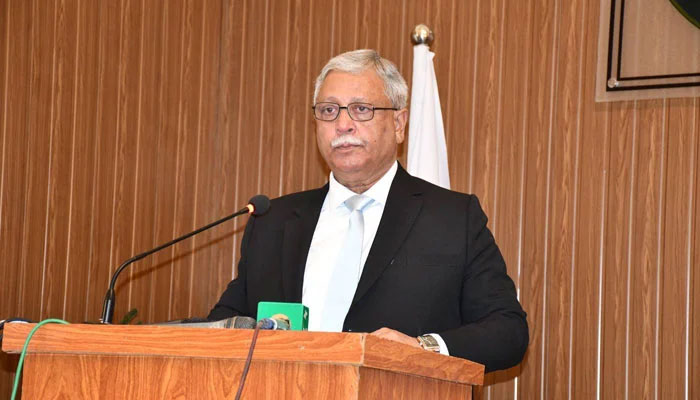
ISLAMABAD: Adviser to National Command Authority (NCA) has vowed that Pakistan’s nuclear weapons programme remains the “sole guarantor of peace and stability in South Asia.”
Lieutenant General (R) Khalid Ahmed Kidwai was speaking here Friday in a seminar hosted by the Center for International Strategic Studies (CISS) regarding celebrations of 27th anniversary of Pakistan’s nuclear tests, commemorated as Youm-e-Takbeer.
The general dilated upon subject second time in three days. He reminded that the Pakistan Air Force’s (PAF) decisive performance, leveraging advanced Chinese-technology and using integrated multi-domain tactics, has established Pakistan as the dominant air power in South Asia.
This shift validates Pakistan’s conventional deterrence as an effective complement to its robust nuclear arsenal. He reminded that Pakistan’s battle-tested conventional deterrent, especially PAF has assumed a leading role in regional deterrence; Pakistan’s credible nuclear deterrence will continue to constrain and limit India’s political and operational choices, thereby maintaining strategic stability; any Indian aggression will be met with a ‘notch-up response’ as Field Marshal Syed Asim Munir has promised, a ‘Quid Pro Quo Plus’, as Pakistan’s retaliation will always be a calibrated and escalated response; India’s pattern of seeking ceasefires following Pakistan’s intense retaliation has become an established norm; and international diplomatic interventions will persist managing crises to prevent escalation beyond defined limits.
The retired general who was the first chief of Strategic Plans Division (SPD), that had the management of missile-nuclear systems, warned that Pakistan reserves the right to reciprocate any terror attack with conventional responses against pre-determined adversaries, reflecting a reciprocal logic to India’s declared doctrines. Over the last six years, India’s Hindutva-driven BJP government had twice tested nuclear-armed Pakistan’s political will, strategic resolve, and military capability first by striking mainland Pakistan in February 2019, and again in Azad Kashmir in May 2025.
On both occasions, India had to bite the dust. The confrontations reaffirmed the credibility of Pakistan’s deterrent posture both conventional and nuclear and demonstrated that any Indian aggression would be met with a stronger-than-proportional response. He made it emphatically clear that Pakistan has steadfast resolve to safeguard its sovereignty and regional peace in an environment shaped by emerging threats and technological advancements, marking a strategic shift that firmly favors Pakistan’s security interests in South Asia.
Interestingly this year’s observance assumed added significance in the aftermath of heightened tensions between Pakistan and India following the false flag action in Pahalgam. Indian military actions, including so-called Operation Sindoor, were widely criticised by speakers at the event as reckless provocations designed to test Pakistan’s thresholds in a nuclearised environment. Pakistan responded with a series of precise retaliatory measures under Operation Bunyan-um-Marsoos, part of the broader Mark-e-Haq campaign.
Experts at the seminar said the response reasserted deterrence, restored strategic balance, and marked what they described as a “decisive paradigm shift” in the regional balance. “It showcased Pakistan’s credible nuclear capability and reaffirmed that this deterrent —operationalised through Full Spectrum Deterrence (FSD) — serves as the cornerstone of peace and strategic stability in South Asia,” said one speaker, adding that the mini-war underscored the deterrent’s enduring role in preserving peace.
The seminar featured senior officials and strategic thinkers, including Ambassador Sohail Mahmood, Director General of the Institute of Strategic Studies Islamabad (ISSI); Muhammad Naeem, former chairman of the Pakistan Atomic Energy Commission (PAEC); Dr Adil Sultan, Dean of Air University; and Brig (R) Dr Zahir ul Haider Kazmi, Adviser on Arms Control at the Strategic Plans Division (SPD).
Speakers observed a pattern in India’s behavior — using false flag operations as a casus belli to justify limited strikes against Pakistan while disregarding the prevailing nuclear environment. They warned that such actions risk dangerous miscalculations.
They emphasised that Pakistan’s nuclear capability is a strategic necessity that has effectively deterred full-scale war, even as threats have evolved in complexity and domain.
The panel stressed that Pakistan now possesses a comprehensive toolkit of both kinetic and non-kinetic options to respond to any future Indian provocations, and that its response will follow a Quid Pro Quo Plus (QPQ+) approach — swift, proportionate, and precise — designed to neutralise aggression and compel de-escalation. “If India persists in its reckless behavior, it must recognise that Pakistan’s resolve must not be underestimated,” one speaker said, noting that the Pakistan Air Force remains fully prepared to assert dominance in South Asian airspace. “India would be wise to acknowledge the limits of its power and act accordingly.”
Speakers also paid tribute to the scientists, engineers, and planners who made the 1998 nuclear tests possible. Despite international embargoes, financial constraints, and geopolitical isolation, they built a robust and self-reliant nuclear infrastructure. The tests, they said, were not just a technical triumph but a symbol of national resilience and technological sovereignty.
The participants emphasised that Youm-e-Takbeer reflects more than a technological milestone. It symbolises Pakistan’s unwavering commitment to peace through credible minimum deterrence — a commitment, they said, that has once again proven decisive in shaping the regional strategic landscape.


