
Pak-US talks on reciprocal tariffs begin
Finance Minister Muhammad Aurangzeb and US Trade rep Jamieson Greer hold talks over phone
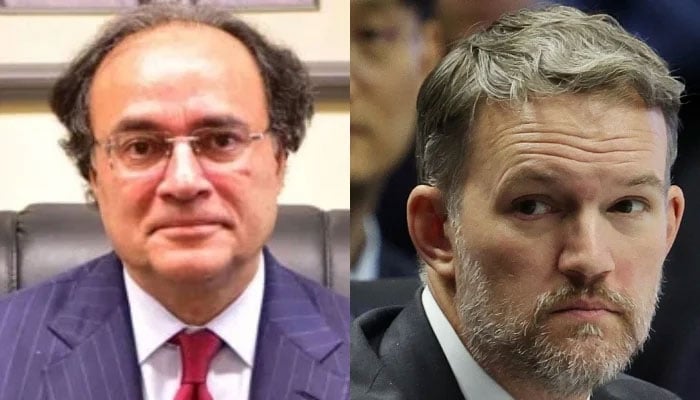
ISLAMABAD: Pakistan and the United States Friday kick-started formal negotiations on reciprocal tariffs imposed by the Trump administration with the understanding that technical-level detailed discussions would follow in the coming few weeks.
In an official announcement, the Ministry of Finance Friday confirmed that Pakistan’s formal negotiations on US reciprocal tariffs had kick-started between Finance Minister Muhammad Aurangzeb and US Trade Representative Ambassador Jamieson Greer through a telephonic/conference call on Friday, May 30.
“The two sides exchanged their viewpoints through a constructive engagement with the understanding that technical-level detailed discussions would follow in the coming few weeks,” the official statement added.
Both sides expressed confidence in advancing these negotiations for a successful conclusion at the earliest.
Talking to The News, top official sources said the 39% tariff imposed by the US on imports from Pakistan could impact Pakistan’s exports.
With the US being an important trading partner, particularly in textiles and apparel, even modest tariff increases have the potential to adversely impact export revenues.
It can be estimated that the impact on export revenues if the price increases by a certain percentage, as if the price elasticity of demand is -0.4, then a 10% increase in export price, assuming all the burden of the increased price is transferred to the consumer. It will reduce export revenues by 4%. If the manufacturer absorbs some of the increase in export prices and passes a fraction of the increased prices to Pakistan’s exports to the US in three sectors from 2003 to 2023.
The price elasticity of demand is -0.4. Hence, a tariff of 39% may lead to a 15.6% fall in exports to the US, assuming that the entire burden of the tariff is passed on to the US consumer. This is equivalent to a fall of $0.8 and an aggregate fall of $4.22 billion from 2024-2028, as estimated by economist Azam Chaudhry.







-
 Dolly Parton's Rare Approach To Battle Grief Following Tragic Loss Of Late Husband Laid Bare
 -
 How Queen Elizabeth's Silence Impacted Diana And Meghan
 -
 Olivia Munn Raves About Her 'Your Friends & Neighbors' Costar James Marsden
 -
 Khloe Kardashian Gets Candid About Weight Loss Struggles
 -
 Jon Hamm Weighs In On ‘dark’ Modern Dating Culture: 'I Was Never Really Good At Dating Anyway'
 -
 Miley Cyrus Receives Heartfelt Praise From 'Love On The Spectrum's Logan Pereira
 -
 DeepSeek V4 Model Bets On Huawei Chips As Demand Surges
 -
 Ty Herndon Talks 'building A Future' With Partner Amid Memoir Release
 -
 'General Hospital' Star Sofia Mattsson Spills The Truth About 'Days Of Our Lives' Role
 -
 Ben Stiller Reveals Hidden Struggles Of Bro Bowlers
 -
 Brian Cox Launches Savage Attack On Johnny Depp
 -
 Pooh Shiesty, His Father Arrested Over Gucci Mane Kidnapping
 -
 Blake Lively 'devastated' After Legal Loss Against Justin Baldoni
 -
 Queen Elizabeth Ignored Warning Signs In Andrew Case To Protect Him?
 -
 'Hollyoaks' Star Keiron Richardson Confirms Speculation About Major Character Exit
 -
 King Charles, Harry Reconciliation: Royal Expert Reflects On 'work Going On Behind The Scenes'