
Rafales shot down: A geopolitical and financial shockwave
Destruction of Rafale jets captured immediate global media attention and sent ripples through international financial markets
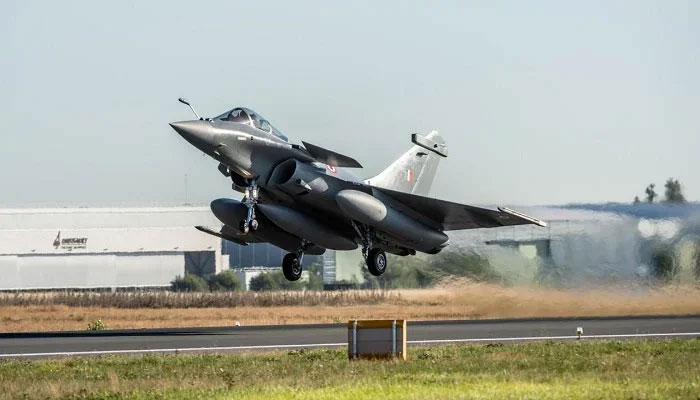
In a dramatic escalation that has jolted South Asia and unsettled global markets, the Pakistan Air Force’s downing of five Indian jets-including two Rafales worth over $200 million-has reshaped the strategic and financial calculus of the region. With more than 100 Rafales ordered by the Indian Air Force as part of a $9.4 billion modernisation program, the loss has sparked global debate on the vulnerability of high-end defence systems in active conflict zones.
Tensions soared between nuclear-armed neighbours India and Pakistan following a deadly attack in Pahalgam, Indian-administered Kashmir, on April 22, 2025. In response to Indian missile strikes along the Line of Control and in Pakistan-administered Kashmir, the Pakistan Air Force shot down five Indian fighter jets on May 7. The escalation claimed the lives of several civilians, including children. Among the downed aircraft were high-value assets: Frence-made Rafales, Russian-origin Su-30MKIs, and MiG-29s.
The destruction of the Rafale jets, widely regarded as the pride of India’s air force modernisation, captured immediate global media attention and sent ripples through international financial markets. Beyond the military dimension, this incident marked a significant geopolitical and symbolic moment, elevating Indo-Pakistani tensions to their highest point since the Balakot strikes in 2019.
Crucially, Pakistan’s successful use of Chinese-made J-10C fighter jets and PL-15 air-to-air missiles has drawn international attention. The Pakistan Air Force’s swift and precise response in intercepting and neutralising the incoming threat demonstrated remarkable operational readiness and tactical excellence. By successfully downing multiple Indian fighter jets-including advanced Rafales and Su-30MKIs, the Pakistan Air Force not only safeguarded key strategic assets but also averted what could have been a much larger humanitarian and infrastructural loss. Their use of cutting-edge J-10C jets and PL-15 missiles highlighted both technological capability and effective military training. In the face of escalation, the PAF’s measured but firm action reinforced Pakistan’s deterrence posture and underscored its commitment to national defence without provoking a wider conflict.
Global markets react: Stock shock amid geopolitical heat
The announcement that Pakistan had shot down at least two Rafale jets triggered a sharp response in global defense, energy, and equity markets. Investor confidence was rattled, and the incident reignited debates on regional stability, deterrence, and the risks of advanced arms diplomacy.
The downing of the Rafale aircraft was more than just a tactical event-it was a symbolic blow to India’s air superiority narrative. Featuring cutting-edge radar systems, electronic warfare capabilities, and long-range missile capacity, the Rafale was seen as a game-changer for the Indian Air Force.
With India having spent approximately $9.4 billion on its Rafale fleet from France’s Dassault Aviation, questions are now being raised about the cost-effectiveness and survivability of such high-value assets in modern warfare. Videos of the Rafale wreckage circulated widely on social media, generating backlash against Prime Minister Narendra Modi’s government and raising uncomfortable questions about the effectiveness of expensive foreign military imports.
Dassault under pressure: Strategic blow and market reaction
The financial fallout was immediate. Shares of Dassault Aviation, the manufacturer of the Rafale, fell nearly 6% on May 8 amid fears over reputational damage and potential disruptions to export deals. Trading floors in Paris, Mumbai, New York, and Beijing witnessed volatility as defense stocks came under pressure.
Despite efforts by French authorities to manage the narrative, viral footage and global media coverage made damage control difficult. The incident also cast a shadow on Dassault’s ongoing negotiations with countries like Indonesia and the UAE, while future Indian contracts may now face increased scrutiny. On May 8, Dassault’s shares dropped by 1.64% to EUR 324 on the Paris Stock Exchange.
Pakistan’s market response: Volatility then recovery
Pakistan’s stock market, too, saw initial turbulence. The KSE-100 index fell 3.1% on May 8 amid broader uncertainty. However, nationalist sentiment following the air force’s successful operations helped stabilise investor confidence. Compounding the positive momentum was the announcement of the next tranche of the IMF program, which sent reassuring signals to investors and helped restore a degree of market stability.
According to the State Bank of Pakistan, foreign exchange reserves also rose by $412 million in the same week, adding to the market’s rebound.
The future of Rafale: Symbolism and sales at stake
While the Rafale jets have not been written off, the incident raises difficult questions for Dassault and India. To retain current and potential buyers, Dassault will need to invest not only in combat system improvements but also enhanced after-sales service, pilot training, and technology upgrades.
The perception damage, however, is real. The downing of Rafale jets by Pakistan air force has momentarily shaken global defense market confidence, particularly in the South Asian context, and exposed fault lines in arms diplomacy. Though markets have shown resilience, the long-term effects on Rafale’s image and India’s defense posture remain uncertain.
In both perception and reality, the downing of India’s Rafale jets has been a strategic setback with tangible market consequences. It highlights the fragile interplay between military hardware, national pride, and global finance. As regional tensions persist, the real test lies ahead: restoring confidence-military, political, and financial-in a highly volatile geopolitical neighborhood.
The author is Chairperson of the Department of International Relations and Political Science at the International Islamic University, Islamabad. She is a recipient of the prestigious Martin Luther King Award, United States







-
 Robbie Williams Confirms ‘exciting’ Performance At FIFA World Cup Final
 -
 Taylor Swift, Travis Kelce's ‘top-secret’ Wedding Location Still A Mystery?
 -
 Matt Damon Talks About Filming ‘The Odyssey’ With No ‘special Treatment’
 -
 Meghan Markle Gives Prince Harry Key Assurance Before Meeting King Charles In UK
 -
 It's Scary': US Congressman Reacts To Anthropic's Powerful AI Model
 -
 King Charles ‘worried’ For Prince William As Heir Doesn’t Have Temperament To Be King
 -
 France Records Around 1,000 Excess Deaths During Deadly Heatwave
 -
 Kris Jenner Crowns Khloe Kardashian 'most Amazing Mother' In Birthday Tribute
 -
 David Beckham Melts Hearts With His Unseen Baby Snaps As Celebrated Mom Sandra
 -
 Which Countries Will Ban Grand Theft Auto VI At Launch?
 -
 Prince Harry’s ‘emotional Safe Haven’ In UK Revealed
 -
 North West Debuts Daring New Facial Piercings At Paris Fashion Week
 -
 Why Tech Firms Are Blaming AI For The Massive Surge In Device And Console Prices
 -
 Prince William’s Secret To A Successful Marriage With Kate Middleton Comes To Light
 -
 Google Gemini AI Capacity Shortage Delays Meta's AI Projects: Report
 -
 Holly Madison Reveals Why She Underwent Plastic Surgery After Pregnancies