
Pakistan forces stand tall against all odds Operation Bunyan-um-Marsoos: A legacy etched in fire and glory
Pakistan’s armed forces had no option but to respond with the full might of their strategic capability
CEO, GFS Builders and Developers
In the shifting sands of South Asian geopolitics, rarely has a single military operation changed the narrative as decisively as Operation Bunyan-un-Marsoos. Launched by Pakistan in the early hours of May 7, this operation was more than just a retaliatory strike — it was a symbol of calculated resolve, unparalleled precision, and unwavering national strength.
Triggered by a series of unprovoked Indian missile attacks targeting civilian areas in Azad Jammu and Kashmir, which left at least 51 martyrs including women and children, Pakistan’s armed forces had no option but to respond with the full might of their strategic capability. But what followed was not mere retaliation — it was a masterclass in 21st-century warfare.
The ISPR confirmed that 11 brave members of Pakistan’s military were martyred during India’s cowardly strikes. Their martyrdom was not in vain. It fortified the resolve of a nation, humbled an aggressor, and reminded the world that Pakistan will never compromise on its sovereignty or dignity.
India’s belligerence, prompted by its own internal political crisis after the Pahalgam incident, lacked both credible evidence as well as international support. The Modi administration’s move to close borders, suspend treaties, and violate sovereign airspace was rightly labelled by Pakistan as an “act of war”. Yet, it was not Pakistan that chose war — it was forced upon us.
Operation Bunyan-un-Marsoos targeted key Indian military installations, including the Pathankot and Adampur airbases — previously seen as impenetrable. Pakistan’s missile command and Air Force, operating in unison, exposed the hollow bravado behind India’s billion-dollar Russian-imported S-400 systems. Not only did Pakistan dominate the skies, but its drones hovered unchallenged over the very heart of India’s defence infrastructure — Delhi, Gujarat, and even military cantonments in Rajasthan.
In a daring extension of hybrid warfare, Pakistan’s cyber command disabled nearly 70% of India’s power grid, plunging major cities into darkness and disrupting communications nationwide. The world watched in awe. Civilian casualties were deliberately avoided. The message was loud but honourable: we are not aggressors, but we will never be subdued.
A ceasefire brokered, but a belligerent remains.
A ceasefire was brokered through intensive efforts by the United States, Turkey, China, and Saudi Arabia. President Donald Trump publicly endorsed Pakistan’s call for peace and strategic restraint, while President Erdogan of Turkey hailed Prime Minister Shehbaz Sharif’s measured leadership.
China, ever the trusted ally, remained firmly supportive of Pakistan’s territorial sovereignty, calling for calm and urging India to refrain from further provocation. Riyadh too, emphasised the importance of regional peace and expressed deep concern over India’s reckless adventurism.
However, in a baffling reversal, India has refused to honour the ceasefire agreement. It recalled its ambassador, expelled Pakistani diplomats, and reignited hostile rhetoric. In response, Pakistan’s Foreign Office declared a senior Indian High Commission officer persona non grata, reiterating that “any attempt to challenge Pakistan’s sovereignty shall be met with a swift, full-spectrum, and decisive response.”
The Indian PM Narendra Modi had hoped to distract a restless electorate with a manufactured external enemy. His government’s failures on human rights, and internal security had already frayed his political capital. But with this misadventure, he not only endangered regional stability but exposed his military’s unpreparedness. Internationally isolated, internally criticised, and diplomatically cornered, Modi’s gamble has backfired.
General Asim Munir: A leader forged in fire
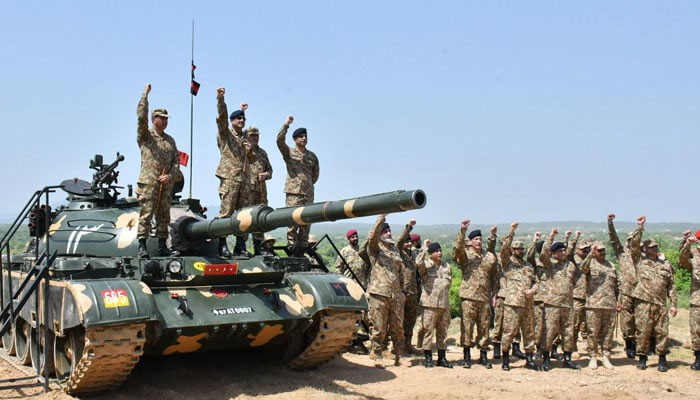
At the heart of Pakistan’s resolute response stands Chief of Army Staff General Syed Asim Munir — a soldier’s soldier, a statesman in uniform, and a strategist of rare calibre. Under his leadership, the Pakistan Army has transformed into a seamless force capable of executing both conventional and hybrid operations with impeccable coordination.
General Munir’s decisions throughout the crisis have won praise not only from military analysts but from the nation at large. His insistence on precise retaliation, his avoidance of civilian casualties, and his firm yet composed tone in national security briefings have elevated Pakistan’s military posture globally.
As news of Pakistan’s successful operation flooded the airwaves, the response from its people was resounding. Social media turned into a digital battlefield of patriotism. Scholars, journalists, politicians, and even citizens from across the globe saluted Pakistan’s armed forces.
Today, Pakistan stands tall not merely because of its military achievements, but because of the moral clarity with which it confronted aggression.
In honouring our forces — Army, Air Force, Navy, and cyber divisions — we honour the very essence of our identity. And in the legacy of Operation Bunyan-um-Marsoos, we find a new chapter in Pakistan’s story: not of victimhood, but of victorious resilience.
“I pay the highest tribute to our brave Armed Forces of Pakistan for their exemplary courage, sharp intelligence, and swift, decisive response to Indian aggression. Their heroic defence of our motherland inspires the entire nation with pride and gratitude. As a proud Pakistani, I salute their unwavering dedication to safeguarding our sovereignty and honour. May Allah continue to protect our defenders and bless Pakistan with lasting peace and strength.”







-
 Angelina Jolie, Brad Pitt's Daughter, Shiloh Makes Surprise Music Video Debut
 -
 ‘Very Angry’ Sarah Ferguson Finally Willing To Sell Out The King & Firm?: Inside Revenge Plans
 -
 Blac Chyna Escalates Legal Battle With Multi-million Dollar Cross-complaint Against Twin Hector
 -
 Meghan Markle Reacts To Patrick J Adams 'jam' Complaint
 -
 Why Attorney Says Justin Baldoni 'not Off The Hook' Despite Court Ruling? Report
 -
 'Abuses' Shouted At Andrew Mountbatten-Windsor As Protesters Breach Security
 -
 Jenna Dewan Reveals Mindset She Follows When Life Gets 'nuts'
 -
 Erika Kirk Dating Claims Surface As She Reclaims Charlie Kirk's Legacy
 -
 Karoline Leavitt Joins Erika Kirk At Washington Event
 -
 Lizzo Reveals Major Update About Her Sobriety Journey
 -
 Princess Beatrice’s Husband Edo ‘questioning Marriage’: ‘His Standing & Status Is Impacted’
 -
 Petition To Strip Blake Lively Of 'It Ends With Us' PGA Credit Gains Massive Support
 -
 New Development In Blake Lively Lawsuit After Judge Dismisses Major Claims
 -
 Blake Lively, Taylor Swift Texts Resurface After Court Ruling
 -
 Prince Harry’s Behavior Towards Queen Elizabeth Gets Exposed: ‘He Drove Her To Paranoia’
 -
 Blake Lively, Justin Baldoni's Legal Case Receives Latest Update