
Dialogue, not destruction
Modi government’s unilateral suspension of Indus Waters Treaty marked yet another dangerous escalation
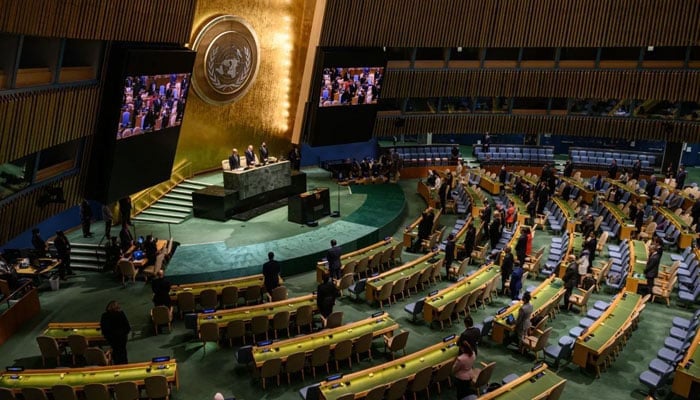
At the UN Security Council open debate, Pakistan’s Permanent Mission to the United Nations made a firm and much-needed call for India to halt its state-sponsored terrorism and return to meaningful dialogue, Counsellor Saima Saleem laying bare the truth that the international community often chooses to ignore: India continues to operate with impunity in its illegal occupation of Jammu and Kashmir, and persistently violates Pakistan’s sovereignty through cross-border aggression and the use of terrorist proxies. Pakistan has rightly pointed out India’s repeated attempts to deflect attention from its human rights abuses through misinformation and denial. No amount of diplomatic whitewashing can hide the realities in Indian Illegally Occupied Jammu and Kashmir (IIOJK), where state forces continue to kill, maim and suppress with utter disregard for international law or human decency.
The Modi government’s unilateral suspension of the Indus Waters Treaty marked yet another dangerous escalation. Weaponising water – a resource critical to 240 million Pakistanis – is a cruel provocation. As Pakistan has reiterated, water should never be used as a weapon of war. Such a move underlines India’s descent into a pattern of hostile, reckless behaviour with potential humanitarian consequences. India’s aggressions are not limited to the border. Its footprint in destabilising Balochistan has been meticulously documented. On Friday, ISPR Director General Lt-Gen Ahmed Sharif Chaudhry presented clear evidence of Indian-sponsored terrorism in Balochistan. India’s proxies have been behind hundreds of attacks, and the Khuzdar attack, where children were targeted, is a horrifying reminder of the depths to which these proxies have sunk. In 2024 alone, Pakistan lost over a thousand lives to terrorism, including more than 200 in Balochistan. Security forces have launched an aggressive counterterrorism campaign, conducting tens of thousands of operations to contain and neutralise these threats.
India’s increased aggression, particularly after Pakistan decisively shut down illegal trade routes and curbed the influence of anti-state actors, reveals a desperation to disrupt Pakistan’s internal stability. The targeting of Chinese nationals and attempts to undermine the China-Pakistan Economic Corridor (CPEC) are part of a larger strategy to isolate and destabilise Pakistan. Yet, through all this, Pakistan has shown restraint. Even when India launched an unprovoked attack earlier this month, without presenting a shred of evidence for its Pahalgam claims, Pakistan did not immediately retaliate. Only after continued aggression did Pakistan respond – and only then did India, sensing the tide turning, seek US intervention for a ceasefire. This pattern – aggression followed by retreat when met with resistance – is becoming India’s modus operandi. Pakistan has been clear: we want peace, but not peace at the cost of our dignity or security. Kashmir, terrorism and water remain the three core issues that need resolution for peace in South Asia, as rightly pointed out by PPP Chairman Bilawal Bhutto. Unless these are addressed through sincere, sustained dialogue, the region will remain a powder keg – one that could ignite with consequences for the entire world.
India must understand that regional dominance through force, intimidation, and subterfuge will not succeed. If it thinks it can repeatedly violate Pakistan’s sovereignty, sponsor terrorism and escape consequences, it is gravely mistaken. And if it believes that Pakistan will stay silent while its civilians and children are attacked, it is deluding itself. And this is not just about India and Pakistan anymore. The international community has a responsibility to stand up for the truth. It must press India to stop its adventurism, cease all forms of state-sponsored terrorism, and return to the table for meaningful dialogue because two nuclear-armed nations cannot afford to play games simply to appease the ego of one man in New Delhi.







-
 Kylie Kelce Explains Why She Avoids Raising Kids With 'silver Spoon'
 -
 Meghan Markle Is Above Royal Family ‘empty Threats,’ Says Insider
 -
 Anne Hathaway Opens Up About 'defeated' Feeling As Working Mom
 -
 Shamed Andrew Should Testify In Epstein Case As ‘act Of Service’
 -
 What Really Happened Before Nicholas Brendon Was Found Dead At Home?
 -
 Sarah Ferguson Branded ‘most Famous Missing Person’ In UK Right Now
 -
 Why King Charles Does Not Need A Driving License? Expert Reveals
 -
 Did Graham Norton Really Sign NDAs For Taylor Swift’s Wedding?
 -
 ‘Polite’ King Charles Treats Staff Better Than ‘boorish’ Andrew
 -
 Princess Beatrice's Husband Raises Eyebrows With Deleted Instagram Post
 -
 Dua Lipa 'snubs' Priyanka Chopra
 -
 Will Taylor Frankie Paul Still Get Her 'Bachelorette' Salary?
 -
 'Harry Potter' Returns: First Glimpse Of HBO's New Series
 -
 Ryan Gosling Credits His Kids For Key Detail In New Role
 -
 Prince William, Kate Middleton Mark 'historic Moment'
 -
 Why Roberts Pattinson Says Couples 'ruin' Their Big Day Amid Suki Waterhouse Wedding Rumors?