
India’s falsehood thwarted by youth-media ‘steel wall’: COAS
FM Asim Munir expressed profound gratitude to political leadership for strategic foresight during Maarka-e-Haq
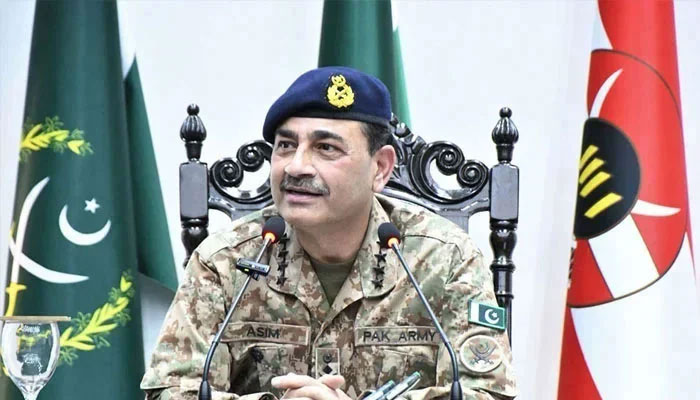
RAWALPINDI: Field Marshal Asim Munir, Chief of Army Staff (COAS), Saturday acknowledged the unwavering role of Pakistani youth and media in countering the disinformation campaign waged by India, describing them as a ‘steel wall’ against malign propaganda.
He was speaking at a dinner hosted by him to honour political leadership, steadfast commitment of the armed forces and the indomitable spirit of the people of Pakistan, as demonstrated during Maarka-e-Haq Operation Bunyan-um-Marsoos, a statement issued by the Inter-Services Public Relations (ISPR) said.
Prominent amongst those who attended the event included President Asif Ali Zardari, Prime Minister Shehbaz Sharif, Deputy Prime Minister/ Foreign Minister Ishaq Dar, Senate Chairman Yusuf Raza Gilani, National Assembly Speaker Ayaz Sadiq, federal ministers, governors, chief ministers, Chairman Joint Chiefs of Staff Committee, Chief of Air and Naval Staff, senior leadership of major political parties, high-ranking government officials and senior officers from the three services.
The participants paid tribute to the sagacious leadership that steered the nation through a defining moment, hailed the courage and sacrifice of the armed forces, and commended the resolute patriotism of Pakistani people.
In his remarks, FM Asim Munir expressed profound gratitude to political leadership for their strategic foresight during Maarka-e-Haq and lauded the seamless inter-services coordination that ensured operational success in Operation Bunyan-um-Marsoos.
The COAS also commended the outstanding contributions of Pakistani scientists, engineers and diplomats, whose professionalism and resolve proved critical during the conflict. The evening stood as a powerful affirmation of national unity and the collective resolve to advance with renewed strength and cohesion.
Separately, Saima Saleem, counsellor on Human Rights for Pakistan’s Permanent Mission to the United Nations, categorically called on India to stop state terrorism and initiate meaningful dialogue. She said this in response to India’s statement during the UN Security Council’s open debate. She said that India has once again resorted to misleading information, deflection and denial.
“No amount of obfuscation can hide the facts, India brazenly kills and maims civilians in Indian Illegally Occupied Jammu and Kashmir (IIOJK). It carries out blatant aggression against Pakistan targeting civilians and sponsors terrorism and assassinations in my country and across the globe,” the counsellor told the 15-member council.
Targeting the Modi government’s unilateral suspension of the Indus Waters Treaty after the Pahalgam incident, she said India had even stooped to a new low of impeding the flow of rivers that serve as a lifeline for the 240 million people of Pakistan. Water is not a weapon of war, she added.
Pointing to the assassination of Sikh leader Hardeep Singh Nijjar in Canada and the conspiracy to assassinate Sikh leader Gurpatwant Singh in the US, Saima reminded the Security Council that India sponsors terrorism and target killings not only in Pakistan but across the world.
She said that Pakistan, along with the international community, condemned the Pahalgam incident. “If India had nothing to hide, it should have agreed to credible, impartial and independent investigations into the incident,” the Pakistani delegate said. “On the contrary,” she added, “India continues to subject people of IIOJK to state-sponsored terrorism to suppress their legitimate freedom struggle.”
Counsellor Saima reminded the UNSC members that between May 6 and 10, India also committed blatant aggression against Pakistan, launching unprovoked attacks on innocent civilians, killing 40, including seven women and 15 children and injuring 121 others, including 10 women and 27 children.
Pointing to the recent heinous acts of terrorism in Pakistan, she said that India continues to provide financial and practical support to terrorist groups, including the Fitna al-Khawarij (TTP), Balochistan Liberation Army (BLA) and Majeed Brigade, whose aim is to kill innocent civilians in Pakistan.
On May 21, a cowardly attack on a school bus in Khuzdar district of Balochistan claimed the lives of innocent children and injured dozens.
She also said if India is genuinely committed to peace and security and good neighbourliness, it should end its state-sponsored terrorism, cease its oppression of Kashmiris, comply with its obligations under international law, UN Charter and bilateral treaties, and engage in meaningful dialogue for peaceful resolution of the IIOJK dispute in accordance with relevant resolutions of the Security Council and the wishes of the Kashmiri people.
Meanwhile, the Pakistan-China Institute (PCI), a premier think tank founded by Senator Mushahid Hussain Sayed, released a landmark report titled “16 Hours That Reshaped South Asia: How Modi’s Miscalculation Led to Pakistan’s Primacy”, offering a comprehensive analysis of the recent Pakistan-India conflict and its far-reaching implications.
At the launch, Senator Mushahid described the report as the first of its kind in Pakistan, dissecting the conflict’s timeline, Modi’s strategic blunder and Pakistan’s decisive response — what he called India’s “most serious setback since Nehru’s defeat in the 1962 war with China.”
Praising Pakistan’s armed forces for their daring, coordinated actions, Mushahid highlighted the inter-service unity between Field Marshal Asim Munir and Air Chief Marshal Zaheer Ahmed Babar. He credited the professionalism of PAF pilots, deployment of advanced electronic warfare, and Pakistan’s attainment of cyber supremacy as core contributors to the nation’s success.
Calling it Pakistan’s “finest hour” since the 1998 nuclear tests, he highlighted the synergy of military execution, deft diplomacy by the Foreign Office, and mature media messaging.
The report commends China’s unwavering support under President Xi Jinping, calling Beijing a “bastion of support” for Pakistan’s sovereignty and a de facto party to the Kashmir dispute.
It also recognizes US President Donald Trump’s role in brokering a ceasefire and reviving the Kashmir issue — moves that dealt a diplomatic blow to India and restored balance in regional narratives.
Senator Mushahid outlined three new strategic realities:
1. Pakistan re-established both nuclear and conventional deterrence despite numerical disadvantages.
2. Beijing has emerged as a stabilising regional force and indirect stakeholder in the Kashmir dispute.
3. The US has repositioned itself as an equitable actor in South Asia’s peace and security.
The report identifies India’s ‘3D strategy’ and proposes a three-pronged response:
*. Proactive diplomacy and deeper ties with allies like China, Turkey, Azerbaijan, Iran, and Saudi Arabia.
*. Creative Lawfare, including legal challenges to India’s RSS-driven policies and reinterpretation of treaties like the Indus Waters Treaty.
*. Narrative Warfare via global media, think tanks, public diplomacy and parliamentary advocacy.
Senator Mushahid cautioned that while war is unlikely, vigilance must prevail. He urged the nation to counter polarisation, offer a healing touch, and formulate a robust counterterror strategy to address internal threats exacerbated by Indian interference.
He hailed the resilience of Pakistani people who rallied behind their military, adding that the conflict has boosted national morale, restored faith in the future, and fostered unity.
Drawing historical parallels, the PCI report compares Modi’s miscalculation to Hitler’s 1941 invasion of the USSR, underscoring how strategic hubris can change the course of history.
Mushahid also praised the Pakistani media for fact-based, responsible reporting that enhanced the country’s credibility both domestically and internationally.
The 25-page PCI report includes a detailed timeline of events since the April 22 Pahalgam attack, global responses and strategic analysis that may shape the region’s trajectory.






-
 Zayn Malik Reveals Why He Collaborated With Blackpink's Jisoo For 'eyes Closed'
 -
 NASA Artemis II Moon Mission Set For Liftoff Today: Here’s What To Know
 -
 Prince Harry Breaks Silence After King Charles Confirmed US Visit: 'Brave Leadership'
 -
 Zayn Malik Shares How His Daughter Really Feels About His Music
 -
 Megan Thee Stallion's Latest Hospitalization Echoes 2020 Shooting Trauma
 -
 Artemis II Mission: King Charles Sends Letter To Astronaut Jeremy Hansen
 -
 Anthropic Claude AI Source Code Leak: ‘Human Error’ Sparks Security Concerns
 -
 Princess Beatrice’s New Move Has Andrew On Edge
 -
 Why Did Luke Combs Think His Career Was Over When He Met Blake Shelton?
 -
 Why Women Fall Behind In AI Use, Former Meta COO Explains
 -
 Did The Big Bang Happen Differently? New Theory Challenges Origin Of Universe
 -
 Asia Shares Jump After Trump Hints Iran Conflict Could End In '2-3 Weeks'
 -
 April Fools’ Day Mystery Explained With Theories Linking Pranks To Calendar Reforms And Folklore
 -
 Andrew Receives Major Warning To Dial Back Expectations Over New Home
 -
 'Shrinking' Stars Get Honest About Harrison Ford Ahead Of Finale
 -
 Flash Flood Warning In Effect For Lawrence And Mercer Counties Amid Storms And Rising Water Levels