
Letters and leadership
Najiba Arif is also a poet and translator of considerable repute, with over dozen books with her name adorning shelves
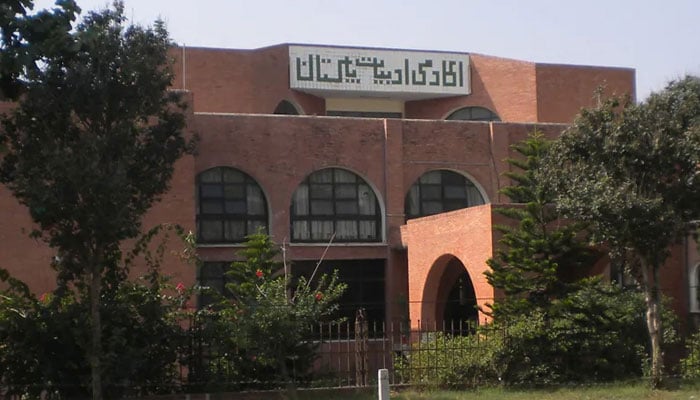
Among the many new academies, institutions and organisations that Z A Bhutto established within just five years, from 1972 to 1977, the Pakistan Academy of Letters (PAL) stands out as a thriving academy. Though it is nearly always short of funds, its chairpersons from Fakhar Zaman and Iftikhar Arif to Qasim Bhugio and Yusuf Khushk have contributed their efforts to produce some good work.
Now under the leadership of Dr Najiba Arif, the first female chairperson of the Academy, the PAL has once again become a dynamic body that organises frequent conferences and seminars across the country, even with the meagre resources it has at its disposal. Najiba Arif is a prolific academic with over 50 research papers to her credit, published in some of the top literary journals and magazines both nationally and abroad. She is also a poet and translator of considerable repute, with over a dozen books with her name adorning the shelves.
As the head of the Urdu department – and later as the dean of the faculty of language and literature – at the International Islamic University in Islamabad, she launched the research journal ‘Meyaar’ that set good research standards in Urdu. She was also the guest editor of ‘Bunyaad’, the research journal of the Lahore University of Management Sciences (LUMS). Another of her contributions was as the editor of the first indexation agency of Urdu journals in Pakistan. Recently she has initiated a series of provincial conferences to discuss the literary developments in all the country's federating units.
Being in Karachi in the last week of April allowed me to attend the second day of the two-day conference ‘Adabyaat-e-Sindh: Muasir Tanazur’ (Literature of Sindh: Contemporary perspective). Held on 25-26 at the National Museum Auditorium, the conference was well-attended on the first day, but due to the strike in Karachi protesting against the genocide, the second day witnessed thin participation. The quality of discussions was high and the level of interest in the audience remained noticeable throughout all the sessions. The first session discussed post-independence literary criticism and research in Sindh.
The second session, ‘The state of fiction in Sindh after independence’, was highly informative and interesting. Iqbal Khursheed is a short-story writer who has established his name in the literary circles of Pakistan at a fairly young age. He set the tone of the discussion on the post-independence fiction in Sindh by recalling his own family’s migration from India to Sukkur and how it impacted the psyche of those who found their new homeland welcoming. When the newcomers settled in Sindh, the linguistic panorama of the province became more colourful and fecund. Of course, the early writers had a tremendous backlog of nostalgia that reflected in their writings.
Iqbal Khursheed cited the examples of ‘Aab-e-gum’ by Mushtaq Yusufi that had a clear touch of nostalgia, and ‘Khuda ki Busti’ by Shaukat Siddiqui which delineated the life in Karachi in the 1950s when the city was stretching itself to accommodate millions of new inhabitants that were pouring in from all corners of India. The life in Lyari Khalid Akhtar is depicted in his novel ‘Chakiwara mein Wisaal’, a literary masterpiece that drew instant appreciation from Faiz Ahmed Faiz. Quratulain Hyder’s novels ‘Aag ka darya’, ‘Sita Haran’, and ‘Housing Society’, Iqbal Khursheed finds epitomes of novel writing in Pakistan. However, Hyder relinquished her Pakistani citizenship to head back to India.
Pre-partition Sindh appears in the stories of Amar Jaleel and in the translations of Agha Saleem, whereas Asad Muhammad Khan carries forward his nostalgia with a pinch of salt. Hasan Manzar is another writer whose novels and novellas have appeared regularly in recent decades. Other writers that Iqbal Khursheed mentioned included Akhlaq Ahmed, a former editor of ‘Akhbar-e- Jahan’, Shamshad Ahmed, Anwar Ahsan Siddiqui, and more recently Kashif Raza and Rafaqat Hayat.
The next speaker was Rafaqat Hayat, who emerged as an outstanding Urdu fiction writer in the 21st century. His novels ‘Khawmakhaw ki Zindagi’ (A futile life) and ‘Mirwah ki raatein’ (The Mirwah nights) proved to be his major early achievements in Urdu fiction writing, discussing common people’s lives in Sindh. More recently, his magnum opus novel ‘Rolaak’, spanning over 600 pages, has attracted wide appreciation and won several literary awards. In his discourse on the literature of Sindh, Rafaqat stressed that by the 1970s the fiction is Sindh did have a nostalgic tinge such as in the fiction of Quratulain Hyder and Ahsan Farooqi.
But in the past 50 years or so Urdu novels did focus on the issues of Sindh as a complex province where diverse ethnic entities converged. In this category, Rafaqat mentioned the name of Hasan Manzar, whose novel ‘Dhani Bukhsh ke betey’ (Dhani Bukhsh’s sons) is a literary tour de force. Asif Farrukhi also wrote stories reflecting the problems of Karachi that deteriorated from the 1980s onwards. Jeem Abbasi is also a prominent name in the fiction coming from Sindh. Though Jeem Abbasi is a Sindhi, most of his fiction writing is in Urdu. Rafaqat Hayat concluded his discussion on an optimistic note that there are visibly new trends in fiction writing in Sindh.
Dr Karan Singh, in his comprehensive essay, outlined all major trends in fiction writing in Sindh. He believed that from the early nostalgic writing the literature in Sindh has moved to reflect the new ground realities of life in the province. He mentioned Umrao Tariq as a noteworthy writer whose ‘Badan ka twaaf’ and ‘Khushki mein jazeerey’ are prime example of contemporary fiction writing in Sindh. In addition, he mentioned Sultan Jameel Naseem, Zaheda Hina, Najmul Hasan, Mubeen Mirza, Anwaar Ahmed Zai, Hasrat Kasgunjwi, and Akhtar Ansari Akbarabadi as prominent writers of Urdu in Sindh.
Akhlaq Ahmed took the floor and, rather than enumerating the names of writers, he preferred to talk about the contours and nature of fiction writing that is never stale, quite contrary to the normal perception about the ‘decline of fiction’. Akhlaq reminded the audience that Karachi suffered under intense ethnic rivalries for at least 25 years, witnessing some improvement in the situation that is still marred by killings almost on a daily basis. But the fiction did not properly reflect that period due to an atmosphere of terror and dominance of a party that many writers feared.
Akhlaq Ahmed opined that we have not translated our fiction into English, nor do we have ample access to world literature in Urdu; that should be a cause of concern. Today’s world has new issues – related to the digital age, mobile technology, and social media. In this unipolar world, the fiction is not the same anymore, with a so-called war on terror appearing to be never-ending, and suicide bombers may appear anywhere from nowhere. Virtual reality is also transforming fiction the world over, which will also reflect in our fiction soon.
The next speaker was Madad Ali Sindhi, who delivered his talk about the evolution of literary journals and magazines in Sindh, citing examples of ‘Nai Zindagi’ that Ubaidullah Sindhi edited. Shaoor by Azar Zubi, Naya Adab by Jamil Jalibi, and Nai Qadrain from Hyderabad and Mehran by Ibraheem Joyo also came under discussion. The session on children’s fiction was pretty interesting as Ibn-e-Aas informed the audience that thousands of books for children appear on shelves every year but most of them revolve around themes of religions and sectarian issues.
Ibn-e-Aas struck a chord with the audience when he asked the listeners to visit any book fair to see the books on display for children and check how many could be considered good literature for children’s intellectual grooming. He was right in pointing out that an overemphasis on patriotism and religiosity has turned children into ticking time bombs that could explode anytime. Overall, the conference was a timely intervention that proved to be a success, though there were some writers whose names appeared in the program, but due to the strike in the city and protests, they could not attend the event.
I must congratulate Dr Najiba Arif on her brilliant leadership at the Academy of Letters, which has become a much more dynamic and lively place.
The writer holds a PhD from the University of Birmingham, UK. He tweets/posts @NaazirMahmood and can be reached at: mnazir1964@yahoo.co.uk







-
 AutoScientist Lets AI Models Train Themselves Faster
 -
 US Businesses Hit By Soaring Wholesale Inflation As Fuel Prices Climb
 -
 Kate Middleton Meets Camilla In Italy
 -
 Barry Keoghan Says It’s Ok To Be Unconventional Dad In Blunt Interview
 -
 'Robots Are The Future': British Tech Firm Humanoid Targets US IPO By 2030
 -
 Iran War Could Cost US Taxpayers $1 Trillion, Expert Warns
 -
 Alibaba Shares Fall After Sharp Decline In Core Profitability
 -
 Barbra Streisand May Avoid Singing Forever After Oscars Backlash
 -
 Nebius Revenue Surges As AI Cloud Demand Fuels Rapid Growth
 -
 How Did Brandon Clarke Die?
 -
 Vin Diesel Brings 'Fast & Furious' Family Reunion To Cannes
 -
 The Frontrunners Who Could Replace Keir Starmer As Party Leader And British Prime Minister
 -
 Sydney Sweeney Video With Scooter Braun Draws Reactions From Taylor Swift Fans, Trump Supporters
 -
 Buckingham Palace 'hostage' Released After King Charles Safe Return
 -
 Taylor Swift Wins BMI Songwriter Crown For Third Year In A Row
 -
 Former NBA Player Jason Collins Dies After Brain Cancer Battle