
Ulema slam India’s move to suspend Indus Waters Treaty
Ulema say violating treaty is a blatant disregard for international law, moral values, and regional peace
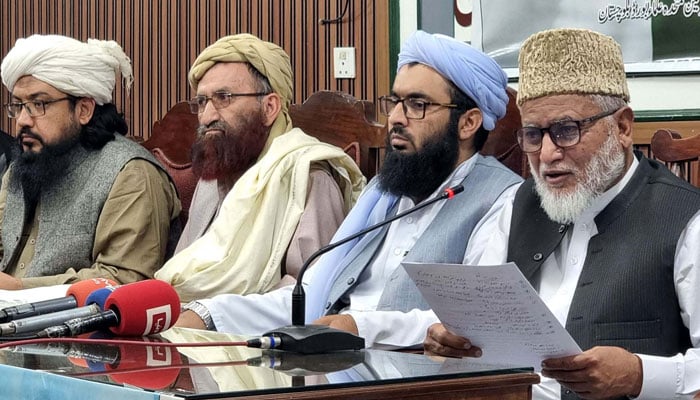
QUETTA: Chairman of the United Ulema Board Balochistan Maulana Hafiz Samiullah Agha and Dr Attaur Rehman have stated that scholars and religious leaders from all schools of thought unanimously condemn India’s suspension of the Indus Waters Treaty.
They said violating the treaty is a blatant disregard for international law, moral values, and regional peace.
They made these remarks during a joint press conference at the Quetta Press Club on Thursday. Leaders of various religious parties including Ibrahim Agha, Allama Shehzad, Ismatullah Salim, Syed Abdul Sattar Chishti, and Maulana Abdul Rehman also shared their views.
The speakers said that the Indus Waters Treaty is a tripartite agreement based on international trust and bilateral understanding. Violating this treaty, they said, is equivalent to pushing global peace into darkness. Upholding the agreement is not just a legal obligation, but also a religious, moral, and humanitarian duty. They pledged that ulema would raise this issue on all relevant forums.
They said a meeting of prominent scholars and religious leaders from various sects was recently held under the title Ulema-o-Mashaykh Paigham-e-Pakistan Conference, where regional tensions, repeated Indian violations of the treaty, provocations along Pakistani border areas, ceasefire violations, and threats to global peace were discussed. The religious leadership unanimously adopted a resolution declaring that breaching the Indus Waters Treaty is tantamount to harming global peace.
They added that Pakistan has always respected international laws, diplomatic agreements, and global trust. The Indus Waters Treaty was a serious peace initiative by Pakistan. As a nuclear, military, ideological, and moral power, Pakistan’s silence — along with that of its scholars and people — should not be mistaken for weakness.
The speakers called on the United Nations, the OIC, human rights organisations, and the global conscience to take notice of the treaty violation and hold the guilty party accountable under international law. They also urged the World Bank to act as a third-party arbitrator and appealed to the Government of Pakistan to raise this issue effectively at international forums.







-
 Dwayne Johnson Confesses What Secretly Scares Him More Than Fame
 -
 Elizabeth Hurley's Son Damian Breaks Silence On Mom’s Romance With Billy Ray Cyrus
 -
 Shamed Andrew Should Be Happy ‘he Is Only In For Sharing Information’
 -
 Daniel Radcliffe Wants Son To See Him As Just Dad, Not Harry Potter
 -
 Apple Sued Over 'child Sexual Abuse' Material Stored Or Shared On ICloud
 -
 Nancy Guthrie Kidnapped With 'blessings' Of Drug Cartels
 -
 Hailey Bieber Reveals Justin Bieber's Hit Song Baby Jack Is Already Singing
 -
 Emily Ratajkowski Appears To Confirm Romance With Dua Lipa's Ex Romain Gavras
 -
 Leighton Meester Breaks Silence On Viral Ariana Grande Interaction On Critics Choice Awards
 -
 Heavy Snowfall Disrupts Operations At Germany's Largest Airport
 -
 Andrew Mountbatten Windsor Released Hours After Police Arrest
 -
 Heidi Klum Eyes Spooky Season Anthem With Diplo After Being Dubbed 'Queen Of Halloween'
 -
 King Charles Is In ‘unchartered Waters’ As Andrew Takes Family Down
 -
 Why Prince Harry, Meghan 'immensely' Feel 'relieved' Amid Andrew's Arrest?
 -
 Jennifer Aniston’s Boyfriend Jim Curtis Hints At Tensions At Home, Reveals Rules To Survive Fights
 -
 Shamed Andrew ‘dismissive’ Act Towards Royal Butler Exposed