
Army chief pledges swift response to Indian misadventure
Any military misadventure by India will be met with a swift, resolute, and notch-up response, says General Asim
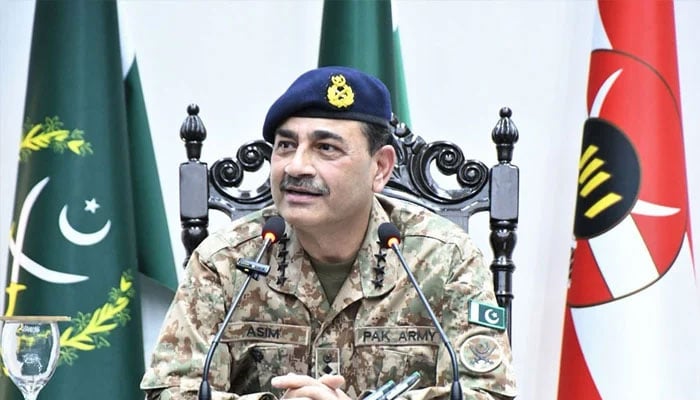
RAWALPINDI: Chief of Army Staff (COAS) General Asim Munir, while reaffirming the unyielding resolve of Pakistan’s armed forces to defend the nation’s sovereignty and territorial integrity at all costs, pledged on Thursday a swift, resolute and notch-up response to any Indian military misadventure.
“Let there be no ambiguity: any military misadventure by India will be met with a swift, resolute, and notch-up response,” General Asim said while addressing troops participating in exercise ‘Hammer Strike’ at Tilla field firing range. Exercise ‘Hammer Strike’ is a high-intensity, field training exercise conducted by the Pakistan Army’s Mangla Strike Corps.
“While Pakistan remains committed to regional peace, our preparedness and resolve to safeguard national interests is absolute,” the army chief stated.
Upon arrival, the COAS was received by the Mangla corps commander. The exercise was meticulously designed to validate combat readiness, battlefield synergy, and the operational integration of cutting-edge weapon systems under near-battlefield conditions.
A diverse array of advanced capabilities, including multirole fighter aircraft, combat aviation assets, long-range precision artillery, and next-generation field engineering techniques, were employed to simulate conventional battlefield scenarios.
Troops from all arms and services demonstrated exceptional tactical cohesion, agility, and lethality during synchronised offensive manoeuvres, reflecting an extraordinary level of training and professionalism. Notably, the exercise showcased Pakistan Army’s increasing absorption of niche and emerging technologies to augment its kinetic and non-kinetic operational capabilities.
During the visit, the COAS lauded the high morale, combat proficiency and warfighting spirit of the officers and troops, terming them the embodiment of Pakistan Army’s operational excellence. He said exercise ‘Hammer Strike’ stands as a testament to the Pakistan Army’s pursuit of continuous transformation through rigorous training, doctrinal innovation and technological modernisation.
Senior military leadership, formation commanders and dignitaries from various services witnessed the exercise.
Meanwhile, President Asif Ali Zardari and Prime Minister Shehbaz Sharif reaffirmed that Pakistan would never compromise on its territorial integrity and sovereignty, vowing to respond to any aggression in a befitting manner. PM Shehbaz called on President Zardari to discuss the current security situation, particularly heightened tensions with India following the Pahalgam incident.
The two leaders expressed grave concern over India’s belligerent attitude and provocative statements, warning that such rhetoric threatens regional peace and stability. They emphasized that the Pakistani nation stands united behind its armed forces, which remain fully capable of countering any threat.
During the meeting, they reviewed Pakistan’s strategic response to India’s aggressive posture and potential acts of hostility. The leaders also regretted the Indian leadership’s unfounded accusations regarding the Pahalgam attack, made without any investigation.
President Zardari commended the government’s measured response to India’s baseless allegations and its responsible handling of the situation. He reiterated Pakistan’s resolve to take all necessary measures to protect its sovereignty, territorial integrity, and national interests at any cost.
Before concluding, PM Shehbaz inquired about the president’s health following his recent recovery from Covid-19.
Also, Chinese Ambassador Jiang Zaidong called on PM Shehbaz Sharif at the PM House in Islamabad and promised that his country would always support Pakistan to achieve the common desire of both countries to secure peace and stability in South Asia. The ambassador thanked the PM for sharing Pakistan’s perspective on the emerging situation due to baseless Indian propaganda and unilateral action, a PM Office news release said on Thursday.
The PM conveyed his warm good wishes to President Xi Jinping and Premier Li Qiang and expressed Pakistan’s sincere thanks to China for its strong and steadfast support to Pakistan, in the situation in South Asia. The PM also underscored that the peaceful resolution of the Jammu and Kashmir dispute was the only way to ensure lasting peace in South Asia.
Meanwhile, PM Shehbaz Sharif had a telephonic conversation with the Emir of Qatar, Sheikh Tamim bin Hamad Al-Thani and discussed with him developments in South Asia. The PM thanked the Emir for solidarity and support for Pakistan, which reflected the deep-rooted brotherly ties between the two countries.|
The Qatari emir appreciated Pakistan’s efforts for peace in South Asia and said that his country wanted to work with Pakistan towards ensuring de-escalation of the current crisis.
Meanwhile, authorities in Azad Jammu & Kashmir shut more than 1,000 madrasas on Thursday over fears of possible military action from India. “We have announced a 10-day break for all madrasas in Kashmir,” said Hafiz Nazeer Ahmed, head of the local religious affairs department.
A department source said it was “due to tensions at the border and the potential for conflict”.
On Thursday, New Delhi reported the seventh straight night of small arms gunfire between the two sides at the heavily militarised Line of Control (LoC), the de facto border.
About 1.5 million people live near the ceasefire line in AJK, where residents are readying simple, mud-walled underground bunkers -- reinforced with concrete if they could afford it. “For one week we have been living in constant fear, particularly concerning the safety of our children,” Iftikhar Ahmad Mir, a 44-year-old shopkeeper in Chakothi on the LoC, told AFP. “We make sure they don’t roam around after finishing their school and come straight home.” Emergency services workers in Muzaffarabad have also begun training schoolchildren on what to do if India attacks. “We have learned how to dress a wounded person, how to carry someone on a stretcher and how to put out a fire,” said 11-year-old Ali Raza.
Separately, Deputy Prime Minister/ Foreign Minister (DPM/FM) Senator Ishaq Dar apprised the Republic of Korea’s Foreign Minister Cho Tae-yul of the escalating regional situation arising from India’s baseless propaganda and unilateral actions, including holding the Indus Waters Treaty in abeyance. He had a telephonic conversation with the Korean FM, a DPM Office news release said. Expressing concern over the situation, FM Cho underscored the importance of resolving issues through dialogue and diplomacy to maintain regional peace and security.
Ishaq Dar also held a telephonic conversation with Deputy Prime Minister/Foreign Minister of Slovenia, Tanja Fajon. FM Fajon called on both countries to exercise restraint and resolve issues through diplomacy, under international law. She welcomed Pakistan’s offer for an independent and transparent investigation.
Also, Ishaq Dar held a telephonic conversation with Deputy PM/Foreign Minister of Somalia, Abdisalam Abdi Ali.
Meanwhile, Indian Defence Minister Rajnath Singh spoke to his US counterpart, Pete Hegseth, on Thursday, according to officials.
Also, India’s foreign minister (FM) said that those who planned and carried out the attack in Indian-occupied Kashmir last week “must be brought to justice”.
“Its perpetrators, backers and planners must be brought to justice,” Subrahmanyam Jaishankar said in a statement following a conversation with US Secretary of State Marco Rubio on Wednesday evening in which they discussed the attack.
Meanwhile, the Azerbaijan government has urged India and Pakistan to exercise restraint and engage in constructive dialogue to deescalate current tensions.
“We are concerned about recent tensions between India and Pakistan following attack in Pahalgam,” the foreign ministry of Azerbaijan said in a statement on Thursday.
“We call on to exercise restraint and engage in constructive dialogue to deescalate current tensions. It is important to refrain from unilateral actions in such a volatile situation. “Moreover we hope an open and transparent international investigation will be carried out to resolve the current situation. We believe a meaningful dialogue and negotiations, consistent with norms and principles of international law and relevant United Nations resolutions, is a path to address the conflict. “Recognising the shared and mutual interest in regional stability, we hope the sides will pursue diplomatic channels to foster peace and cooperation, safeguarding the well-being of their peoples and the broader region.”


