
Stunned by Trump’s tariffs, world clothing suppliers prepare to squeeze workers
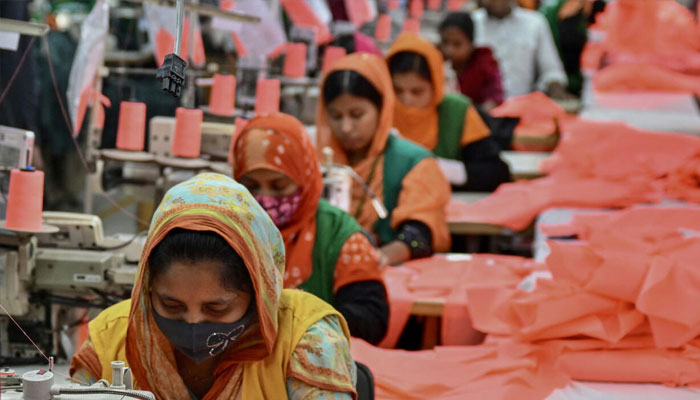
Dina Sidiqqi, an anthropologist says that costs of tariffs would inevitably be borne by workers on the production line
BEIJING: If the mark of a good pair of sneakers is the number of miles they’ve travelled, Nike’s must be top of the line. Of the 528 factories contracted by Nike to produce finished goods in 37 countries and regions across the world, just 28 of those are based in the US. Those factories directly employ some 4,117 workers – a figure that, presented on Nike’s interactive Manufacturing Map as a percentage of the total workforce of 1,149,901, is rounded down to 0 percent.
The rest, most of them at least, are in Asia – part of a decades-long policy of outsourcing production to countries where low wages have allowed the kind of mass production of low-cost clothing and footwear that has become a staple of globalised life. It is these countries – including major producers and exporters such as Bangladesh, Vietnam, China, Cambodia and Indonesia – that supply Western brands with low-cost clothes, shoes and textiles. And it is these countries that have found themselves hit hardest by US President Donald Trump’s sweeping “Liberation Day” tariffs.
Just what will happen to those jobs is anyone’s guess. While Trump has justified his global tariff regime with the promise of bringing manufacturing jobs back to the US, the president has said little about his vision for the labour-intensive production lines built around cutting and sewing low-cost clothes and footwear. But whether those industries can survive in countries hammered by tariffs that could price them out of the lucrative US market remains far from clear.
Mark Anner, dean and distinguished professor at Rutgers’ School of Management and Labor Relations, said that it was hard to imagine that Trump’s tariffs could drive textile production back to the US. “Of the garments purchased in the US, 97 percent are made outside the US – only three percent of the garments we wear are made within the US,” he said. “So the idea that through this tariff regime, jobs would come back to the US – I just see that as highly unlikely for a whole bunch of reasons.”
One of the major challenges is likely to be lack of trained – or willing – labour. While 139,000 people worked in apparel manufacturing in the US as of January 2015, according to the Bureau of Labor Statistics, that number had shrunk to just under 85,000 by January this year. A statement by the National Council of Textile Organizations praising Trump’s tariff regime said that the broader US textile sector employed some 471,000 workers – a fraction of the country’s 170 million-strong labour force. What little garment and textile production that has stayed in the US has relied disproportionately on undocumented immigrant labour to keep costs down – the same undocumented workers that Trump has promised to crack down on.
“In terms of cost, one of the major exporters of garments to the US is Bangladesh – I was just doing the math on the hourly rate. You’re looking at a minimum wage in the US of $7.25 – that’s the federal minimum wage, but many states have higher minimum wages. And we’re talking about four million workers in Bangladesh making garments at 55 cents an hour. I don’t know how that gets replicated in the US or moved to the US.”
Faced with an uncertain future, garment manufacturers will likely do what they have always done in times of crisis: squeeze. Dina Sidiqqi, an anthropologist at New York University, said that the costs of the tariffs would inevitably be borne by the workers on the production line. “Additional costs will be absorbed the way they always are – by passing them down to workers,” she said. “Manufacturers do not want to see a dip in their profit levels. They will compensate by reducing the number of workers, and increasing production targets of those who remain.”







-
 Tucker Carlson Says Passport Seized, Staff Member Questioned At Israel Airport
 -
 Taylor Swift Made Sure Jodie Turner-Smith's Little Girl Had A Special Day On 'Opalite' Music Video Set
 -
 Eric Dane Says Touching Goodbye To Daughters Billie And Georgia In New Netflix Documentary
 -
 Channing Tatum Reveals What He Told Daughter After Violent Incident At School
 -
 King Charles Lands In The Line Of Fire Because Of Andrew Mountbatten-Windsor
 -
 Denise Richards Doubles Down On Abuse Claims Against Ex Husband Aaron Phypers Amid Show Return
 -
 Russia Set To Block Overseas Crypto Exchanges In Sweeping Crackdown
 -
 Gwyneth Paltrow Reveals Deep Personal Connection With Kate Hudson
 -
 Prince Harry, Meghan Markle’s Game Plan For Beatrice, Eugenie: ‘Extra Popcorn For This Disaster’
 -
 OpenAI To Rollout AI Powered Smart Speakers By 2027
 -
 Is Dakota Johnsons Dating Younger Pop Star After Breakup With Coldplay Frontman Chris Martin?
 -
 Hilary Duff Tears Up Talking About Estranged Sister Haylie Duff
 -
 US Supreme Court Strikes Down Trump’s Global Tariffs As 'unlawful'
 -
 Kelly Clarkson Explains Decision To Quit 'The Kelly Clarkson Show'
 -
 Inside Hilary Duff's Supportive Marriage With Husband Matthew Koma Amid New Album Release
 -
 Daniel Radcliffe Admits To Being Self Conscious While Filming 'Harry Potter' In Late Teens