
The Modi-Trump tango
India managed excellent working relationship with Biden administration with economic clout
A strong economy is a national security imperative. It is also crucial to foster social and political stability. It also effectively shapes a cohesive national identity necessary to mould international relations positively. It also enables mutually beneficial alliances instead of reducing a country to a proxy or pawn.
Post-9/11, as countries scrambled for political alignments in their national interest, we proved to be rudderless as well as spineless. Washington treated us accordingly. Mark Twain cautioned that the principle of give and take is the principle of diplomacy - give one and take ten. We opted to suicidally plunge into a proxy war that wrought nothing but destitution and destruction on Pakistan.
The Washington-led West, which considers us a vassal, completely ignored our national security concerns. Given their economic and strategic ties with India, they accepted the latter’s malicious claim of Pakistan as a terror-exporting country. Relegated to a dependent nation, our rulers were totally bereft of the footing required to take a stand.
They also failed miserably to put India in the dock internationally. This was despite the capture of Kulbhushan Jadhav, the DisInfoLab expose and India’s assassination spree in Pakistan and across the globe. Kabul cosying up to Delhi remains yet another policy failure. A secure western border has morphed into a conduit of India-patronised terror in Pakistan. With most of the developed world as major trading partners, India forced anti-Pakistan narratives and forged strategic alliances. In the US, India’s ruling party and members of its diaspora remained steadfast Trump supporters since his first presidential campaign.
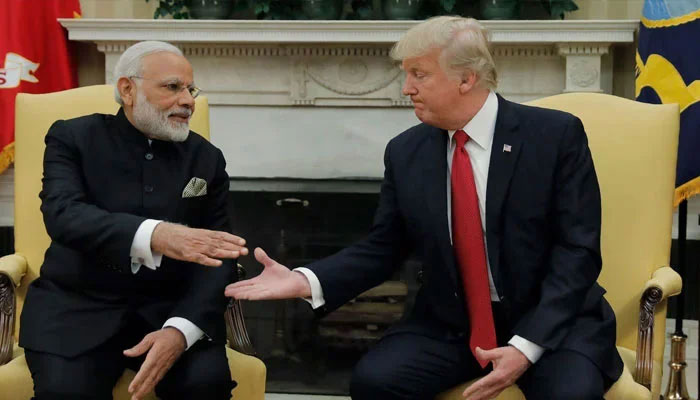
In 2019, over 50,000 people gathered at the ‘Howdy, Modi’ Texas rally, one of the largest receptions of a foreign leader in the US. Trump hailed Modi as “one of America’s greatest, most devoted and most loyal friends”. Despite this, India with its economic clout and Indian-Americans in policy-affecting positions, managed an excellent working relationship with the Biden administration.
Meanwhile, our ruling coterie, thinking Trump was done and dusted after his first term, gloatingly drew comparisons with Imran Khan. Some claimed that “we have one (Trump) in Pakistan too, he will be shown the way out soon”. Berating Trump, more than a faux pas, did nothing to help us fare better with the Biden setup.
After Trump’s win, disparaging remarks changed to fawning platitudes. Trump was hailed for his remarkable resilience and his win was touted as a victory for democracy.
The turnaround was a crass display of opportunism. To make it all the more self-deprecating, fervent attempts were made to get an invite for his inauguration; none arrived.
With six Indian-Americans elected to Congress, members of the Indian diaspora are now part of President Trump’s core team. These include Kash Patel, a vocal Modi supporter, as director FBI and Vivek Ramaswamy, another Modi fan, leading DOGE alongside Elon Musk. Ricky Gill has been appointed senior director for South and Central Asia at the National Security Council and Kush Desai as the White House deputy press secretary.
Dr Jay Bhattacharya, a Stanford professor, has been placed as director of the National Institute of Health, Sriram Krishnan as senior White House policy advisor on AI whereas Harmeet Dhillon will serve as the assistant attorney general for civil rights at the Department of Justice. Last but not least, we have Tulsi Gabbard, a fierce Modi ally, as Trump’s intelligence czar. Always championing Modi, she severely criticised Washington’s decision to bar his entry in the wake of the Gujarat massacre. These are not knee-jerk placements but meticulous manoeuvrings that took decades in the making. Indian-Americans have crucial representation in major fields like the tech industry, academia and think tanks. Michael Kugelman, director at the Woodrow Wilson Center describes this as “the rise of Indian Americans in politics reflects not only their growing influence in domestic policymaking but also their ability to shape foreign policy narratives, particularly in relation to South Asia.”
This ever-deepening US-India relationship has severe, none for the better, implications regarding Pakistan. Just weeks into his presidency, the Trump-Modi tango manifested itself in a White House joint statement calling on Pakistan to ensure that its territory is not used in cross-border terror attacks. The extradition of Mumbai attack accused Tahawwur Rana to India indicates an imminent witch trial to maliciously implicate Pakistan.
With Trump shunning the EU stance on the Ukraine war and imposing tariffs, Europe has reached out to Modi for help. More than 20 European Commissioners headed by EU President Ursula von der Leyen are in India seeking Modi’s help regarding Ukraine, a free-trade agreement and collaborative technology.
The EU-India trade volume in 2024 amounted to $126 billion. AI will figure prominently in the discussions given India’s ingress in the technology field and with Narendra Modi co-chairing the recent AI Action Summit in Paris which will be followed by one in India after six months.
As India’s role in the international strategic policy expands, that of Pakistan is ever-diminishing. While speaking at the Munich Security Conference recently, Bilawal Bhutto naively flaunted the virtues of our run-to-the-ground strategic location. This obsession as a quid pro quo for handouts has no takers in the unipolar world of today.
Ukraine’s gambit has cost it dearly. Presenting itself as a strategic proxy for Europe and the US, has seen a war raging on its soil. The customary discarding of a proxy led to the fiery exchange at the Oval Office last week. For Ukraine, it is a portent of worse to come. This example along with our aid-dependent survival should evoke realism in our power elite. Boisterous claims like billions pouring in, compounded by narcissistic self-glorification images and our minister extolling his government’s whole-hearted commitment to human rights at a Geneva conference, belies reality. This ludicrous swagger, our undoing, maintains a deadly stranglehold on the national cause. For the sake of Pakistan, if nothing else, it has to go.
The writer is a freelance contributor. He can be reached at: miradnanaziz@gmail.com


