
Exhumed remains belong to Mustafa Amir, shows initial report
SIU launches crackdown in connection with Armaghan drugs case, arrests son of renowned TV actor
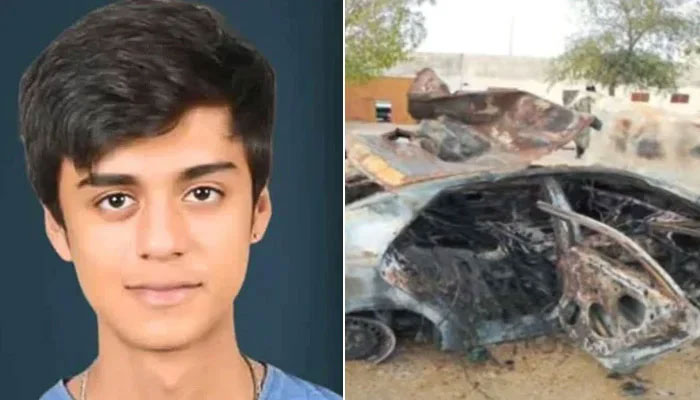
The remains recovered during the exhumation at the Edhi Cemetery on Friday belong to Mustafa Amir, according to the initial DNA profiling report.
Amir’s mother Wajeeha also confirmed that the remains recovered during the exhumation belong to her son. The body was kept at the Edhi morgue after the exhumation. The authorities had initially said the DNA report could take up to a week.
The funeral prayer for slain Mustafa was offered at a mosque in Karachi’s Defence. A large number of citizens attended his funeral prayer. He would be buried at a graveyard in Defence Phase-VIII.
Meanwhile, the Special Investigation Unit (SIU) has launched a crackdown in connection with the Armaghan drugs case, arresting a suspect identified as Sahir Hassan, son of a renowned television actor.
SIU chief SSP Shoaib Memon confirmed the arrest, saying that Hassan was arrested at his residence in Defence with half a kilogramme of the drug Veet. He pointed out that this is the first arrest in the case but more are expected soon.
SSP Memon clarified that while the suspects were involved in large-scale drugs trade and consumption, there is no indication of links to international networks or dark web operations. “Drugs were being dealt at a significant level, but not to the extent of an international syndicate.”
It is worth mentioning that the Mustafa Amir murder case is being investigated by the Anti-Violent Crime Cell (AVCC), which falls under the Criminal Investigation Agency (CIA), while the investigation into the drug-related activities of prime suspect Armaghan has been assigned to the SIU, which also falls under the CIA.
The inquiry into the large cache of weapons recovered from Armaghan’s house and their possible use in criminal activities, and their legality and licences has been handed over to the Counter Terrorism Department. Moreover, the Federal Investigation Agency is being involved in investigating Armaghan’s connections to digital currency, money laundering and call centre operations.
Sheraz’s statement
The video statement of co-accused Sheraz, who was arrested in the Mustafa Amir case, has once again cast doubts on Amir’s cause of death. In the statement circulating on different media, Sheraz explicitly claimed that Amir was still alive when he was beaten at the bungalow and put in the car.
He said that had Amir received immediate medical attention or been taken to a hospital, he might have survived. However, after a three-and-a-half-hour drive to Balochistan, the car was set on fire with Amir inside.
Sheraz also mentioned that before setting the car on fire, Armaghan briefly opened and closed the trunk. According to him, Armaghan took only a second to do so.
His statement that it took only a second to open and close the trunk suggests that it would have been nearly impossible for Armaghan himself to determine whether Amir was conscious, unconscious or already dead.
On the other hand, police initially relied on postmortem and chemical examinations following the exhumation, hoping to establish if Amir was alive when the car was set on fire.
However, that hope has now diminished, as the exhumation board confirmed that the body was so severely burnt that determining the exact cause of death was nearly impossible. As a result, the investigation remains at a standstill, with the authorities left only with speculations regarding the circumstances of Amir’s death.
Interestingly, just hours after the exhumation board’s negative response, an unexpected video statement from Sheraz surfaced, shedding new light on the case. This statement was recorded at the AVCC office by a private news channel’s reporter, who was apparently especially called in by the police, following which the statement was leaked.
According to Sheraz, when Amir was tortured and placed in the car's trunk, he was still alive. His statement, however, did not clarify if Amir was still alive when the car was torched. This uncertainty has kept the mystery alive, leaving a crucial question unanswered in the case.
According to Sheraz’s video statement, on January 6 he received a call from Armaghan, who asked him to come over. Since it was a routine call, he went to Armaghan’s house. When he arrived, Armaghan was sitting inside, using drugs. About half an hour later, Amir also arrived.
Sheraz said he did not know Amir personally, adding that Amir used to supply drugs to Armaghan. When Amir arrived, he handed Armaghan a packet of drugs, and in exchange, Armaghan took money out of a drawer and gave it to him. Amir then sat down and started smoking weed.
“Everything seemed fine while they were smoking, but as soon as the cigarette finished, things changed. Armaghan suddenly got up and started beating Mustafa with an iron rod. After receiving two or three blows, Mustafa tried to grab the rod, but as soon as he did, Armaghan picked up a rifle and fired multiple shots around him.
“Since this was happening inside a closed room, everyone was shocked. Armaghan then snatched the rod back from Mustafa and resumed beating him. He would hit him, then sit down, then get up again and continue the assault. This went on about three or four times. Later, Armaghan tied Mustafa up with a cloth sheet and put him inside the trunk of Mustafa’s car, which had no registration plate.
“After that, Armaghan called his servants, who were inside the house. They must have heard the gunshots, but they weren’t allowed to come out of their rooms. Armaghan showed them the crime scene and ordered them to clean up the bloodstains, saying he would be back soon.
“Then Armaghan came downstairs, grabbed a small weapon, and got into Mustafa’s car. The fuel tank was almost half empty, so he told me to go to the generator area, where there were two containers — one with diesel and one with petrol. He asked me to bring the petrol container.
“When I brought it, he poured around 90 per cent of the petrol into Mustafa’s car and kept the remaining 10 per cent aside. Then he got into the driver’s seat, asked me to sit with him, and we drove off. We first went to Boat Basin, then Mauripur, and from there to Northern Bypass towards Balochistan.
“It took around three and a half hours to reach the location. The area had sand dunes, so Armaghan drove the car off-road and parked it behind the dunes so it wouldn’t be visible from the road.
“As soon as he opened the trunk, he immediately shut it again. Then he told me, ‘Let’s walk towards the road.’ As I started walking, within 30 to 40 seconds, I heard the sound of a fire igniting. When I turned around, the car was on fire, and Armaghan was running towards me, telling me to hurry up and leave.
“I tried to stop him multiple times while he was beating Mustafa, but Armaghan was extremely aggressive and kept attacking him. He was furious and kept asking Mustafa, ‘Why did you send me a picture of a banana peel?’ and ‘What is your connection with that girl?’
“Armaghan was my childhood friend, but we had lost contact for a while. A few months ago, we reconnected. When I saw his luxurious lifestyle, expensive cars and wealth, I was impressed and decided to reconnect with him.
“I didn’t know that departments like the AVCC or the CID existed. I only knew that if I went to the police station, these rich people would frame me in a false case. If I had known that the AVCC and the CID actually work for justice, I would have gone to them first and told them everything.
“Armaghan wasn’t a drug dealer himself, but there were other guys like Mustafa who used to supply him with drugs. Whenever I asked him where he got so much money from, because he would spend millions on drugs and alcohol-fuelled parties, he would shut me up and change the topic.”
Speaking to The News about Sheraz’s video statement recorded in police custody, senior criminal lawyer Abid Zaman said police lack concrete evidence, making it unlikely for the case to hold up in court. He added that the video statement has no legal value in court, as Sheraz can later retract it, claiming that it was obtained under duress. Zaman emphasised that without solid evidence, police do not have a strong case.







-
 'Buffy' Star Nicholas Brendon's Death Case Takes Massive Turn
 -
 FKA Twigs Takes Legal Stand Against Ex Shia LaBeouf
 -
 ‘Progressive’ Kate Middleton Snubs Outdated Royal Etiquette
 -
 Kylie Kelce Explains Why She Avoids Raising Kids With 'silver Spoon'
 -
 Meghan Markle Is Above Royal Family ‘empty Threats,’ Says Insider
 -
 Anne Hathaway Opens Up About 'defeated' Feeling As Working Mom
 -
 Shamed Andrew Should Testify In Epstein Case As ‘act Of Service’
 -
 What Really Happened Before Nicholas Brendon Was Found Dead At Home?
 -
 Sarah Ferguson Branded ‘most Famous Missing Person’ In UK Right Now
 -
 Why King Charles Does Not Need A Driving License? Expert Reveals
 -
 Did Graham Norton Really Sign NDAs For Taylor Swift’s Wedding?
 -
 ‘Polite’ King Charles Treats Staff Better Than ‘boorish’ Andrew
 -
 Princess Beatrice's Husband Raises Eyebrows With Deleted Instagram Post
 -
 Dua Lipa 'snubs' Priyanka Chopra
 -
 Will Taylor Frankie Paul Still Get Her 'Bachelorette' Salary?
 -
 'Harry Potter' Returns: First Glimpse Of HBO's New Series