
Punjab’s Lakhodair landfill to become Pakistan’s first government-to-government carbon market pilot project
Lakhodair landfill was chosen for its high potential in methane reduction
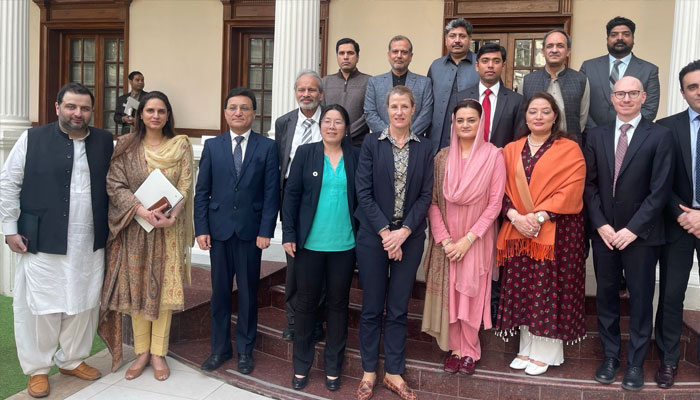
LAHORE: The Punjab Government in its remarkable step towards climate action, the Supporting Preparedness for Article 6 Cooperation (SPAR6C) program has announced plans to provide technical assistance for the Lakhodair Landfill in Lahore, Punjab, marking Pakistan’s first-ever government-to-government carbon market initiative. The initiative will also bring foreign direct investment and show the world that Punjab is ready for transparent investments as well as that the Punjab Government can earn dollars through mitigation for funding other public sector projects without burdening our coffers. This important step is like an alternative source of financing supporting our budget for at least the next ten years.
The announcement was made during a high-level meeting held yesterday at the Chief Minister’s Office in Lahore, attended by representatives from the German Federal Ministry for Economic Affairs and Climate Action (BMWK), the Global Green Growth Institute (GGGI), UNEP Copenhagen Climate Centre, and local stakeholders from Pakistan’s government.
This pioneering project focuses on leveraging the landfill as a key site for methane capture, a potent greenhouse gas that contributes significantly to climate change. With Lakhodair Landfill processing over 5,500 tons of waste daily, nearly 55-60% of which is biodegradable, the site offers a significant opportunity to mitigate emissions. The project is expected to reduce methane emissions by capturing and utilizing the gas, providing a cleaner environment and improving air quality in Lahore. Moreover, it will contribute to Pakistan’s broader climate goals by generating carbon credits under Article 6 of the Paris Agreement.
The Lakhodair landfill, which has accumulated over 12 million tons of waste since its inception in 2016, was chosen for its high potential in methane reduction. The methane, which is produced as organic waste decomposes, has a warming potential over 80 times that of carbon dioxide in the first 20 years it remains in the atmosphere. Through the project, the captured methane will be used in Lahore’s natural gas infrastructure, replacing the use of conventional natural gas and reducing carbon emissions from compressed natural gas (CNG) consumption.
The SPAR6C program, led by the Global Green Growth Institute and implemented in Pakistan by the UNEP Copenhagen Climate Centre, has already been instrumental in building a pipeline of mitigation projects across Pakistan. This new collaboration at Lakhodair is expected to serve as a model for future projects that engage both the public and private sectors while benefiting local communities. The initiative aligns with Pakistan’s Nationally Determined Contributions (NDCs) under the Paris Agreement, with emissions reductions from the Lakhodair project contributing 5% of the nation’s total NDC target.
At the strategic meeting, attended by senior officials such as Romina Alam Khurshid, Environmental Coordinator to the Prime Minister, and Saba Asghar Ali, Chief of the Environment Planning and Development Board Punjab, the parties discussed the operationalization of carbon market projects at both provincial and national levels. Maryam Aurangzeb, Senior Minister of Punjab, remarked that the project will set a valuable precedent for the equitable distribution of carbon market benefits between the private sector, public sector, and local communities. The emission reductions will not only create opportunities for carbon credit monetization but also foster job creation, enhance community resilience, and improve public health outcomes.
“The Lakhodair initiative exemplifies how carbon markets can help bridge investment gaps while generating vital environmental and economic benefits for Pakistan,” said Dr. Urwah Khan, Climate and Energy Advisor at UNEP Copenhagen Climate Centre. “We are committed to helping Pakistan harness the potential of Article 6 carbon markets to meet its climate targets and promote sustainable development.”
One of the key goals of the project is to build a robust carbon market infrastructure, which will enable Pakistan to tap into global carbon finance mechanisms. SPAR6C will provide critical technical and financial feasibility studies, along with capacity-building programs for local stakeholders. This support will ensure the Lakhodair project meets the necessary requirements to be eligible for international cooperation under Article 6, an initiative designed to foster market-based climate actions globally.
Babar Sahibdin, CEO of the Lahore Waste Management Company (LWMC), emphasized the significant economic potential of the Lakhodair Landfill project, especially in the context of waste segregation and reuse. “The second phase of the Suthra Punjab (Clean Punjab) initiative presents an opportunity for more than Rs 200 billion in market potential. The Lakhodair Landfill can be a focal point for collaboration under Article 6, offering benefits for both the local economy and community,” he said.
Marshall Brown, the SPAR6C Global Programme Manager, added, “We look forward to supporting the development of this project into one of Pakistan’s first successful Article 6 transactions. Through SPAR6C and the newly launched Carbon Transaction Facility, we are determined to help Pakistan unlock financing for its climate objectives.”
As Pakistan’s first potential Article 6 project, the Lakhodair Landfill Gas Recovery Project serves as an important milestone in the country’s journey toward sustainable climate finance. The project not only strengthens Pakistan’s position in the global carbon market but also demonstrates the country’s commitment to achieving a low-carbon, climate-resilient future. By capturing methane emissions and reducing greenhouse gases, it aligns with both national and global climate strategies while offering an innovative alternative financing model for public sector projects.
The collaborative approach between the German and Pakistani governments, alongside international development agencies, highlights the power of public-private partnerships in addressing climate change. As the project moves forward, it will serve as a model for future climate mitigation initiatives, demonstrating how carbon markets can catalyze investments, create jobs, and generate tangible environmental and economic benefits for local communities.
This initiative reflects a broader commitment by Pakistan to foster climate resilience, reduce emissions, and attract global investments to support sustainable development.
Through continued cooperation under Article 6 of the Paris Agreement, the country aims to achieve long-term climate goals while also securing the financial resources needed to fund its national climate agenda.







-
 Kylie Kelce Explains Why She Avoids Raising Kids With 'silver Spoon'
 -
 Meghan Markle Is Above Royal Family ‘empty Threats,’ Says Insider
 -
 Anne Hathaway Opens Up About 'defeated' Feeling As Working Mom
 -
 Shamed Andrew Should Testify In Epstein Case As ‘act Of Service’
 -
 What Really Happened Before Nicholas Brendon Was Found Dead At Home?
 -
 Sarah Ferguson Branded ‘most Famous Missing Person’ In UK Right Now
 -
 Why King Charles Does Not Need A Driving License? Expert Reveals
 -
 Did Graham Norton Really Sign NDAs For Taylor Swift’s Wedding?
 -
 ‘Polite’ King Charles Treats Staff Better Than ‘boorish’ Andrew
 -
 Princess Beatrice's Husband Raises Eyebrows With Deleted Instagram Post
 -
 Dua Lipa 'snubs' Priyanka Chopra
 -
 Will Taylor Frankie Paul Still Get Her 'Bachelorette' Salary?
 -
 'Harry Potter' Returns: First Glimpse Of HBO's New Series
 -
 Ryan Gosling Credits His Kids For Key Detail In New Role
 -
 Prince William, Kate Middleton Mark 'historic Moment'
 -
 Why Roberts Pattinson Says Couples 'ruin' Their Big Day Amid Suki Waterhouse Wedding Rumors?