
Journalism’s slow death
Today, journalism in Pakistan is not just suffering under oppression; it is also being hollowed out from within
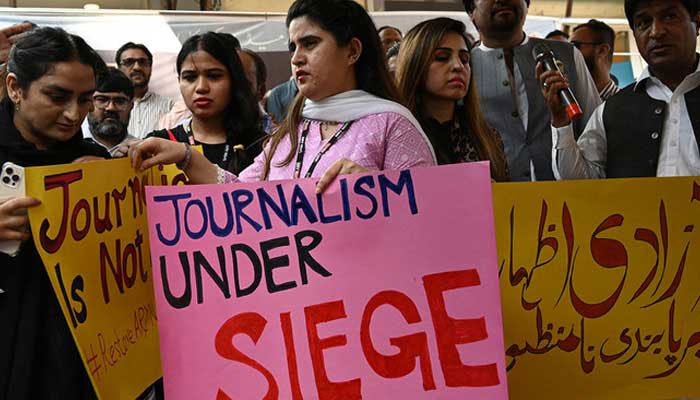
Journalism in Pakistan has always been a high-risk profession, but today, it faces an existential crisis. The Prevention of Electronic Crimes Act (Peca) has become a powerful tool to silence dissent, criminalise reporting and suppress free speech.
With increasing censorship and legal threats, Pakistan has become one of the most dangerous places for journalists. Reporters Without Borders (RSF) has rightly called this one of the most challenging times for the profession.
But while external threats from the state are undeniable, there is another, more uncomfortable truth: journalists themselves have played a role in their profession’s decline. Today, journalism in Pakistan is not just suffering under oppression; it is also being hollowed out from within.
Once known as the voice of truth and the champion of accountability, journalism in Pakistan has transformed into a battleground of sensationalism, political loyalties, and power struggles. The relentless race for ratings, viral trends and social media dominance has overshadowed the fundamental principles of fact-based reporting. Instead of prioritising investigation and public interest, newsrooms are now dictated by corporate profits and political narratives. Objectivity has become a casualty in a system where journalists, rather than holding power accountable, have themselves become instruments of power.
In the past, we often heard that journalism in Pakistan had been politicised but today, it has become something far more dangerous: militarised. The control of narratives is no longer limited to political affiliations; it is now deeply embedded in institutional influence, security doctrines and orchestrated media management. Journalists, whether willingly or under coercion, have become part of a structure where information is carefully curated to serve not just political but also strategic and ideological interests. The press, once known as the fourth pillar of the state, now often functions as an unofficial extension of power centres, amplifying selective narratives while silencing inconvenient truths.
A handful of highly paid anchors dominate the media landscape, but they are no longer engaged in investigative journalism. Instead, many have become mouthpieces for institutions and political parties that fund, operate and control them.
The very journalists who once sought to expose hidden truths are now the gatekeepers of selective narratives, delivering scripted revelations instead of genuine reporting. The so-called ‘inside news’ they present is often nothing more than controlled leaks – information strategically fed to them by those in power to shape public perception rather than challenge it. In this carefully orchestrated game, journalism has become a tool of influence rather than a pursuit of truth.
At the same time, disinformation has blurred the line between fact and fiction. Social media platforms are flooded with half-truths, manipulated narratives and misleading reports – often amplified by journalists themselves without verification. Public trust in the media has eroded, and the profession’s credibility is at an all-time low. Instead of being a force that counters propaganda, journalism is now frequently complicit in spreading it.
The real tragedy, however, lies with field reporters, producers and researchers – the backbone of journalism – who are either underpaid or not paid at all. Journalism, once seen as a noble profession, has become a cruel industry where the workers toil for truth but are left without dignity, security or financial stability. The ones who chase stories often cannot afford to eat, while those who sell narratives sit in air-conditioned studios, dictating the national discourse.
Yet, despite these challenges, all hope is not lost. Journalism in Pakistan can still reclaim its integrity, but through practical and urgent resistance.
Opposing Peca is not just a fight for press freedom but for journalism’s survival itself. These laws will criminalise journalists and embolden institutions to dictate narratives without challenge. Journalist unions such as PFUJ (Pakistan Federal Union of Journalists), KUJ (Karachi Union of Journalists) and international watchdogs like RSF (Reporters Without Borders) are already protesting against Peca, but resistance must go beyond demonstrations. It must translate into sustained legal battles, collective newsroom defiance and stronger alliances with global press freedom organisations.
Safety mechanisms for journalists must be implemented. Press freedom organisations, unions and legal bodies must actively push for protective legislation, fight arbitrary arrests and resist laws like Peca that criminalise journalism. At the same time, news organisations must adopt internal policies that protect journalists from institutional pressures, allowing them to report without fear of losing their jobs – or worse, their lives.
The battle is against censorship as well as against the slow erosion of journalism’s soul. Peca and state repression are undeniable threats, but the profession’s greatest danger lies in its own willingness to compromise. If journalists do not fight to restore their credibility, they will lose freedom and relevance both.
The future of journalism depends on those who dare to speak truth to power – not just against authoritarian regimes, but also within their own ranks. It is time to think beyond Peca, not just in resisting oppression, but also in rebuilding the very essence of what journalism was meant to be.
The writer is a journalist, researcher and human rights activist.







-
 Kylie Kelce Explains Why She Avoids Raising Kids With 'silver Spoon'
 -
 Meghan Markle Is Above Royal Family ‘empty Threats,’ Says Insider
 -
 Anne Hathaway Opens Up About 'defeated' Feeling As Working Mom
 -
 Shamed Andrew Should Testify In Epstein Case As ‘act Of Service’
 -
 What Really Happened Before Nicholas Brendon Was Found Dead At Home?
 -
 Sarah Ferguson Branded ‘most Famous Missing Person’ In UK Right Now
 -
 Why King Charles Does Not Need A Driving License? Expert Reveals
 -
 Did Graham Norton Really Sign NDAs For Taylor Swift’s Wedding?
 -
 ‘Polite’ King Charles Treats Staff Better Than ‘boorish’ Andrew
 -
 Princess Beatrice's Husband Raises Eyebrows With Deleted Instagram Post
 -
 Dua Lipa 'snubs' Priyanka Chopra
 -
 Will Taylor Frankie Paul Still Get Her 'Bachelorette' Salary?
 -
 'Harry Potter' Returns: First Glimpse Of HBO's New Series
 -
 Ryan Gosling Credits His Kids For Key Detail In New Role
 -
 Prince William, Kate Middleton Mark 'historic Moment'
 -
 Why Roberts Pattinson Says Couples 'ruin' Their Big Day Amid Suki Waterhouse Wedding Rumors?