
Feb 8, 2024 elections: Women in 18% communities voted differently from male counterparts
PTI won more support from women in 1,260 communities out of total of 3,884 communities
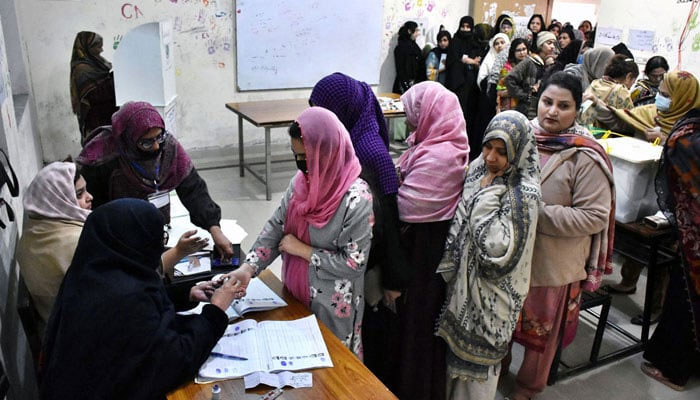
ISLAMABAD: Women voters in 18 percent of communities under the jurisdiction of male and female polling stations voted differently from their male counterparts in National Assembly constituencies during the General Election 2024, according to a report on Women Voting Choices by Free and Fair Election Network (Fafen) that was released here on Sunday. The Fafen report, which compares the results of male and female polling stations in the same communities, finds that in 82 percent of the communities, male and female voters’ choice of winner was aligned, with both returning the same winner from their respective polling stations.
Since election results of combined polling stations do not provide a gender-wise breakdown of how male and female voters vote, Fafen’s assessment could only compare the results of male and female polling stations.
Furthermore, it has limited its scope to male and female polling stations where men and women from the same electoral areas voted. The assessment includes 21,188 communities comprising 42,804 comparable male and female polling stations.
In 18 percent of the communities, male and female voters diverged in their choice of winner as they returned different winners from their respective polling stations. Compared to rural areas, communities in urban areas showed more divergent choices among male and female voters.
Among regions, Islamabad had the highest proportion (37 percent) of electoral communities with different winners in male and female polling stations. Balochistan had the second-highest proportion (32 percent) followed by Sindh (19 percent) and Punjab (18 percent), while Khyber Pakhtunkhwa (KP) had the lowest proportion (13 percent) of such electoral communities.
Of the 3,884 communities where women’s choice of winner for National Assembly seats was different, the Pakistan Tehreek-e-Insaf (PTI) won more support from women in 1,260 communities, followed by the Pakistan Muslim League Nawaz (PMLN) in 1,027 and the Pakistan Peoples Party Parliamentarians (PPPP) in 694 communities.
Regional trends showed that while the PTI performed well across the country in terms of women voters’ choice, the PMLN remained strong in Punjab, and the PPPP dominated in Sindh. In 37 NA constituencies, the largest proportion of voters in female polling stations did not vote for the winning candidates. In 226 NA constituencies, the largest proportion of voters in female polling stations voted for the constituency winner. In 166 of those NA constituencies, compared to voters in male polling stations, a larger proportion of voters in female polling stations polled for the winner. In seven constituencies – NA-43 Tank-cum-Dera Ismail Khan, NA-49 Attock-I, NA-55 Rawalpindi-IV, NA-87 Khushab-I, NA-94 Chiniot-II, NA-128 Lahore-XII and NA-163 Bahawalnagar-IV –, the lead at female polling stations determined the winner.
For example, in NA-43 Tank-cum-Dera Ismail Khan, the PTI narrowly won edging out the Jamiat Ulema-e-Islam-Fazl (JUIF) by 555 votes. PTI-supported candidate garnered a lead of 1,430 votes at female polling stations alone, a margin that decisively affected the overall outcome. The performance of political parties among female voters in electoral communities reflects the significant regional and demographic patterns. As elaborated above, in 3,884 (18%) electoral communities, women chose a different winner from men in their community.
Of the 3,884 communities, women returned PTI candidates as winners in 1,260 (32%). The PMLN followed closely, winning the largest share of women voters in 1.027 (26%) communities. The PPPP followed winning 694 (18%) communities. The JUI-P, MQM-P, other parties, and independent candidates also featured as choice among the women voters in several communities. Most of the communities where PTI remained dominant were in Punjab and Sindh, reflecting the party’s appeal among female voters across these regions.
In Punjab alone, the party won 840 electoral communities where female preferences differed from male voting patterns. The PMLN won 895 such communities, the bulk in Punjab, underscoring its historical voter base and sustained support from female voters in the province. The PPPP showed a distinct regional pattern, winning female polling stations in 694 diverging electoral communities, with the majority (413 communities) in Sindh. Finally, the JUI-P demonstrated concentrated support in Khyber Pakhtunkhwa, where female voters in 101 electoral communities broke rank with male voters to support the party.
Independent candidates were also successful in getting support from women voters in 263 communities. Overall, the data highlights that female voters’ preferences vary significantly across regions, with each party receiving varying levels of support among women who returned a different winner than the men in their community.
This variation underscores the importance of localised and gender-sensitive strategies for political parties aiming to effectively engage female voters across Pakistan. Comparison of Male and Female Choices at their Respective Polling Stations, the results of 7,768 polling stations (3,884 male and 3,884 female polling stations) in the 3,884 communities determine who won the male polling stations where female polling stations returned a specific party.
Of the remaining communities, male vote elected PTI candidates in 122, PMLN candidates in 102, and independent candidates in 95. Of the 1,260 communities where the PTI won the female polling station, voters at male polling stations in 835 returned the PMLN as the winner. Among the rest, male voters returned PPPP candidates winners in 51 communities, independent candidates in 78, and other parties in 296 communities.
The 1,027 communities where the PMLN won the female polling station, voters at male polling stations in 869 returned the PTI as the winner. Among the rest, male voters returned independent candidates as winners in 95 communities, other parties in 47, and PPPP in 16 communities. Of the 694 communities where the PPPP won at the female polling stations, male voters in 31 communities chose candidates from other parties.
Of the 640 communities where other parties won the female polling station, voters at male polling stations in 334 returned the PTI as winners. Among the rest, male voters returned candidates from other parties as winners in 127 communities, the PPPP in 94, independent candidates in 48 communities and PMLN in 37 communities.







-
 Halle Bailey Gets Candid About Turning ‘diary Entries’ To Music
 -
 Todd Bridges Divorces Wife Bettijo B. Hirschi 3 Months After Announcing Split
 -
 Canucks Vs Wild: Boldy And Kaprizov Lead Minnesota To Playoffs As Vancouver End Season At The Bottom
 -
 Princess Beatrice, Eugenie Urged To Avoid Royal Ascot Despite King Charles’ Invite
 -
 Calgary Weather: Snow Brings Dozens Of Crashes During Second Spring Storm
 -
 Jessica Simpson Finds New Boyfriend After Parting Ways With Eric Johnson
 -
 Capitals Vs Devils: Jack Hughes Shines With Five Points As Devils Cruise Past Capitals
 -
 Tornado Warnings: Southeast Wisconsin Sees Warnings Expire After Damaging Winds And Storm
 -
 OKC Thrash Lakers As Luka Doncic Exits With Hamstring Issue Ahead Of MRI Scan
 -
 US Army Chief Randy George Asked To Step Down By Pete Hegseth In Major Shakeup
 -
 Justin Baldoni Reacts After Judge Drops Key Claims In Blake Lively Lawsuit
 -
 King Charles Has Developed A ‘swagger’ In Queen Camilla Love
 -
 Blake Lively Breaks Silence After Judge Dropped Her Major Claims Against Justin Baldoni
 -
 Queen Camilla, King Charles ‘private Date Nights’ Laid Bare By Insider
 -
 Tom Brady Reveals How Family Life Changed His Strict Diet
 -
 King Charles Powerful Enough To Stop Emerging ‘WW 3’ With US Visit