
Chinese varsity, PU ink MoU on research in health sciences
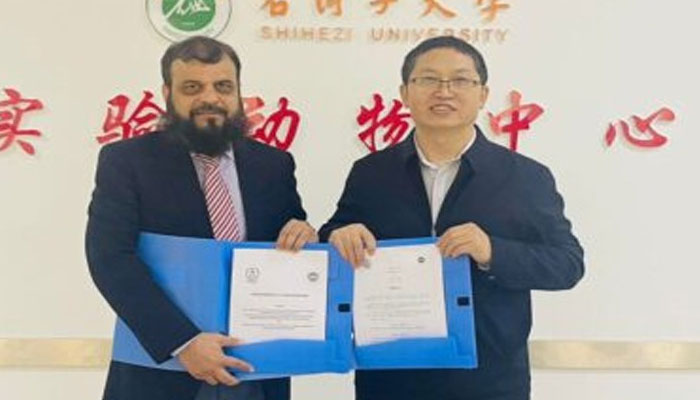
LAHORE: School of Medicine, Shihezi University, China, and the Centre of Excellence in Molecular Biology (CEMB), University of the Punjab, have signed a Memorandum of Understanding (MoU) to foster collaboration in cutting-edge scientific research and academic exchange, aligning with global advancements in health sciences.
The agreement was signed by Prof Dr Wang Yuanzhi, Vice Dean School of Medicine, Shihezi University, Xinjiang, China and Prof Dr Moaz ur Rahman, Director of the Centre of Excellence in Molecular Biology, University of Punjab, Pakistan, said a press release issued here on Sunday.
This important partnership agreement was facilitated by Prof Dr Cheng, Chairman of the Symposium, and scholar from China Agricultural University, who played a pivotal role in fostering this collaborative agreement.
The Pakistani delegation participated in the International Symposium on Veterinary Vaccine and Drug Technology Cooperation among the Belt and Road Countries. During their visit to Shenzi, this important MoU was signed.
This strategic partnership promotes innovation and collaboration in health sciences by establishing joint research centers, facilitating researcher and student exchanges, and organizing international conferences.
Under the MoU, the two institutions will collaborate on diverse areas, including developing technical research projects, shared academic data and publications, and intellectual property rights.
Both parties are committed to fostering academic exchanges, with joint training programs for students and researchers forming the core of the collaboration. This partnership is a testament to the deepening ties between Pakistan and China in scientific and technological domains.
For China, it reflects an ongoing commitment to fostering collaboration with Belt and Road countries, advancing shared goals in health sciences and technology. The International Symposium, where the agreement was signed, provided a platform for scientists, researchers, and academics from across the globe to converge and share insights. The MoU will remain in effect for five years, with provisions for extension upon mutual consent. Both institutions are optimistic about the long-term benefits of this collaboration, not only for their respective countries but also for the global scientific community.
The signing of this MoU is an important step towards the shared vision of Pakistan and China to harness the power of science and technology for mutual progress and prosperity. It is a beacon for future collaborations within the Belt and Road Initiative, underscoring the importance of innovation and shared growth in shaping a better future.


