
Pakistan’s poor air quality affecting people’s life expectancy
Adverse effects of country’s worsening air pollution has been found to significantly affect life expectancy of its citizens
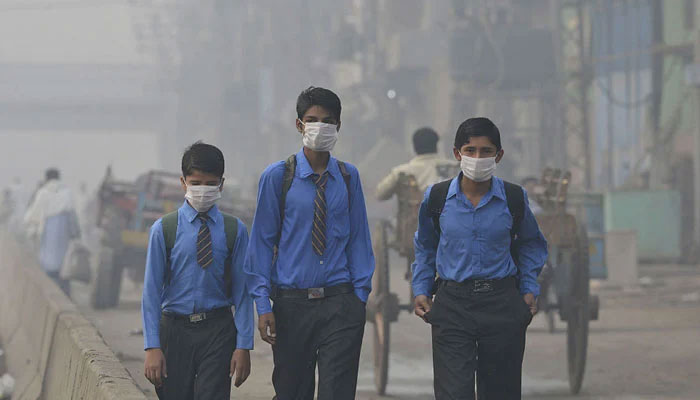
ISLAMABAD: As Pakistanis grapple with the ongoing socio-political, economic, and security issues, they also remain threatened by climate-induced challenges such as air pollution, risking not only their habitat but also their overall health and well-being.
In an annual Air Quality Index (AQLI) report produced by the University of Chicago’s Energy Policy Institute (EPIC), the adverse effects of the country’s worsening air pollution has been found to significantly affect the life expectancy of its citizens.
As Pakistanis grapple with the ongoing socio-political, economic, and security issues, they also remain threatened by climate-induced challenges such as air pollution, risking not only their habitat but also their overall health and well-being.
In an annual Air Quality Index (AQLI) report produced by the University of Chicago’s Energy Policy Institute (EPIC), the adverse effects of the country’s worsening air pollution has been found to significantly affect the life expectancy of its citizens.
The report maintained that since virtually the entire population of Pakistan breathes air that doesn’t meet the PM2.5 standard set at 15 µg/m³, people’s life expectancy could be increased by 2.3 years if the country is able to meet its own PM2.5 standard.
“In Pakistan, where the PM2.5 concentration was 38.9 µg/m³ in 2022 — 10% lower compared to the particulate levels in 2021, the average resident would gain 3.3 years from meeting the World Health Organisation (WHO) guideline,” read the AQLI 2024 annual update.
“Those in Peshawar, the most polluted city in the country, would gain 5.6 years,” it added.
Elaborating on the increase in factors affecting air pollution, the AQLI underscored an approximately fourfold increase in the number of vehicles in the country since the early 2000s as well as a significant increase in the use of fossil fuel for electricity generation.
Noting that 94 out of 252 countries and territories globally had national standards, making up 80% of the world’s population, it highlighted that 37 of those countries weren’t meeting them — which amounts to 30%of the world’s population.
Terming global pollution as the “greatest external threat to human life expectancy”, the report stated that people in the most polluted areas of the world breathe air that is six times more polluted than those in the least polluted areas, which in return, reduces their life expectancy is reduced by an average of 2.7 years compared to those living in the cleanest places.







-
 Tucker Carlson Says Passport Seized, Staff Member Questioned At Israel Airport
 -
 Taylor Swift Made Sure Jodie Turner-Smith's Little Girl Had A Special Day On 'Opalite' Music Video Set
 -
 Eric Dane Says Touching Goodbye To Daughters Billie And Georgia In New Netflix Documentary
 -
 Channing Tatum Reveals What He Told Daughter After Violent Incident At School
 -
 King Charles Lands In The Line Of Fire Because Of Andrew Mountbatten-Windsor
 -
 Denise Richards Doubles Down On Abuse Claims Against Ex Husband Aaron Phypers Amid Show Return
 -
 Russia Set To Block Overseas Crypto Exchanges In Sweeping Crackdown
 -
 Gwyneth Paltrow Reveals Deep Personal Connection With Kate Hudson
 -
 Prince Harry, Meghan Markle’s Game Plan For Beatrice, Eugenie: ‘Extra Popcorn For This Disaster’
 -
 OpenAI To Rollout AI Powered Smart Speakers By 2027
 -
 Is Dakota Johnsons Dating Younger Pop Star After Breakup With Coldplay Frontman Chris Martin?
 -
 Hilary Duff Tears Up Talking About Estranged Sister Haylie Duff
 -
 US Supreme Court Strikes Down Trump’s Global Tariffs As 'unlawful'
 -
 Kelly Clarkson Explains Decision To Quit 'The Kelly Clarkson Show'
 -
 Inside Hilary Duff's Supportive Marriage With Husband Matthew Koma Amid New Album Release
 -
 Daniel Radcliffe Admits To Being Self Conscious While Filming 'Harry Potter' In Late Teens