
iCube Qamar successfully deployed in orbit
After deployment, orbiter will allow imaging of desired lunar surfaces in selected 12-hour elliptical orbit
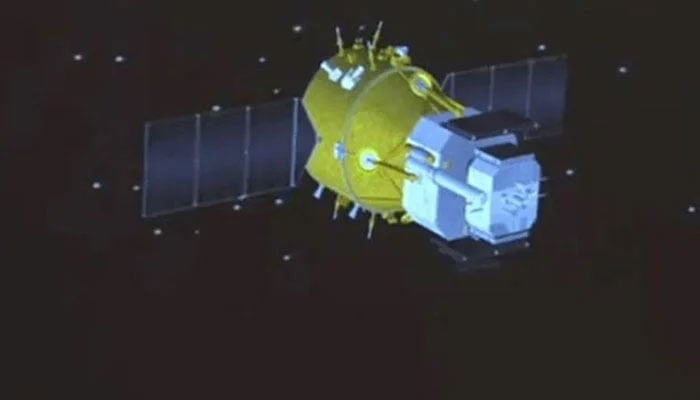
ISLAMABAD: Pakistan’s first lunar mission, iCube Qamar, has been successfully deployed in orbit, Dr Khurram Khurshid, a member of the core team at the Institute of Space Technology (IST), told Geo on Wednesday.
He said the orbiter was successfully deployed in lunar orbit on 8th May at 1:14pm PST, terming the development “a great success overall”.
Following its deployment, the satellite will allow imaging of the desired Lunar surfaces in a carefully selected 12-hour elliptical orbit.
The iCube Qamar was launched on board China’s Chang’e-6 from Hainan, China, on May 3.
Ahead of the launch of the satellite last week, Dr Khurram said that the Pakistani satellite — carried by China’s Long March-5 rocket — will reach the lunar orbit in five days and will circle around the moon for three to six months.
He added that different pictures of the surface of the moon will be taken with the help of satellite after which Pakistan will have its own satellite images of the moon for research.
The satellite was designed and developed by the Islamabad-based Institute of Space Technology (IST) in collaboration with China’s Shanghai Jiao Tong University (SJTU) and Pakistan’s national space agency Suparco.
iCube Qamar orbiter carries two optical cameras to image the lunar surface. Following successful qualification and testing, the orbiter was integrated with China’s Chang’e6 mission — the sixth in a series of lunar exploration missions.
CubeSats are a class of small satellites used by academic institutes for experimental and research purposes in low Earth orbits, generally with an altitude of less than 1,000 km. However, these satellites are now finding many applications in higher orbits and deep space missions.
Moon is in an elliptical orbit at an average distance of around 384,400 km from the Earth, which makes it challenging to communicate with and control small satellites.
The opportunity to release CubeSat into lunar orbit from the Chang’e-6 mission was offered by the China National Space Agency (CNSA) through the Asia Pacific Space Cooperation Organization (APSCO) to member states.
After a thorough evaluation, Pakistan’s proposal was accepted out of all APSCO member states.
The design, development and qualification of iCube-Q was led by faculty members and students of the IST in collaboration with SJTU and support from Suparco. iCube Qamar carries two cameras as payload for imaging lunar surface and Earth/moon images from lunar orbit besides having 3-axis altitude control for desired orientation, onboard computer, thermal control, telemetry and telecommand and payload data communication modules for connecting through deep space network.







-
 King Charles, Princess Anne, Prince Edward Still Shield Andrew From Police
 -
 US Set To Block Chinese Software From Smart And Connected Cars
 -
 Carmen Electra Says THIS Taught Her Romance
 -
 Leonardo DiCaprio's Co-star Reflects On His Viral Moment At Golden Globes
 -
 SpaceX Pivots From Mars Plans To Prioritize 2027 Moon Landing
 -
 King Charles Still Cares About Meghan Markle
 -
 J. Cole Brings Back Old-school CD Sales For 'The Fall-Off' Release
 -
 GTA 6 Built By Hand, Street By Street, Rockstar Confirms Ahead Of Launch
 -
 Funeral Home Owner Sentenced To 40 Years For Selling Corpses, Faking Ashes
 -
 Why Is Thor Portrayed Differently In Marvel Movies?
 -
 Dutch Seismologist Hints At 'surprise’ Quake In Coming Days
 -
 Australia’s Liberal-National Coalition Reunites After Brief Split Over Hate Laws
 -
 DC Director Gives Hopeful Message As Questions Raised Over 'Blue Beetle's Future
 -
 King Charles New Plans For Andrew In Norfolk Exposed
 -
 What You Need To Know About Ischemic Stroke
 -
 Shocking Reason Behind Type 2 Diabetes Revealed By Scientists