
Imran challenges in SC indictment in cipher case
Khan states petitioner, co-accused had immunity in respect of alleged offence therefore, proceedings should be declared null and void
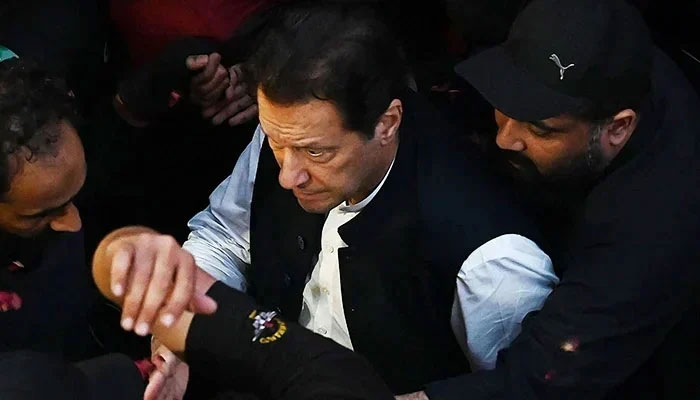
ISLAMABAD: Former prime minister and Chairman Pakistan Tehreek-e-Insaf (PTI) Imran Khan Wednesday requested the Supreme Court to declare as illegal, unlawful the charge framed against him by the trial court in cipher case.
He filed an appeal in the apex court through his counsel Hamid Khan under Article 185(3) of the Constitution, praying to grant leave to appeal against the impugned order dated October 26, 2023, passed by the Islamabad High Court (IHC) and framing of charge by the trial court on October 23, 2023. He requested for declaring as illegal, unlawful and violative of the Code of Criminal Procedure, 1898 and Article 4 and 10-A of the Constitution of Pakistan, 1973.
The former PM stated that the petitioner and co-accused had an immunity in respect of the alleged offence under Article 248 of the Constitution of Pakistan, 1973 and therefore, the whole proceedings should be declared null and void.
He questioned as to whether the rushed process of charge framing did not affect the accused’s rights as guaranteed by Article 4 and Article 10-A of the Constitution of Pakistan, 1973, particularly with regard to ensuring a fair trial and proceedings.
“Whether the trial court hastily framed charges under the Official Secrets Act, 1923, in clear violation of the Code of Criminal Procedure, 1898, and the Constitution of Pakistan, 1973?” the PTI chairman questioned.
Similarly, he questioned as to whether the mandatory provisions requiring the provision of copies to the accused “not less than 7 days before framing of charge” were not blatantly flouted, violated, or overlooked by both the trial court and the Islamabad High Court.
“Whether the trial court’s refusal to exercise powers under Section 94 of the Code of Criminal Procedure, 1898, to compel the prosecution to disclose the cipher document was justified and consistent with legal requirements?”, the PTI chairman questioned and further asked as to whether the trial court’s decision to frame the charge could be considered legally sound when the main documentary evidence central to the prosecution case, the cipher telegram, was not part of the challan or supplied to the accused seven days prior to the framing of the charge?
The PTI chairman submitted that the proceedings initiated in flagrant non-compliance with Section 241-A of the Criminal Procedure Code, 1898, and the erroneous and unlawful framing of charges on October 23, 2023 were duly challenged before the IHC through Criminal Revision No 166/2023.
Regrettably, he contended that the IHC, in its adjudication on the matter, dismissed the Criminal Revision Petition and issued an impugned order on October 26, 2023. “This order resulted in a gross misreading and non-reading of material evidence. Consequently, the petitioner, deeply aggrieved by the impugned order dated 26-10-2023 and the framing of charges on 23-10-2023, humbly seeks the kind indulgence of this august court to set aside the impugned order dated 26-10-2023,” Khan submitted.
The subsequent arbitrary actions and highhandedness displayed by his political opponents, who assumed control of the federal government, undeniably reflect a clear case of political victimisation against him and his party, the PTI chairman contended.
He submitted that subsequent events had been marred by an alarming trend of political victimisation that not only targets the petitioner but also extends to his allies and political party.
“Unfortunately, a disheartening trend has emerged where state machinery, in a questionable display of power and authority, has made strenuous attempts to concoct and fabricate false cases,” Imran contended, adding that the registration of the present case is another facet of the malevolent campaign, with the sole objective of settling scores with him.
Imran Khan contended that the cipher telegram, at the heart of the dispute, represents the core evidence upon which the entire prosecution’s case relies, adding that the failure to even examine the contents of this cipher telegram to establish the accuracy of the allegations, and hastily proceeding to frame charge, is a clear indication of bias on the part of the trial court.
The PTI chairman, however, submitted that the trial court’s dismissal of the application under Section 94, in addition to other illegalities committed, serves as compelling evidence of the trial court’s bias and a preconceived state of mind.
A prejudiced trial is being conducted against the petitioner, who has served as the 22nd PM of Pakistan and is fully entitled to the ‘Immunity’ from being tried in an illegal trial based on the allegations merely to the extent of his lawful act done during his tenure as the PM of Islamic Republic of Pakistan, the PTI chairman submitted.


