
Largest Haj in history begins
“The numbers will exceed 2.5 million pilgrims,” said an official
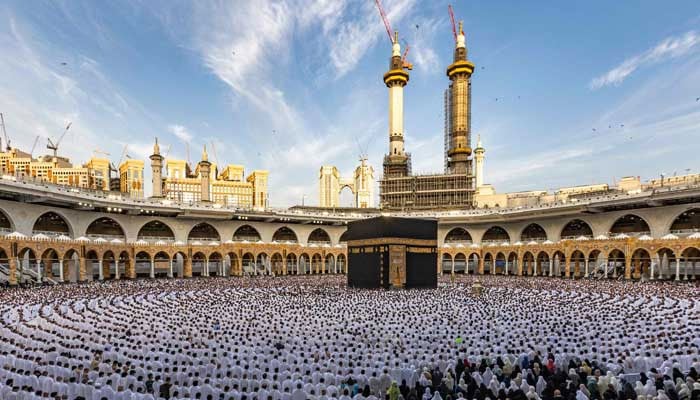
MAKKAH: Hundreds of thousands of Muslims from around the globe walked solemn circles around the Ka’aba on Sunday to begin the biggest Haj pilgrimage in several years.
Islam’s holiest site is expected to host more than two million worshippers from 160 countries during the annual rites that could break attendance records, with 1.6 million foreigners already arriving by late Friday.
“This year, we will witness the largest Haj pilgrimage in history,” if things go according to plan, predicted an official with the Saudi Ministry of Haj and Umrah.
“The numbers will exceed 2.5 million pilgrims,” added the official, speaking on condition of anonymity because he is not authorised to speak with the press.
The Haj began early on Sunday with the tawaf — the circumambulation of the Kaaba, the large cubic structure draped in black cloth with gold trimmings that Muslims around the world pray towards every day.
“I am living the most beautiful days of my life,” said Saeed Abdel Azim, a 65-year-old Egyptian performing the ritual. “The dream has come true,” added the retiree, who had saved for 20 years to pay the thousands of dollars needed to take part.
The Haj is one of the five pillars of Islam and must be undertaken at least once by all Muslims with the means.
A series of rites are completed over four days in Makkah and its surroundings in the west of oil-rich Saudi Arabia.
On Sunday afternoon, pilgrims started moving to Mina, about five kilometres (three miles) from the Grand Mosque, ahead of the Haj’s climax at Mount Arafat, where the Prophet Mohammed (SAW) is believed to have delivered his final sermon.
Mina, the world’s largest tent city, readied to receive the influx of pilgrims, with food supplies brought in and security forces deployed around the area.
More worshippers are expected to head to Mina on Monday, as a vibrant atmosphere takes hold of the tented city with the arrival of pilgrims by foot or via airconditioned buses.
Outside the Grand Mosque, thousands prayed on colourful carpets that adorned the pavement, with male pilgrims wearing simple white robes. The area was dotted with ambulances, mobile clinics and fire trucks.
The Haj poses a considerable security challenge and has seen several disasters over the years, including a 2015 stampede that killed up to 2,300 people.
There have been no major incidents since, and catastrophe was the last thing on pilgrims’ minds.
“I cannot describe my feelings,” said Indonesian student Yusuf Burhan, 25. “This is a great blessing. I never imagined that I would perform the Haj this year.”
This year’s summer timing for the Haj, which follows the lunar calendar, is testing the endurance of worshippers during the mostly outdoor ritual.
Carrying white umbrellas to shield themselves from the scorching sun, policemen in the mountainous city have conducted foot patrols and set up checkpoints to inspect Haj permits.
Others splashed water on pilgrims as temperatures climbed towards 45 degrees Celsius (113 degrees Fahrenheit).
Thousands of paramedics were on standby inside the Grand Mosque. Saudi authorities said more than 32,000 health workers will be on hand to treat cases of heatstroke, dehydration and exhaustion.
The Haj, which costs at least $5,000 a person, makes billions of dollars a year for Saudi Arabia, the world’s biggest oil exporter, which is trying to diversify its economy beyond fossil fuels.
This year’s will be the biggest since 2019, before the Covid pandemic, when about 2.5 million people took part.
Only 10,000 were allowed in 2020, at the height of the global outbreak, rising to nearly 59,000 in 2021.
Last year’s cap of one million has been removed.
Saudi businessman Samir al-Zafni said all his hotels in Makkah and Madinah are at full capacity until the first week of July.
“This year there is not a single vacant bed in our group of 67 hotels,” he told AFP.
The Haj also demonstrates social reforms in the deeply conservative kingdom.
This year’s pilgrimage will be the biggest since Saudi Arabia scrapped rules in 2021 that banned women who weren’t accompanied by a male relative.
Waiting for a car to take him out of the vicinity of Makkah’s grand mosque, Moroccan merchant Abdullah al-Haqouni, 65, said he was struggling with the temperature.
“I am very tired. The heat is unbearable,” he said, carrying a green umbrella.







-
 Why Attorney Says Justin Baldoni 'not Off The Hook' Despite Court Ruling? Report
 -
 'Abuses' Shouted At Andrew Mountbatten-Windsor As Protesters Breach Security
 -
 Jenna Dewan Reveals Mindset She Follows When Life Gets 'nuts'
 -
 Erika Kirk Dating Claims Surface As She Reclaims Charlie Kirk's Legacy
 -
 Karoline Leavitt Joins Erika Kirk At Washington Event
 -
 Lizzo Reveals Major Update About Her Sobriety Journey
 -
 Princess Beatrice’s Husband Edo ‘questioning Marriage’: ‘His Standing & Status Is Impacted’
 -
 Petition To Strip Blake Lively Of 'It Ends With Us' PGA Credit Gains Massive Support
 -
 New Development In Blake Lively Lawsuit After Judge Dismisses Major Claims
 -
 Blake Lively, Taylor Swift Texts Resurface After Court Ruling
 -
 Prince Harry’s Behavior Towards Queen Elizabeth Gets Exposed: ‘He Drove Her To Paranoia’
 -
 Blake Lively, Justin Baldoni's Legal Case Receives Latest Update
 -
 Kylie Jenner Says Goodbye To Her Halloween Era: 'I've Retired It'
 -
 Mel B Reveals Why Spice Girls Documentary May Never Happen
 -
 Maggie Gyllenhaal Recalls Emotional Impact Of Seeing Husband With Other Woman
 -
 Scarlett Johansson Shares Wild First Concert Story