
Suo moto right of SC, not CJP: Justice Isa
Top court judge says Article 184(3) that gives right to take suo motu is for public interest and enforcement of fundamental rights
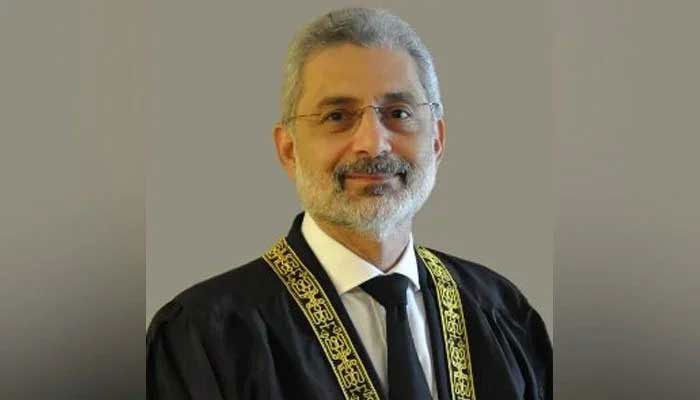
ISLAMABAD: Senior puisne judge Justice Qazi Faez Isa said on Wednesday that the authority to take a suo motu action under provisions of Article 184(3) of the Constitution lies with the apex court and not the chief justice only.
“My friends are of the view that the [sou motu] powers can only be exercised by the chief justice of Pakistan,” he said while addressing a ceremony, organised in connection with the Constitution of Pakistan’s Golden Jubilee in the capital.
He asked for the clause that made the chief justice master of rules, so he could correct himself. He added that the third opinion was that all judges and the chief justice of Pakistan (CJP) must unite under Article 184(3). Justice Isa said that Article 184(3) of the Constitution was for the public interest and enforcement of fundamental rights. “The clause of Article 184(3) was added to the Constitution for the oppressed but was used extensively for both good and bad reasons and one should be vigilant while using it,” said Justice Isa.
According to the senior-most judge, every case, whether criminal or civil, had at least one right to appeal, but that was not the case under Article 184-3. “Whenever there is injustice, it doesn’t last long,” Justice Isa asserted.
Referring to the secession of East Pakistan, the SC senior judge said the country did not split all of a sudden, as the seeds of [bifurcation] were sown [long ago]. He said the main reason for the division of Pakistan was a wrong judicial decision.
The senior puisne judge said that Justice Munir planted the seed of the separation of Pakistan. “This poisonous seed grew and in December 1971 the country was divided into two parts,” Justice Isa said. He was referring to a verdict given in 1955. The Federal Court, led by Chief Justice Muhammad Munir, had ruled in support of the Governor General. The court suspended the decision of the high court and held the Governor General, and not the Constituent Assembly, to be the sovereign authority.
He said the effects of actions taken today would manifest years and centuries later. “They issue different kinds of orders; I don’t know who they are fooling,” Justice Isa said. He said a decision would still be wrong even if it was decided by a majority. “There are differences of opinion in a society and if everyone starts to support one thing, then it would become a dictatorship.”
The senior judge said the worst thing was arrogance followed by ego and one should not have an ego if they were sitting in some position [of power]. “The day I become egoistic, I will not be a judge,” said Justice Isa, adding that dissent had nothing to do with ego.
Justice Isa further said, “We have a responsibility to uphold the Constitution as it is a gift and can never be found again. Those who do not follow the Constitution do not need to live in Pakistan and the Constitution also applies to foreigners residing in Pakistan.”
He added: “The Constitution has not been presented the way it deserves to be.” He said, “Many senior lawyers don’t love the Constitution, as they only care about money.”
He said the idea of establishing Pakistan was to have a country free from the exploitation of Muslims, where they could live as they wished. He said the biggest Muslim state in the world came into being but the job was left half done.
Isa said the “legislative assembly worked for seven years. When the Constitution reached the brink of completion, Ghulam Muhammad, a civil servant, stumbled on it.”
Justice Isa regretted that there had been no elections in the legislative assembly of 1956 which ended within two years. “A civil servant concluded that he was a wise man, and there came the martial law of 1958,” the justice said, adding that this “wise man” formed the 1962 Constitution on his own and ended democracy.
“According to the civil servant, the people are not conscious; they have no intelligence, so there should be a filter. This wise man introduced basic democracy for the filter.” Under this basic democracy, 80,000 elected representatives should choose the president and control people along with him, he added.
Referring to the constitutional amendment to Article 58(2B), the justice said it had been introduced to dissolve the elected parliament whenever they wanted. Under the 18th Amendment, 58(2B) was abolished and gave rights to the provinces, added the judge. He said the 18th Amendment removed all errors that had marred the Constitution of ‘73. “The 18th Amendment strengthened the federation and gave powers to the provinces,” he said, adding that 17 ministries had been abolished under the amendment.
About the 50th anniversary of the Constitution, Justice Isa said it (the Constitution) was for the people of Pakistan, who have their rights in it. “This document is of every single citizen,” added the SC judge.


