
Failure of reforms can lead to IMF programme suspension: Dr Hafiz A Pasha
Dr Hafiz Pasha laments over depleting capacity to utilize even released resources for development projects under the PSDP
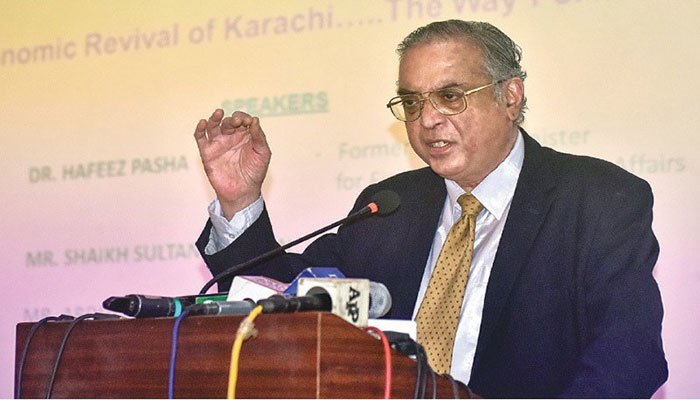
ISLAMABAD: Former minister for finance Dr Hafiz A Pasha has warned that the IMF programme could land into suspension mode if Pakistan showed its inability to undertake structural reforms and tough conditionalities in the wake of the third wave of Covid-19 pandemic. He also said that Pakistan should reduce the power tariff for industrial sector instead of hiking the tariff on the IMF demand in order to generate increased requirement for electricity
“Pakistan will have to manage $40 billion debt obligations for repayment over the next three years and the financing of multilateral donors may dry up after suspension of the Fund-sponsored program. As a result of PM’s visit, Saudi Arabia may resume oil facility on deferred payment but it is unlikely that they will provide major financing requirement keeping in view their own increased budget deficit,” former minister for finance Dr Hafiz A Pasha said in a pre-budget 2021-22 webinar organized by the Pakistan Institute of Development Economics (PIDE) on Friday.
When asked whether PM’s ongoing visit to Kingdom of Saudi Arabia (KSA) could provide an alternate plan to help Pakistan to exit from the IMF program, he replied that the KSA had suspended the oil facility on deferred payment after getting back $1 billion deposits. Now it is hoped that the oil facility on deferred payment is likely to be resumed during the much-hyped visit of the prime minister, he added. However, he made it clear that the expectation of major contribution from KSA for total debt obligation requirement of $40 billion from 2021-22 to 2023-24 might not materialise keeping in view their higher budget deficit.
He said that with low growth of four percent, it is bound to increase 20 million people falling below the poverty line and it will also increase unemployment in Pakistan. He said that Pakistan required GDP growth of 6.5 percent and more in order to avoid falling of more people into the poverty trap.
Dr Pasha lamented over depleting capacity to utilize even released resources for development projects under the Public Sector Development Program (PSDP) and stated that the utilization of PSDP stood at Rs277 billion in nine months (July-March) period of the current fiscal year out of the total released amount of Rs494 billion. He said that the throw forward of development schemes requirement stood at Rs7.5 trillion to Rs8 trillion, indicating that 7 to 8 times resources were required to complete all PSDP projects on the existing list. “This is hilarious and there is a need to impose moratorium on inclusion of new projects into the PSDP from the next budget with approval of the National Economic Council (NEC),” he added.
He said that if Pakistan asked the IMF for re-negotiation of structural reforms and tough conditions, then the IMF could suspend the programme as it did on the eve of first wave of Covid-19 pandemic. He said that it had resulted into decreased inflows of $6 billion from multilateral creditors, so in case of dry up of dollar inflows, Islamabad would have to come up with an alternate plan to get financing of $40 billion debt obligation requirement over the next three years. He explained that the figure of $40 billion debt obligation was given by IMF in its latest report.
Dr Pasha opposed the IMF demand for doing away with GST exemptions and said that these tax exemptions were related to agriculture and medicines. He said that there should be zero tax on fertilizer sector.
He said that there were 12 slabs of Personal Income Tax and it should be brought down to 5 to 6 slabs in the upcoming budget. He said that the rate of highest income bracket of 35 percent should be brought down from Rs75 million to Rs15 million while the minimum income taxable ceiling should be jacked up from Rs600,000 to Rs750,000 per annum.
“With these taxation measures, the FBR could generate additional Rs300 to Rs350 billion in the coming budget,” he said and added that the FBR’s annual target should be fixed at Rs5,400 billion instead of Rs6,000 billion recommended by the IMF.
Former deputy chairman Planning Commission and Vice Chancellor PIDE Dr Nadeem Ul Haq said that the IMF focused on raising tax revenues and came up with the tax target that proved highly ambitious. During the webinar, renowned economist and former Chief Economist Dr Pervez Tahir, Dr Vaqar and others also spoke on the occasion.







-
 Leonardo DiCaprio's Co-star Reflects On His Viral Moment At Golden Globes
 -
 SpaceX Pivots From Mars Plans To Prioritize 2027 Moon Landing
 -
 J. Cole Brings Back Old-school CD Sales For 'The Fall-Off' Release
 -
 King Charles Still Cares About Meghan Markle
 -
 GTA 6 Built By Hand, Street By Street, Rockstar Confirms Ahead Of Launch
 -
 Funeral Home Owner Sentenced To 40 Years For Selling Corpses, Faking Ashes
 -
 Why Is Thor Portrayed Differently In Marvel Movies?
 -
 Dutch Seismologist Hints At 'surprise’ Quake In Coming Days
 -
 Australia’s Liberal-National Coalition Reunites After Brief Split Over Hate Laws
 -
 DC Director Gives Hopeful Message As Questions Raised Over 'Blue Beetle's Future
 -
 King Charles New Plans For Andrew In Norfolk Exposed
 -
 What You Need To Know About Ischemic Stroke
 -
 Shocking Reason Behind Type 2 Diabetes Revealed By Scientists
 -
 SpaceX Cleared For NASA Crew-12 Launch After Falcon 9 Review
 -
 Meghan Markle Gives Old Hollywood Vibes In New Photos At Glitzy Event
 -
 Simple 'finger Test' Unveils Lung Cancer Diagnosis