
Philosophy behind socialism with Chinese characteristics
In China, Communism flourished in rural areas, with farmers acting as pioneering members and advocates
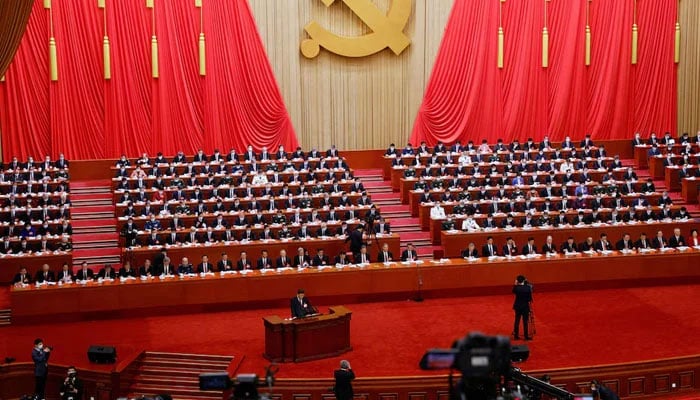
The ideology of Socialism with Chinese characteristics continues to evolve under the leadership and guidance of Communist Party of China (CPC). The party’s successive leadership has helped refine and adapt the ideology of Socialism to meet the changing needs of Chinese society, while adhering to fundamental principles and core philosophy of Communism.
This adjustment was necessary because the Chinese revolution and the CPC have different historical contexts and structures compared to European Communist parties and revolutions. In China, Communism flourished in rural areas, with farmers acting as pioneering members and advocates.
These farmers were the torchbearers of the Communist message. Unlike European movements and revolutions, the Chinese Revolution was led and achieved by the farmers.
Following the establishment of modern China, efforts to devise Socialism with Chinese characteristics accelerated.
Chairman Mao led the effort to tailor Communism to China’s needs, laying the groundwork for Socialism with Chinese characteristics. He focused on the ideological framework and conceptualised the need for Socialism with Chinese characteristics.
The work was further strengthened with the ideological guidance and work of Comrade Deng Xiaoping. He introduced the economic reforms and revolutionised the production sector with Chinese characteristics.
He was the first to formally introduce and use the terminology of Socialism with Chinese characteristics.
President Jiang Zemin and President Hu Jintao contributed by presenting the Three Representatives and Scientific Development theories.
However, since 2012, President Xi has augmented efforts to construct Socialism with Chinese characteristics to meet China’s future needs. He has consolidated the work on Chinese Socialism by presenting President Xi’s Thought on Socialism with Chinese Characteristics in the New Era.
The evolution and contributions of successive leadership have made Chinese Socialism a distinct model of socialism, one that is dynamic and future-oriented.
It possesses specific characteristics that distinguish it as a unique brand and practice, setting it apart from other forms of Communism and socialism. First, it practices scientific Communism with Chinese characteristics.
Scientific Communism is an old concept that has been studied within the context of Communism for a long time. It typically focuses on theoretical and philosophical work, with the practical aspect often lacking to a great extent.
However, in China, scientific Communism is not limited to study of philosophy or social changes; it equally focuses on actions.
The analysis of modern Chinese history indicates that, on one hand, China continued to study philosophy of scientific Communism, as discussed above.
Simultaneously, the CPC worked to identify societal needs by studying social behaviour and took necessary actions. The philosophy of acting, not just studying, helped China make significant strides. For example, Deng Xiaoping introduced reforms after studying ground realities and society and concluding the socialist production system was insufficient to meet ever-growing needs of the population. It is also part of Deng Xiaoping’s principal contradiction. President Jiang Zemin, Three Representatives, also highlighted the societal needs and required reforms in the structure of the CPC. He presented the idea of Socialist market economy to strengthen role of markets in the economy, but with a strong ideological component.
Moreover, the decision-making process is highly scientific, not whimsical or based on utopian ideology. For example, Deng Xiaoping said, “Seek truth from facts”.
He emphasised the importance of a data-driven decision-making process. Furthermore, the Chinese leadership has made efforts to enhance the role of science and technology in development.
For instance, PM Zhou Enlai presented the concept of Four Modernisations. President Hu Jintao coined the term “scientific outlook on development” to emphasise importance of science and innovative solutions in driving economic growth. Since 2012, President Xi has made innovation a primary instrument to address contemporary challenges and realise the dream of rejuvenation and the China Dream.
Second, philosophy and spirituality have played a prominent role in the evolution of Chinese Socialism. In my view, philosophical spiritualism embodies the essence of Chinese characteristics.
Chinese modernisation and the evolution of socialism thrived on the back of spirituality.
The ideology and philosophy of shared prosperity, harmony, societal welfare and centralised people-centric governance, as well as the virtue of the ruler, have deep roots in Chinese spirituality, as constructed by the elders.
Taoism, Confucianism, and Buddhism (the Three Teachings) played a defining role in shaping the ideology and civilisation.
Taoism (500 BCE) promoted the concept of harmony between humans and the natural world. It encourages following the flow of nature to create a harmonious way of living. It presents the idea of yin and yang, which represent interconnection of opposites, such as good and evil, dark and light and passive and active.
At the same time, it focuses on deity, purity and inner development. Purity of mind, soul and body is recognised as a critical element.
The practice of Taoism promotes self-awareness and emphasises importance of transcending the mortal body. It encourages cultivation of qi (inner energy), deep thinking, and spirituality. Taoist ideology has a significant impact on Chinese society through art, culture, martial arts and various other aspects. It was also practiced as a religion during the Tang Dynasty.
Confucianism is a vital aspect of Chinese civilisation. It focuses on the ideology of virtuous living and adhering to a moral code of conduct. Confucius emphasised importance of cultivating conscience and character to strengthen one’s inner self while highlighting moral development. He believed morality and inner growth nurture character development, which ultimately contributes to progress of society and the state.
His emphasis was particularly on social living and the roles individuals play within a community.
He advocated for utilising social values to create state institutions and establish order by defining individual roles.
Some scholars argue Confucius’s work aimed to emphasise unity between humanity and heaven. Confucius promoted a centralised system of governance; however, he also believed rulers must be virtuous and exemplify good character. The ideal way for a ruler to govern is by sharing prosperity with the people and other states.
The Yellow Emperor is regarded as one of the founding fathers of Chinese culture and has had a profound influence on Chinese civilisation.
He governed the country with kindness and empathy, contributing to societal development by adhering to a virtuous code of conduct. It is believed he was devoted to a deity, which helped him cultivate a righteous code of conduct characterised by kindness, empathy and integrity. Thus, it is thought he exemplified the practical application of these traits and his devotion to the deity, which remains highly relevant today. These characteristics are integral to the policies and practices of modern China.
President Xi further integrated these traits, particularly those of Taoism and Confucianism, into Chinese socialism.
He has devised policies and instruments to practice these ideologies, such as community with a shared future, ecological civilisation, etc., which promote the philosophy of harmony from Taoism and shared prosperity from Confucianism.
Moreover, he urges all CPC members to strictly observe the core Socialist values: democracy, civilised behaviour, harmony, freedom, equality, justice, rule of law, patriotism, dedication, integrity and friendship, as defined by the elders.
From the above discussion, we can infer Chinese Socialism is a blend of scientific Communism and philosophical spirituality.







-
 AutoScientist Lets AI Models Train Themselves Faster
 -
 US Businesses Hit By Soaring Wholesale Inflation As Fuel Prices Climb
 -
 Kate Middleton Meets Camilla In Italy
 -
 Barry Keoghan Says It’s Ok To Be Unconventional Dad In Blunt Interview
 -
 'Robots Are The Future': British Tech Firm Humanoid Targets US IPO By 2030
 -
 Iran War Could Cost US Taxpayers $1 Trillion, Expert Warns
 -
 Alibaba Shares Fall After Sharp Decline In Core Profitability
 -
 Barbra Streisand May Avoid Singing Forever After Oscars Backlash
 -
 Nebius Revenue Surges As AI Cloud Demand Fuels Rapid Growth
 -
 How Did Brandon Clarke Die?
 -
 Vin Diesel Brings 'Fast & Furious' Family Reunion To Cannes
 -
 The Frontrunners Who Could Replace Keir Starmer As Party Leader And British Prime Minister
 -
 Sydney Sweeney Video With Scooter Braun Draws Reactions From Taylor Swift Fans, Trump Supporters
 -
 Buckingham Palace 'hostage' Released After King Charles Safe Return
 -
 Taylor Swift Wins BMI Songwriter Crown For Third Year In A Row
 -
 Former NBA Player Jason Collins Dies After Brain Cancer Battle