
UN chief briefed on threat India poses to regional stability
Bilawal asks António Guterres to continue his proactive role in promoting de-escalation and facilitating dialogue
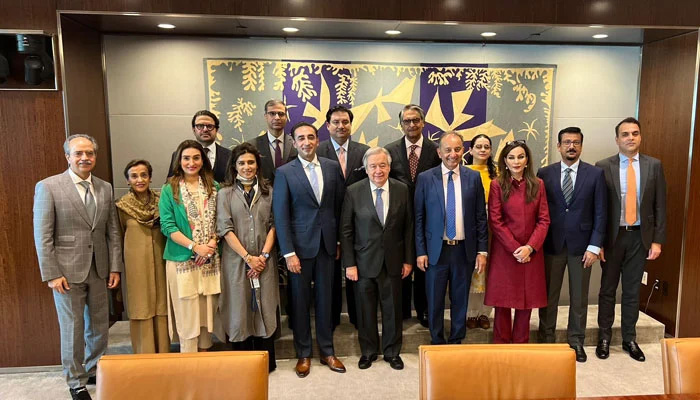
NEW YORK/ISLAMABAD: Bilawal Bhutto has informed the Secretary-General of the United Nations António Guterres that India’s unilateral military actions, including deliberate attacks on civilians leading to killings and death of civilians and damage to civilian infrastructure and the arbitrary holding in abeyance of the Indus Water Treaty, represented a dangerous escalation that risked destabilizing the entire region.
The communication took place during meeting of a high-level parliamentary delegation of Pakistan, led by Chairman of the Pakistan People’s Party Bilawal Bhutto Zardari, with the Secretary-General of the United Nations António Guterres, at UN Headquarters in New York on Tuesday.
The meeting was part of Pakistan’s ongoing diplomatic outreach following the recent Indian military provocations and escalating regional tensions. During the meeting, Bilawal Bhutto Zardari presented a letter of the Prime Minister Shehbaz Sharif to the Secretary-General United Nations. He commended the secretary-general’s efforts and statements on the importance of restraint, dialogue and diplomacy. Bilawal Bhutto briefed the secretary-general on Pakistan’s position in the aftermath of the Pahalgam attack of April 22. He categorically rejected India’s baseless and premature allegations against Pakistan, made without any credible investigation or evidence.
Bilawal underscored Pakistan’s mature, responsible, and restrained conduct in the face of grave provocations, reaffirming its commitment to international law and the principles enshrined in the UN Charter, including the right to self-defense. He warned against India’s attempts to establish a dangerous “new normal” marked by impunity, unilateralism, and the use of force, which risks triggering a broader conflict in a nuclearized region.
Bilawal asked the secretary-general to continue playing a proactive role in promoting de-escalation and facilitating dialogue between Pakistan and India. He urged the Secretary-General to use his good offices to help defuse tensions, restore the normal functioning of the Indus Waters Treaty, and promote a comprehensive dialogue between Pakistan and India — particularly on the Jammu and Kashmir dispute, which remains central to ensuring lasting peace in South Asia.
The delegation also briefed the secretary general on the humanitarian implications of holding in abeyance of the Indus Water Treaty, India’s unprovoked aggression and violation of UN Charter and International law. It was regrettable that water war was being imposed on Pakistan, Bilawal said.
Secretary-General UN António Guterres welcomed Pakistan’s desire for peace and reaffirmed the United Nations’ strong interest in the preservation of peace, restraint, and diplomacy in the region. He reiterated the UN’s commitment to supporting all efforts aimed at de-escalation and peaceful resolution of disputes through dialogue, in accordance with the principles of the UN Charter and relevant Security Council resolutions.
The secretary-general assured the delegation that the United Nations remains fully engaged in promoting peace and stability in South Asia and would continue to support all efforts to reduce tensions and resolve dispute.
Earlier, speaking at a press conference at the United Nations Headquarters, Bilawal Bhutto Zardari emphasized that sustainable peace with India can be achieved through unconditional dialogue and diplomacy and ruled out accepting any preconditions for talks.
Chairman PPP Bilawal Bhutto Zardari said that while Pakistan seeks peace, it will not accept any preconditions for dialogue.
He also criticized India for levelling baseless allegations against Pakistan in connection with the Pahalgam incident without any investigation or evidence. He said Prime Minister Shehbaz Sharif offered India a transparent investigation into the matter, because we were confident that our hands were clean, yet New Delhi chose to act with hostility. “India has violated our territorial integrity and targeted innocent civilians,” he said. “It has demolished mosques and is actively involved in promoting terrorism in Balochistan and Khyber Pakhtunkhwa.”
He said during recent hostilities, Pakistan had the capability to down 20 Indian fighter jets but deliberately chose to bring down only six, showing restraint. Reaffirming Pakistan’s unwavering condemnation of terrorism, Bilawal pointed out the country has suffered the most due to terrorism, including the assassination of his own mother, former Prime Minister Benazir Bhutto. “Terrorism should not be used as a political weapon,” he warned. “Recent tensions show how quickly matters can escalate between two nuclear-armed neighbours. The role of the international community, including the US president, was crucial in averting further escalation.” He held India’s policies responsible for regional instability, stating that unresolved issues like Kashmir lie at the heart of Indo-Pak tensions. “India used Israeli drones during its aggression against Pakistan. Its alliance with Tel Aviv is also reflected in similar approaches, including human rights violations and disregard for international laws,” Bilawal said, drawing parallels between Indian Prime Minister Narendra Modi and Israeli Prime Minister Benjamin Netanyahu. “Modi seems to be a political copy of Netanyahu. Both promote extremism and hatred, becoming the biggest roadblocks to peace in the region,” he said. He condemned India’s violation of the Indus Waters Treaty and questioned global silence: “If a nation’s lifeline is cut off, what should the reaction be?” Bilawal said Modi now aims to strangle the Indus Valley Civilization by attempting to block water flows to Pakistan —a clear violation of international agreements. “We will not allow water to be used as a weapon,” Bilawal declared “How can we remain silent if India tries to cut off Pakistan’s water?” he questioned.
Bilawal said Indian Prime Minister Narendra Modi of becoming “the butcher of Kashmir” after “being the butcher of Gujarat.” He criticized India for spreading fake news and misinformation both during and after the conflict. Earlier in the day, the high-level Pakistani parliamentary delegation, led by PPP Chairman and former foreign minister, Bilawal Bhutto Zardari on Tuesday emphasized the United Nations Security Council (UNSC) to play its crucial role to ensure peace and conflict resolution in the face of a growing trend of unilateralism and escalation.
The delegation held a meeting with the President of the UNSC for the month of June, Ambassador Carolyn Rodrigues-Birkett, Permanent Representative of the Republic of Guyana.
The meeting was part of Pakistan’s sustained diplomatic outreach to brief key UN stakeholders on the alarming regional situation following recent Indian provocations and blatant aggression.
The delegation urged the Council to play a proactive role in promoting de-escalation, ensuring respect for international law and treaties and facilitating peaceful resolution of the disputes, including the Jammu and Kashmir dispute in line with the Security Council resolutions.
Bilawal conveyed Pakistan’s deep concern over India’s baseless allegations following the Pahalgam attack, which he said were made without any credible investigation or substantiated evidence. He condemned India’s unilateral military actions, including deliberate strikes on civilians and civilian infrastructure, and the arbitrary holding in abeyance of the Indus Water Treaty — a move that he said dangerously weaponizes a vital natural resource and undermines international treaties with implications for regional peace and security.
He stressed that Pakistan condemns terrorism in all its forms and manifestations, adding that Pakistan is one of the biggest victims of terrorism itself. He underscored that a terrorist incident should not be used as a pretext for unilateral and illegal actions that threaten peace and security in South Asia.Bilawal Bhutto reiterated Pakistan’s call for holding ceasefire, resumption of the normal functioning of the Indus Water Treaty, and the initiation of a comprehensive dialogue with India, centered on the resolution of the Jammu and Kashmir dispute.
The President of the Security Council, Ambassador Rodrigues-Birkett reaffirmed the Security Council’s commitment to upholding international peace and security in line with its mandate. The high-level Pakistani parliamentary delegation briefed members of the Organization of Islamic Cooperation (OIC) at the UN on the grave developments in South Asia following India’s military aggression.
Addressing the OIC Permanent Representatives, Bilawal categorically rejected India’s attempt to link Pakistan to the Pahalgam incident without any credible investigation or evidence, according to a press release issued by Pakistan Mission to the UN. He also highlighted that the hasty attribution of blame was used as a pretext for unlawful military actions, including cross-border strikes, which targeted civilians and civilian infrastructure.
Bilawal expressed grave concern at the unilateral suspension of the Indus Waters Treaty — a move that Pakistan considers a blatant act of weaponizing water and a violation of international and treaty obligations. He made it clear that Pakistan cannot allow this to become a new normal. He stressed that due to India’s belligerent aggression, the world had become a less safe place, with real and present implications for peace and security in South Asia.Thanking the OIC countries for their role at de-escalation, mediation and ceasefire, Bilawal underscored that the only path to peace is dialogue, engagement and diplomacy.
Reaffirming Pakistan’s commitment to peace, restraint, and diplomacy, he called for the restoration of the Indus Waters Treaty, full respect for the ceasefire, and the resumption of a comprehensive dialogue with India, with the resolution of the Jammu and Kashmir dispute at its core.
They reiterated their concern over the worsening security situation in South Asia and stressed the importance of upholding the sanctity of treaties, including the Indus Water Treaty. The OIC countries welcomed Pakistan’s commitment to dialogue and diplomacy for the resolution of all disputes, including the Jammu and Kashmir dispute, in accordance with the UN Security Council resolutions.
In a a meeting with the acting US Ambassador to the UN, Dorothy Shea, the PPP chairman urged the United States to play its role in ensuring comprehensive dialogue between India and Pakistan to address all outstanding issues. In this regard, Bilawal, also underscored the need for dealing with India’s move to hold in abeyance the Indus Water Treaty, saying it amounted to the weaponization of water, according to a press release of the Pakistan Mission to the UN. During the meeting, Bilawal expressed gratitude to the US Administration, in particular President Donald Trump for facilitating the ceasefire between Pakistan and India. He briefed Ambassador Shea on the developments following the Pahalgam attack of April 22, expressing deep concern over India’s immediate attribution of blame to Pakistan without any credible investigation or verifiable evidence. Pakistan, he said, had been at the forefront in the fight against terrorism and has made big sacrifices in this fight.
The delegation also met the President of the General Assembly, Philemon Yang. Bilawal Bhutto Zardari apprised the president of the deteriorating regional security situation. Underscoring Pakistan’s principled approach of restraint and responsibility, Bilawal Bhutto-Zardari reaffirmed the country’s commitment to peace, regional stability, and multilateralism. He emphasized that sustainable peace in South Asia cannot be achieved without a just and peaceful settlement of the Jammu and Kashmir dispute, in accordance with the UN Charter and relevant Security Council resolutions.
Meanwhile, Vice President Pakistan People’s Party and Parliamentary leader of the PPP in the Senate Senator Sherry Rehman said Pakistan’s principled and responsible position is gaining traction across key international forums. Speaking through video message from New York as part of Pakistan’s high-level diplomatic delegation, Senator Rehman shared that Chairman Bilawal and the delegation have held meetings with China, Russia, the United States, members of the E10. “Bilawal spoke about Pakistan’s strategic restraint, addressed concerns over Indus Waters Treaty.”
She emphasized that Bilawal raised Kashmir as the core issue and stated unequivocally that if we truly desire lasting peace then the resolution of the Kashmir issue is essential.
Sherry stressed that Bilawal emphasised multilateralism and the international legal frameworks and military codes that are being flagrantly violated in Modi’s India. On terrorism, Bilawal made it clear that since the martyrdom of Shaheed Mohtarma Benazir Bhutto, Pakistan has become a frontline state in the fight against terrorism. Bilawal also called out India’s politics of propaganda, misinformation, and constant vilification of Pakistan, calling it unsustainable and dangerous, she said. The PPP Chairman asked “Why this ‘new India is targeting minorities, particularly Muslims, at home, while promoting hostility abroad?”
In a related development, Special Assistant to the Prime Minister (SAPM), Syed Tariq Fatemi, called on Russian Foreign Minister Sergey Lavrov in Moscow. The SAPM conveyed prime minister’s warm greetings and reiterated the Pakistani leadership’s commitment to deepening bilateral cooperation with Russia across various sectors, including energy, connectivity, and trade.
Fatemi also provided a detailed briefing on recent developments in South Asia, outlining Pakistan’s concerns regarding regional escalation risks. In particular, he highlighted the serious implications of India’s threat to disrupt the Indus Waters Treaty by declaring it in so-called “abeyance.”
Foreign Minister Lavrov expressed satisfaction with the steady growth in bilateral cooperation, underscoring key collaborative projects such as the establishment of new Steel Mills and critical connectivity initiatives. He reaffirmed Russia’s eagerness to strengthen ties with Pakistan within the framework of the Shanghai Cooperation Organization, particularly in the area of counter-terrorism.Regarding Pakistan-India relations, Foreign Minister Lavrov emphasized Russia’s support for the normalization of ties between the two countries, noting its positive impact on regional stability. Before concluding the meeting, the SAPM hand-delivered a letter from Prime Minister Shahbaz Sharif to President Vladimir Putin. In a significant diplomatic development Russia announced its support for normalization of ties between Pakistan and India without siding with its old associate, India. The announcement came during the meeting of Special Assistant to Prime Minister (SAPM)/ State Minister Syed Tariq Fatemi with Russian Foreign Minister Sergey Lavrov.


