
Judges transfer case: Info kept secret, only revealed during process, SC told
Justice Mazhar says CJs of three high courts are involved in transfer process and not everything was in hands of executive
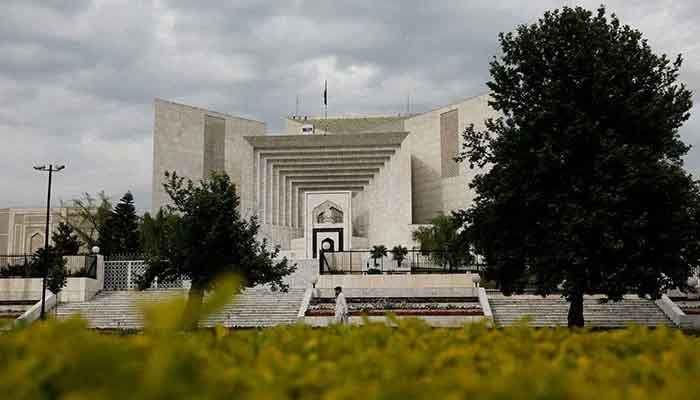
ISLAMABAD: The counsel for five Islamabad High Court (IHC) judges informed the Supreme Court on Thursday that information was concealed and was provided only during the process of transferring judges from various high courts to the IHC.
A five-member Constitutional Bench of the apex court, headed by Justice Muhammad Ali Mazhar, heard identical petitions filed by the IHC judges challenging the transfer of judges to the IHC as well as the seniority issue of judges.
On Thursday, Barrister Salahuddin Ahmed, representing the IHC judges, argued in his rebuttal that meaningful consultation is essential for transferring a judge to another high court, adding that without it, the process is merely symbolic.
He also alleged that information was concealed and was provided during the transfer process.
Justice Mazhar observed that the matter involves constitutional and legal interpretation, noting that the chief justices of three high courts were involved in the transfer process and not everything was in the hands of the executive.
The judge also pointed out that consent is typically sought from judges being transferred.
Barrister Salahuddin highlighted that the summary claimed only one judge from Punjab was appointed to the IHC, whereas there are currently three judges from Punjab serving there, suggesting possible bad faith in the process.
He submitted that all principles related to judges’ seniority in Pakistan are derived from court decisions, adding that while there are three judicial precedents available—though none are actual case laws—they emphasise past practices, guidance from civil service rules, and transparency.
Salahuddin argued that civil service rules state if two judges are appointed on the same day, seniority is determined by age. Justice Mazhar noted that this principle also applies to the judiciary.
Barrister Salahuddin agreed but pointed out that such principles are not explicitly stated in the law or Constitution, only in court decisions. Justice Mazhar questioned whether a judge brings his service book upon transfer and whether the transfer is temporary or permanent. Salahuddin replied that while a judge brings his service record for benefits or pension purposes, a new oath is taken upon transfer, which determines seniority. The counsel contended that transferring a judge to another high court does not render the original seat vacant and that a permanent transfer would nullify Article 175A of the Constitution. He argued that historically, there is no precedent for the permanent transfer of a judge from one high court to another.
Justice Mazhar acknowledged that the case is the first of its kind.
Salahuddin added that under Article 200, only a temporary transfer is permitted, while a permanent appointment must be made by the Judicial Commission of Pakistan.
Justice Mazhar responded that while Article 175A allows new appointments, appointments and transfers are distinct concepts.
The court adjourned further hearings until June 16, when Barrister Salahuddin will continue his rebuttal arguments. Justice Muhammad Ali Mazhar remarked that if the hearing concludes on June 16, a short order will be issued after consultation with the judges.







-
 Lawyer Of Epstein Victims Speaks Out Directly To King Charles, Prince William, Kate Middleton
 -
 Microsoft CEO Shares How Gates Doubted $1bn OpenAI Investment
 -
 Milo Ventimiglia Calls Fatherhood 'pretty Wild Experience' As He Expects Second Baby With Wife Jarah Mariano
 -
 Chinese Scientists Unveil Advanced AI Model To Support Deep-space Exploration
 -
 Anthropic’s New AI Tool Wipes Billions Off Cybersecurity Stocks
 -
 Trump Announces He Is Sending A Hospital Ship To Greenland Amid Rising Diplomatic Tensions
 -
 'Never Have I Ever' Star Maitreyi Ramakrishnan Lifts The Lid On How She Avoids Drama At Coffee Shops Due To Her Name
 -
 Inside Prince William’s Plans For Prince Harry: What Will Happen To Duke Once He’s King
 -
 Chyler Leigh Pays Moving Homage To 'Grey’s Anatomy' Co-star Eric Dane: 'He Was Amazing'
 -
 Did You Know Tech CEOs Limit Screen Time For Their Own Kids?
 -
 Matthew Lillard Admits Fashion Trends Are Not His 'forte'
 -
 SpaceX Launches Another Batch Of Satellites From Cape Canaveral During Late-night Mission On Saturday
 -
 Princess Beatrice, Eugenie Get Pulled Into Parents’ Epstein Row: ‘At Least Stop Clinging!’
 -
 Inside Kim Kardashian's Brain Aneurysm Diagnosis
 -
 Farmers Turn Down Millions As AI Data Centres Target Rural Land
 -
 Trump Announces A Rise In Global Tariffs To 15% In Response To Court Ruling, As Trade Tensions Intensify