
Modi’s religious nationalism as foreign policy
Pakistan should not remain under any illusion about threat posed by India: it is serious, strategic and enduring in nature
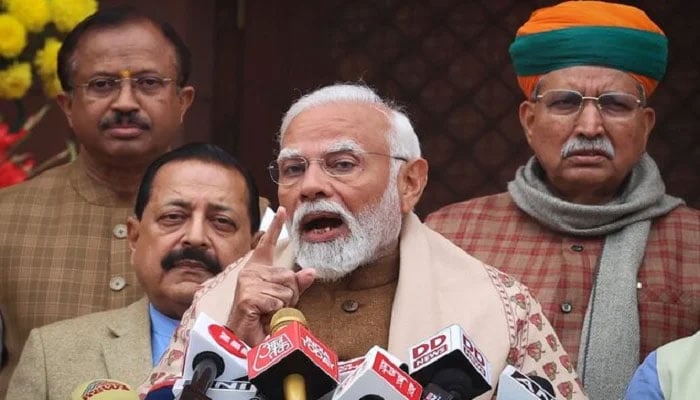
The unprovoked air attack launched by a hegemonic and Hindutva-driven India against Pakistan in the early hours of May 7 and its subsequent hostile acts against the latter’s sovereignty and territorial integrity have once again driven home the serious threat that it poses to Pakistan’s security and economic well-being.
Pakistan’s political leadership and armed forces deserve credit for responding befittingly to the Indian aggression, leading to a ceasefire on 10 May. However, Pakistan’s policymakers must understand the true nature of the threat posed by India and adopt an appropriate mix of policies to overcome it.
By now, it is generally recognised that India’s overarching strategic goal is to establish its hegemony in South Asia and the Indian Ocean regions. It is doubtful that the debacle India recently suffered in its clashes with Pakistan will persuade it to give up this goal, which is indirectly supported by the Indo-US strategic partnership to contain China. India views Pakistan as the greatest obstacle to the realisation of its hegemonic ambitions in South Asia. This factor has been and is likely to remain at the core of the tensions and disputes between the two countries for the foreseeable future.
The growing sway of Hindutva in Indian society under the Modi-led BJP has not only resulted in the persecution of Muslims, Christians and other minorities in that country but has also added elements of religious animosity and belligerence in India’s relations with a Muslim-majority Pakistan. This is not surprising considering Modi’s anti-Muslim track record, including the large-scale massacre of Muslims in 2002 during his tenure as chief minister of Gujarat and his lifelong commitment to RSS, a Hindu militant organisation with a strong anti-Muslim bias.
It is also worth mentioning that there is an inherent ideological contradiction between an impregnable caste system barring vertical mobility and Muslim ideals of social egalitarianism and human brotherhood. These cultural differences will continue to cast their shadow on Pakistan-India relations as long as Hindutva remains a potent force in the Indian body politic.
Kashmir, the Indus Waters Treaty, and other outstanding Pakistan-India disputes have their own adverse impact on the relations between these two countries. Under Modi’s rule, the Kashmir dispute, because of the extreme steps taken by the Indian government on August 5, 2019, is further away from a settlement than it has ever been. As for the Indus Waters Treaty, by suspending it unilaterally and illegally, India has further aggravated the tensions between the two countries. The government of Pakistan has rightly warned India that any attempt by it to stop or divert its share of river waters will be considered as an act of war.
India’s sponsorship of acts of terrorism in Balochistan and our tribal areas on a massive scale has added another potent adverse element to the toxic mixture of tensions and conflicts between the two countries. We also need to remember that Pakistan’s location at the faultline between the Islamic and Hindu civilisations will have its own adverse effects on Pakistan-India relations as elaborated by Huntington in his book,’“The Clash of Civilizations and the Remaking of World Order’.
Pakistan should not remain under any illusion about the threat posed by India: it is serious, strategic and enduring in nature. Despite temporary ups and downs in Pakistan-India relations depending upon the nature of the government in New Delhi, the Indian threat to Pakistan will remain a long-term challenge for Pakistan. Obviously, Pakistan must maintain a credible security deterrent, including its nuclear capability, to ward off any immediate threat to its security while engaging India in a dialogue to defuse tensions, adopt CBMs and try to resolve outstanding disputes.
But as Paul Kennedy stressed in his famous book, ‘The Rise and Fall of the Great Powers’, any long-term contest between nations, as in the case of Pakistan and India, is ultimately decided by the balance of economic power. The Soviet Union collapsed not because of the shortage of conventional or nuclear weaponry but because of its economic weakness. Its weak economic foundation simply could not sustain its heavy military superstructure, leading to its disintegration.
Therefore, considering the enduring and serious nature of the security threat posed by India, Pakistan's economic and technological strength and scientific advancement will play the decisive role in determining the outcome of the long-term contest between the two countries. The main challenge confronting the government of Pakistan in the face of the long-term threat posed by India is to strike the right balance between the requirements of a credible security deterrent to ward off short-term threats to its security as against the need to accelerate economic and technological development and scientific advancement to meet the compulsions of long-term security.
One should examine the pros and cons of geoeconomics in Pakistan’s foreign policy against the background of the foregoing considerations. Although there is no widely accepted singular definition of geoeconomics, it is generally understood to refer to the use of geography and economic tools to promote national interests. The underlying assumption of the proponents of geoeconomics is that the logic of mutually beneficial commerce separates market dynamics from geopolitical compulsions.
There is a degree of validity in the assumption that economic and commercial interdependence in some cases, can help tame political tensions. But as the historical evidence and the recent developments between the US and China clearly demonstrate, in the ultimate analysis, geopolitical compulsions invariably trump geoeconomic considerations. During my tenure as the Pakistan ambassador to Iran (1997-2003), I recall that India withdrew from the Iran-Pakistan-India gas pipeline project because of political considerations. Thereafter, it was renamed as the Iran-Pakistan gas pipeline project.
Unfortunately, the proponents of geoeconomics in Pakistan in their enthusiasm, inspired in some cases by the US, for economic and commercial cooperation with India overlooked the contradictions between their recommendations and the above-mentioned geopolitical compulsions governing Pakistan-India relations.
Ironically, while advocating free trade and economic cooperation with India, some analysts were busy casting aspersions on CPEC. They also overlooked the fact that, according to economic analysis, in any scheme of regional economic integration, the bigger and more advanced economy tends to dominate the smaller and less advanced ones. As for the US, for obvious strategic reasons, it saw no contradiction in its advocacy of a liberal trade regime between Pakistan and India while opposing CPEC and the Iran-Pakistan gas pipeline project.
Ideally, trade between Pakistan and India should take place only if it is on a level playing field and positively impacts the growth and development of Pakistan’s economy as a whole and its critically important sectors. Of course, the decision on the resumption of Pakistan-India trade will have to be closely aligned with the strategic realities governing their relations.
As for regional economic integration, Pakistan should focus on countries to its west and north within the framework of the Economic Cooperation Organization rather than India.
The writer is a retired ambassador and author of ‘Pakistan and a World in Disorder – A Grand Strategy for the Twenty-First Century’. He can be reached at: javid.husain@gmail.com


