
Comment: Pakistan’s military strategy gets global validation
In stark contrast, 87-hour conflict triggered severe crisis of confidence within Indian Air Force (IAF)
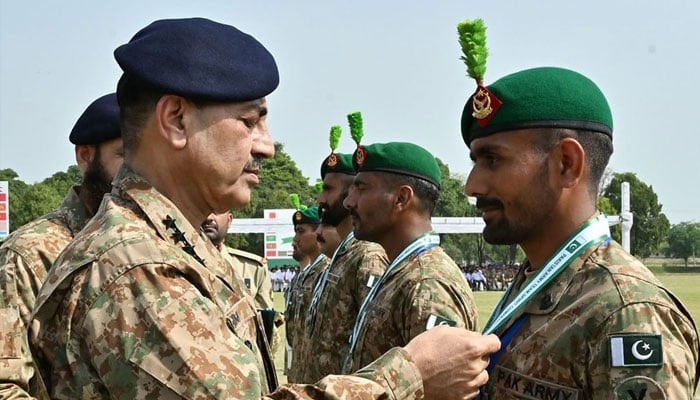
In just 87 hours and 25 minutes, Pakistan’s military rewrote the rules of modern warfare. Confronting the world’s second-largest army -- with $70 billion in procurements over two decades -- and an air force that spent $50 billion on advanced platforms, the Pakistan Armed Forces delivered three decisive outcomes: strategic precision, technological dominance, and calibrated deterrence.
The 87-hour conflict was not merely a battlefield victory for Pakistan’s military; it was a global validation of three pillars: its military doctrine, its procurement strategy, and its integration of 21st-century warfare technologies.
In stark contrast, the 87-hour conflict triggered a severe crisis of confidence within the Indian Air Force (IAF). The $16.2 billion investment in Rafale aircraft -- touted as symbols of air superiority -- has exposed five glaring vulnerabilities: a flawed aerial doctrine, inadequate operational readiness, lack of pilot training realism, politically driven procurement decisions, and a preference for prestige platforms over combat-proven capabilities.
Most notably, Pakistan’s ability to detect, track, and destroy high-value targets such as Rafale jets demonstrates that its entire kill chain -- radar, data link, ECM, and missile launch -- is functioning cohesively and effectively.
This reflects a fundamental shift: Pakistan’s armed forces have evolved from a platform-centric mindset to a system-centric model of warfare, while India’s military remains largely trapped in the prestige-driven pursuit of hardware dominance without the supporting ecosystem.
PAF’s forward deployment of J-10Cs armed with PL-15s, beyond-visual-range air-to-air missiles (BVRAAM), gave the PAF air dominance beyond visual range. The battlefield success of this combination not only exposed the limitations of India’s airpower but also validated Pakistan’s strategic shift toward high-impact, cost-effective, and networked warfare.
In the largest air battle since World War II, Pakistan also managed to dominate the electromagnetic spectrum through the effective use of KORAL ECM systems to jam, confuse, and suppress India’s radar installations. Yet another clear validation of Pakistan’s overall military strategy.
The neutralisation of a dozen Indian drones through a layered defenc -- integrating anti-aircraft artillery, short-range surface-to-air missiles and electronic countermeasures -- demonstrates that Pakistan had not only anticipated the future of drone swarms, but had invested in a multi-tiered response system capable of countering next-generation threats.
Finally, Pakistan’s measured response, avoiding civilian targets, demonstrates a strategy focused on controlled escalation. This helped maintain international support and denied India a moral high ground.
In 87 hours, Pakistan did more than win a battle; it shattered myths, recalibrated regional deterrence, and proved that a smart military strategy can outmatch sheer size. The 87-hour conflict will be remembered not for what India lost, but for what Pakistan’s military decisively gained: global validation of a doctrine rooted in precision, integration, and strategic maturity.


