
Modi’s war agenda
On night of May 7, Indian armed forces launched unprovoked assault
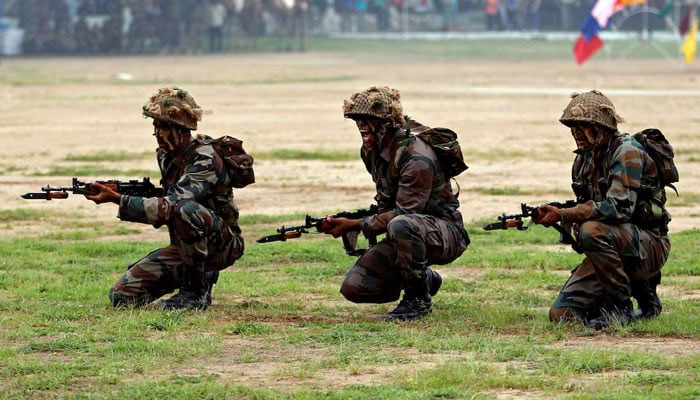
The latest warmongering antics from Indian Prime Minister Narendra Modi are not rooted in strength or strategy but in desperation. They stem from a political playbook drenched in paranoia and populism.
When a country drapes its insecurities in the tricolour and sends its troops across borders without military foresight, it’s not valour but vanity. On the night of May 7, Indian armed forces launched an unprovoked assault. Under the false pretence of targeting religious seminaries allegedly harbouring militants, Indian warplanes violated international law and moral decency by striking residential areas.
This was not just a tactical miscalculation, but a strategic self-humiliation. The Modi-led government, intoxicated by ultranationalist fervour, decided to raise the stakes far beyond rhetoric. This reckless aggression was a catastrophic misreading of military balance and regional stability. And while India hoped to whip up a storm of patriotic hysteria to cover its internal failures, particularly in Indian Illegally Occupied Jammu and Kashmir (IIOJK), it underestimated the cost of rousing a neighbour whose military readiness doesn’t rely on loud declarations, but on results.
It is crucial to understand that this latest confrontation is not a one-off anomaly but part of a calculated pattern. Since Narendra Modi assumed office, India's posture towards Pakistan has shifted from hostility to outright recklessness. The 2019 Balakot episode, which ended with a humiliating downing of an Indian jet and the capture of its pilot, should have taught New Delhi restraint. Yet, Modi’s strategy has remained addicted to provocation. Whether it’s altering the constitutional status of Occupied Kashmir, suppressing dissent with brute force or staging theatrical airstrikes, India has continuously chosen the path of escalation.
Despite repeated calls from Islamabad for evidence linking Pakistan to the Pahalgam attack, New Delhi failed to provide even a single shred of verifiable proof. Instead, it chose to fan the flames of war hysteria to distract from its increasing human rights violations in IIOJK and the crumbling edifice of its internal governance.
But in the game of brinkmanship, there's a thin line between calculated risk and suicidal arrogance. Modi’s miscalculation met with a swift and decisive answer. Pakistan’s military response was a show of unflinching precision.
In a retaliatory operation carried out within hours, the Pakistan Air Force struck back hard. Five Indian aircraft, three Rafale fighter jets, one Su-30mki, and one Mig-29 Fulcrum were obliterated. These are not obsolete relics of the past; they represent the core of India’s modern aerial strike capability. The Rafale, in particular, boasts advanced avionics, stealth features and multi-role adaptability. That such technologically superior jets were brought down speaks volumes about Pakistan’s air defence systems, radar architecture and command coherence. It is a reality check for Indian defence planners, who have been lulled into overconfidence by glitzy procurement deals and media-fueled bravado.
The ISPR DG had clearly warned India of dire consequences in case of any misadventure. New Delhi ignored that warning, only to be met with an ironclad demonstration of military might. The message was unambiguous: Pakistan does not seek conflict, but it is always prepared to defend its sovereignty with force and finesse.
The reverberations of Pakistan’s counterstrike weren’t limited to the air. Along the Line of Control (LoC), Indian military posts were decimated in pinpoint attacks. These were not impulsive retaliations; they were well-calibrated strategic responses designed to impose a cost without triggering full-scale escalation.
Pakistan’s Defence Minister Khawaja Asif encapsulated the state’s position with clarity and resolve: “We have consistently maintained over the past fortnight that Pakistan will not initiate any hostility. However, if attacked, we will respond decisively.” Pakistan’s precise retaliation and offer to de-escalate reflect mature military leadership, unlike India’s reckless theatrics and humiliating white-flag surrender in Leepa Valley. Modi’s political bravado clearly outweighs his grasp of military reality turning a political stunt into a credibility crisis.
India’s strikes violate international law and the UN Charter, risking regional stability by bypassing diplomacy and evidence. While New Delhi courts chaos, Pakistan stands firm with restraint and readiness. Its calibrated military response and diplomatic overtures for peace reflect a maturity missing in New Delhi’s belligerent tone.
The international community must now confront a sobering question: how long will it allow a nuclear-armed state like India to weaponise fiction, fan communal tensions, and destabilise an already fragile region for electoral gains? The threat is not just to Pakistan, but to regional peace and global security. And the answer must come not only through military preparedness but through sustained diplomatic pressure on India to cease its warmongering and return to the table of reason.
This is more than a military standoff; it is a clash of ideologies. India fuels war to hide failure; Pakistan answers provocation with discipline, proof, and strategic clarity. Behind Indian media’s bluster lies the exposed fragility of its military theatrics. The world must now acknowledge that Pakistan has not only demonstrated superior military capability but also a more mature geopolitical vision. In the end, war is not won by the loudest rhetoric but by the quiet force of precision, preparedness and principle. And in that contest, Modi’s bluster has met its match.
The writer is a freelance contributor and writes on issues concerning national and regional security. She can be reached at: omayaimen333@gmail.com


