
Freedom in decline
Without viable answer to economic difficulties of independent press, its freedom will continue to decline
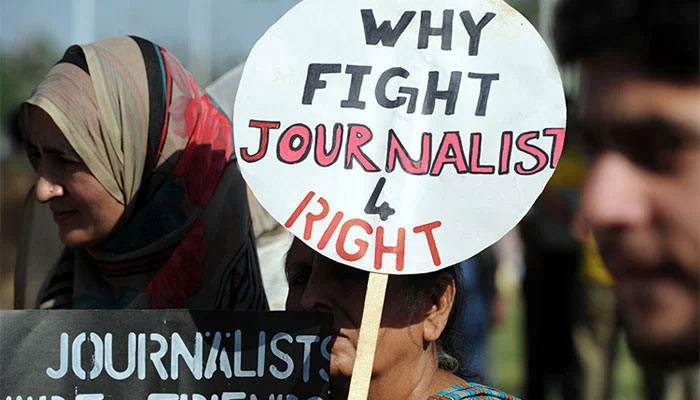
Today marks the 32nd annual World Press Freedom Day and the theme for this year focuses on ‘Freedom of expression in the face of the AI revolution’. Experts acknowledge that AI can help support freedom of expression by making information easier to access and can also help media organisations by automating tasks, making them more efficient. But at the same time, the International Federation of Journalists (IFJ) has urged media to prioritise ethical use of AI in journalism, stressing that AI must support, not replace, human journalists, and calling for stronger dialogue to ensure AI use protects press freedom, jobs and editorial integrity. The UN has also noted that, despite the financial potential of AI, the financial health of many media outlets is weakening. This is something most journalists in Pakistan will be intimately familiar with. Without the ability of those working in the media to effectively and independently monetise their work and make a living, how can there be a free press/media? Sadly, the existential financial challenge that the free press faces is only a boon to those seeking to turn journalism into a mouthpiece for the powerful – and there appear to be more such types in power across the globe than ever before.
According to the Freedom Network’s annual Freedom of Expression and Media Freedom Report 2025, the Pakistani media now faces an existential threat amidst an increasingly restrictive environment, deteriorating safety and job security and significant challenges to professional integrity of media and its practitioners. The report points to the role of the amendments made to the Peca law in January as playing a major role in the current crisis by making it easier for the authorities to arrest, fine and jail journalists. As such, Pakistani journalists face an environment where they are increasingly unable to pay their bills, have declining job security and operate in a legal climate that makes it easier than ever before for the state to punish them for simply doing their job. The costs of the free press are only climbing and the rewards are fast diminishing. And the problem is a global one. Even states that were once seen as champions of the press and free expression are now becoming increasingly hostile to journalists. The US and India are two of the most notable examples. The former is defunding public news organisations at a time when media organisations are shutting down at an unprecedented rate. In the latter, a highly concentrated media ownership, often with close ties to the business and political worlds, has put press freedom in crisis since the rise of Indian Prime Minister Narendra Modi in 2014. Freedom to write what one wants and hold the powerful to account requires being off the latter’s payroll, a power that an increasingly few number of journalists have.
As such, the RSF has, for the first time ever, classified the state of global press freedom as in a ‘difficult situation’ and it now rates conditions for journalism as ‘poor’ in half the world’s countries. This, of course, includes Pakistan, which ranks 158th out of 180 countries on the RSF index. This puts freedom of the press in quite a tricky situation. If it were just a question of bad and authoritarian laws, the solution would simply be repealing those laws. But how does one solve the broader economic problem of journalism which makes it unprofitable to engage in and more vulnerable to coercive financial power? A publicly-financed model would be one answer but as the Trump onslaught shows, what is given by the state can be taken away, leaving the press helpless, and a government that financially controls the media can also bend it to its will. Without a viable answer to the economic difficulties of the independent press, its freedom will continue to decline.


