
Sindh govt, WFP to co-finance Rs578m school meals project
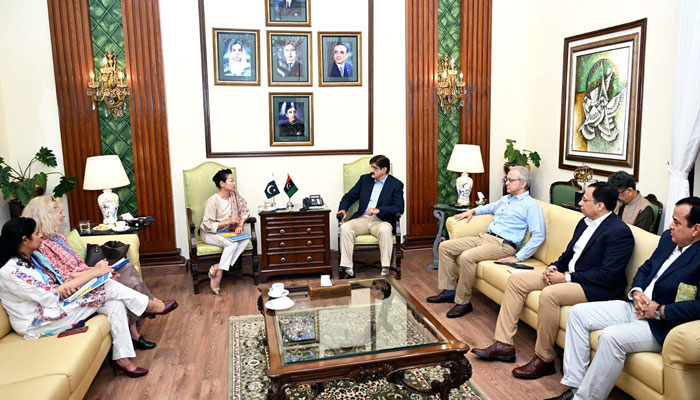
The Sindh government and the World Food Programme (WFP) on Thursday decided to co-finance a one-year pilot project to provide daily meals to 11,000 District Malir primary school students up to the fifth grade to help improve their learning, attendance and nutrition.
The meeting between Chief Minister Syed Murad Ali Shah and WFP Country Director Coco Ushiyama at the CM House focused on enhancing ongoing initiatives such as the Nashonuma and Mamta programmes, and decided on a joint effort to combat malnutrition and improve school retention through a new school feeding scheme.
Coco provided an overview of the WFP’s current programmes in Sindh, with a special emphasis on maternal & child nutrition. She discussed stunting, wasting, conditional cash transfers (CCTs) and food supplement distribution to address malnutrition.
Shah expressed appreciation for the WFP’s contributions, and shared details of his government’s health-focused initiatives like supporting pregnant and lactating women, and children suffering from malnutrition, through two major programmes: the federal Benazir Income Support Programme’s Nashonuma initiative, and the provincial Mother & Child Support Programme (Mamta).
The meeting also addressed concerns regarding the perceived duplication between the two programmes. It was concluded that while some overlaps exist, the designs of the two programmes are largely complementary. Nashonuma targets beneficiaries through the national Kafalat registry, while Mamta allows for self-enrolment across 15 Sindh districts.
It was agreed that given their shared goal of improving maternal & child health among the ultra-poor, both initiatives should continue. While Nashonuma is focused primarily on food supplements, Mamta emphasises financial support through CCTs.
To enhance coordination and reduce redundancy, three action points were established: revisiting the technical designs of both programmes to align conditionalities for inclusive service delivery; establishing a two-way data-sharing mechanism to identify overlaps, optimise resources and fill service gaps; and developing a joint enrolment and targeting framework to streamline beneficiary identification and service delivery.
The meeting between the provincial government and the WFP delegation also agreed to explore future joint interventions to address the impacts of climate change, particularly concerning Sindh’s vulnerable population.
School meals project
The Sindh government and the WFP will co-finance a one-year pilot of the school meals project in District Malir for the 2025-26 school year at Rs578.39 million. The programme aims to provide daily hot meals to 11,000 primary school students up to the fifth grade to improve learning, attendance and nutrition.
The Sindh government will contribute Rs462.71 million (80 per cent), and the WFP will provide Rs115.68 million (20 per cent). This initiative is designed to combat classroom hunger, enhance concentration and academic performance, and reduce gender disparities by incentivising girls’ education.
A centralised kitchen system will be established for meal preparation, packaging and distribution. The meals will include lentils, rice/bread, vegetables, and a weekly serving of fruit. The Sindh Food Authority, along with a dedicated food safety officer, will ensure hygiene and nutritional standards. The WFP will oversee implementation through a third-party contractor and will lead monitoring, evaluation and reporting.
The pilot will specifically target peri-urban schools in Malir that have basic infrastructure, clean water and sanitation facilities. The schools must also meet minimum student enrolment thresholds.
A robust monitoring system will track key metrics such as enrolment, retention and attendance to maintain 70 per cent daily attendance. The WFP will conduct baseline and end-line evaluations to inform potential scaling-up across Sindh. Data from the Education Management Information System and school records will be utilised to measure impact.
Shah emphasised that beyond educational benefits, the project is expected to reduce malnutrition, stimulate local job creation through food procurement, and strengthen community food systems. He also highlighted the programme’s potential to empower girls by providing targeted incentives and improving school participation.
“The pilot project will offer crucial insights into sustainable school meal delivery models, and guide future efforts for scaling up across Sindh,” the CM concluded.







-
 Hailey Bieber's Subtle Gesture For Eric Dane’s Family Revealed
 -
 Moment Prince William 'broke Down' And 'apologised' To Kate Middleton
 -
 Paul Mescal And Gracie Abrams Stun Fans, Making Their Romance Public At 2026 BAFTA
 -
 EU Rejects Any Rise In US Tariffs After Court Ruling, Says ‘a Deal Is A Deal’
 -
King Charles Congratulates Team GB Over Winter Olympics Success
-
 Meryl Streep Comeback In 'Mamma Mia 3' On The Cards? Studio Head Shares Promising Update
 -
 Woman Allegedly Used ChatGPT To Plan Murders Of Two Men, Police Say
 -
 UK Seeks ‘best Possible Deal’ With US As Tariff Threat Looms
 -
 Andrew Arrest Fallout: Princess Beatrice, Eugenie Face Demands Over Dropping Royal Titles
 -
 Rebecca Gayheart Breaks Silence After Eric Dane's Death
 -
 Kate Middleton 2026 BAFTA Dress Honours Queen Elizabeth Priceless Diamonds
 -
 Sterling K. Brown's Wife Ryan Michelle Bathe Reveals Initial Hesitation Before Taking On New Role
 -
 BAFTA Film Awards Winners: Complete List Of Winners
 -
 Millie Bobby Brown On Her Desire To Have A Big Brood With Husband Jake Bongiovi
 -
 Backstreet Boys Admit Aging Changed Everything Before Shows
 -
 Biographer Exposes Aftermath Of Meghan Markle’s Emotional Breakdown