
US tariffs represent risk to Pakistan’s medium-term outlook: State Bank
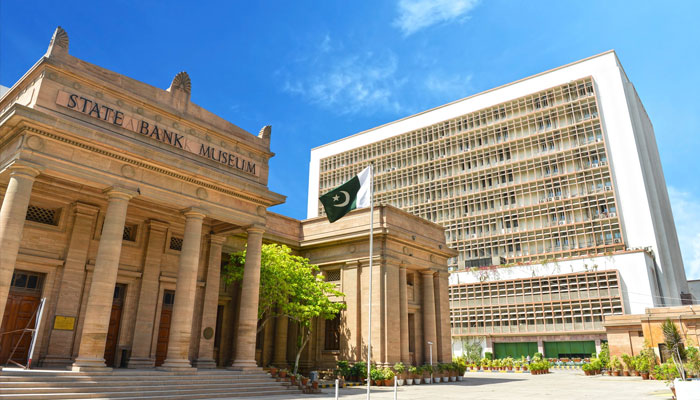
KARACHI: Pakistan’s central bank on Monday cautioned about risks to the country’s medium-term economic outlook due to uncertainties arising from global trade disruptions and associated commodity price volatility in the wake of US President Donald Trump’s tariffs.
Macroeconomic conditions however further improved in the first half of the current fiscal year, as inflation fell sharply, the current account balance turned into a surplus, and the fiscal deficit was contained to the lowest level since FY05, according to the State Bank of Pakistan’s half-yearly report for FY25 on the nation’s economy.
The favourable outcomes were mainly supported by calibrated monetary policy, fiscal consolidation, stable global commodity prices, and the approval of the IMF’s Extended Fund Facility (EFF) programme, the SBP said.
Recently, Fitch Ratings has upgraded Pakistan’s rating to ‘B-’ from ‘CCC+’. Islamabad is expecting disbursements of $2.3 billion in two separate loans from the IMF: approximately $1 billion as the second instalment of the $7 billion bailout secured last year and $1.3 billion under the Resilience and Sustainability Facility (RSF), pending approval by the IMF's executive board. Pakistan and the IMF reached a staff-level agreement last month on the first review of the EFF and a new arrangement, RSF.
In addition to the US tariffs, the SBP’s report said, the changing geopolitical situation, adjustments in administered energy prices, response of domestic aggregate demand to various fiscal measures, and spillover of movements in international currencies on the local currency pose threats to the nation’s economy.
Although Trump has temporarily halted the heaviest tariffs on nearly all trading partners, a 10 per cent blanket duty persists, with a 145 per cent tariff on China, the US’s largest trading partner.
“The macroeconomic outlook is contingent on how the global economic and political environment shapes up,” the report said.
“In this context, there are three prominent risks. First, the recent shift towards more protectionist trade policies has already begun to take effect,” it said.“These tariffs are impacting geopolitical contenders and key trading partners. Rising tariffs could disrupt trade and economic activity, having implications for EMDEs’ [emerging market and developing economies] exports and remittances and international commodity prices,” it added.
“Second, the possible spillovers of ongoing geopolitical conflicts to the global economy, in general, and commodity prices, in particular. Third is concerning the resurgence of inflation globally due to tariffs and potential supply-chain constraints and their implications for global financial conditions, which may adversely impact emerging economies.”
The report projects that real GDP growth for FY25 will be in the range of 2.5 per cent to 3.5 per cent. During meetings with global financial and investment institutions at the IMF-World Bank Spring Meetings in Washington last week, SBP Governor Jameel Ahmad stated that the country’s economy is gradually recovering and is expected to grow around 3.0 per cent this fiscal year.
Last week, the IMF revised Pakistan’s growth forecast for the current fiscal year, lowering it from 3.0 per cent to 2.6 per cent. The IMF has also cut its global growth forecast amid Trump's trade tariff measures.
The central bank stated that, due to a significant disinflationary trend and recent changes in food and energy prices -- both domestically and internationally -- the average inflation projection for FY25 is set at 5.5 per cent to 7.5 per cent. With an increase in projected growth for workers’ remittances, lower commodity prices, and ongoing momentum in exports, the current account balance for FY25 is anticipated to range from -0.5 per cent to 0.5 per cent of GDP. This balance is expected to provide a cushion against lower financial inflows and help strengthen external buffers, according to the report.
The SBP’s governor mentioned that the central bank has successfully built foreign exchange (FX) buffers through FX purchases, supported by a surplus in the external current account. The SBP aims to increase FX reserves to $14 billion by June 2025. Currently, the SBP’s reserves stand at $10.21 billion -- sufficient to cover two months of imports.
The report highlights that weak growth in labour productivity and total factor productivity has negatively impacted the country’s economic competitiveness over time, contributing to frequent boom-bust cycles. Therefore, it emphasises the importance of addressing macroeconomic and structural constraints to enhance productivity growth.







-
 Andrew Mountbatten-Windsor In A Fix Over New Disturbing TMZ Photos
 -
 Eric Dane Opened Up About Releasing His Memoir Just Two Months Before His Death Due To ALS Complications
 -
 Zendaya, Tom Holland Already Married? Actress Shows Off New Ring
 -
 King Charles Holds Emergency Meeting After Andrew Arrest: 'Abdication Is Not Happening'
 -
 Amazon Can Be Sued Over Sodium Nitrite Suicide Cases, US Court Rules
 -
 'Vikings' Star Mourns Eric Dane's Death
 -
 Patrick Dempsey Reveals Eric Dane's Condition In Final Days Before Death
 -
 'Heartbroken' Nina Dobrev Mourns Death Of Eric Dane: 'He'll Be Deeply Missed'
 -
 Andrew Mountbatten-Windsor’s Arrest: What Happened When A Royal Was Last Tried?
 -
 Alyssa Milano Expresses Grief Over Death Of 'Charmed' Co-star Eric Dane
 -
 Prince William, Kate Middleton Camp Reacts To Meghan's Friend Remarks On Harry 'secret Olive Branch'
 -
 Daniel Radcliffe Opens Up About 'The Wizard Of Oz' Offer
 -
 Channing Tatum Reacts To UK's Action Against Andrew Mountbatten-Windsor
 -
 Brooke Candy Announces Divorce From Kyle England After Seven Years Of Marriage
 -
 Piers Morgan Makes Meaningful Plea To King Charles After Andrew Arrest
 -
 Sir Elton John Details Struggle With Loss Of Vision: 'I Can't See'