
Civilians can’t be tried under military law without explicit mention: SC
Khwaja Haris argues that under Islamic law, punishments under Hudood Ordinance were clearly defined
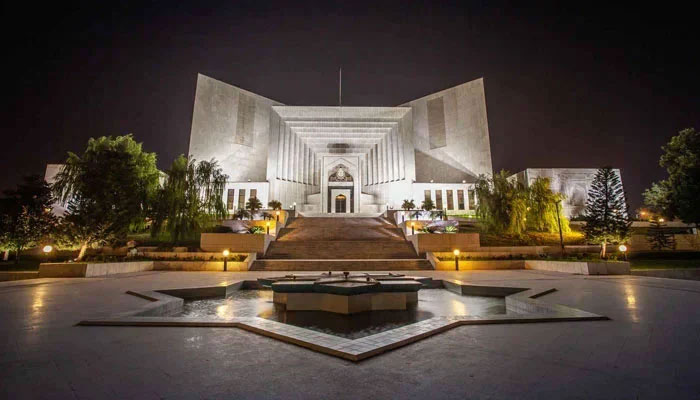
ISLAMABAD: The Supreme Court on Friday observed that if civilians were meant to be tried under the military law, then it would have been explicitly stated. The court also questioned whether any military officers or institution had been held accountable for May 9, adding that attacks on military installations represented a security failure.
A seven-member Constitutional Bench of the apex court, headed by Justice Amin-ud-Din Khan, heard the Intra-Court Appeals (ICAs) filed by the federal government and the Ministry of Defence against its earlier judgement declaring the trial of civilians in military courts unconstitutional.
Khwaja Haris, counsel for the Ministry of Defence, concluded his rebuttal arguments, after which the court adjourned the matter until April 28, when the attorney general will commence his arguments. Justice Syed Hassan Azhar Rizvi asked the counsel how the “pick and choose” method was applied in the trial of accused persons in the May 9 incidents. Khwaja Haris replied that no such method existed, adding that decisions were based on the nature of the crime, with cases referred to anti-terrorism courts or military courts accordingly. Justice Musarrat Hilali questioned what Article 8(3) stated and whether civilians fell under its scope, emphasising that the article pertained to maintaining discipline among armed forces members.
Similarly, Justice Hasan Azhar Rizvi questioned the relevance of military law if a civilian attacked army installations. However, Justice Naeem Akhtar Afghan observed that if civilians were meant to be included, the law would have stated so explicitly. Justice Afghan noted that many aspects of earlier constitutions were incorporated into the 1973 Constitution, with later modifications during martial law eras through constitutional amendments, but the Army Act provisions remained untouched.
Khwaja Haris argued that under Islamic law, punishments under the Hudood Ordinance were clearly defined. He maintained that whether a crime fell under the Official Secrets Act was not a matter of arbitrary selection. The Defence Ministry counsel went on to submit that advocate Faisal Siddiqi had cited the 1995 law, but their case did not fall under that legislation. Khwaja Haris explained that under Section 2(1)(d) of the Army Act, the nature of the crime was clearly defined. “Crimes specified in the Army Act also fall under the Official Secrets Act,” Khwaja Haris maintained. Justice Mandokhail questioned whether all civil crimes under the Official Secrets Act could be tried in military courts, giving the example of kidnapping—if done for terrorism, it falls under the Anti-Terrorism Act, and if for ransom, under the Penal Code. Justice Mazhar inquired about the meaning of “member related to the armed forces” in the Army Act. At this, Justice Musarrat Hilali remarked that once “member of the armed forces” is stated, nothing more remains. Khwaja Haris responded that the law about armed forces members was complete, while “related to armed forces” was merely a provision. He argued that military court proceedings were constitutionally validated and that court-martials could occur in both wartime and peacetime. Justice Musarrat Hilali noted that Section 2(1)(d)(1) was added in 1967 under the 1962 Constitution. Justice Mandokhail remarked that under Article 202, there were two types of courts: the high court and subordinate judiciary. Justice Hilali again asked whether military law contradicted the Constitution, stating, “Our 1973 Constitution is very strong.” Khwaja Haris insisted that fair trials also occurred in court-martial proceedings, with presiding officers being legally qualified. Justice Rizvi observed that 12 or 13 military installations were attacked, representing a security failure. The judge questioned whether any action had been taken against military officers or if any institution had held itself accountable for May 9. At this, the additional attorney general told the court that only the attorney general would answer that question. Later, the court adjourned the hearing until April 28.






-
 Kanye West Banned: Keir Starmer Blasts Wireless Festival For Giving Slot To Controversial Rapper
 -
 Prince William Earns Praise For ‘no-nonsense’ Approach Amid Andrew Drama
 -
 NASA Clarifies Video Of Nutella Jar On Artemis II
 -
 Prince Harry, Meghan Markle's New Plans Regarding Australia Revealed
 -
 Offset Hospitalized: Everything To Know From Police Statements To Fears For His Family
 -
 Richard Gadd Breaks Silence On 'Baby Reindeer' Lawsuit Drama
 -
 Penny Lancaster Pokes Fun At Time With Rod Stewart
 -
 Kim Kardashian 'targeted Slapping' Video Sparks Hilarious Reactions
 -
 Where Will Andrew Mountbatten-Windsor Be Buried Once He Passes Away?
 -
 Meghan Markle Receives Support As Bizarre Easter Egg Criticism Backfires
 -
 Can Aging Be Reversed? First Human Trials Set To Begin
 -
 Kanye West Blocked From UK As Explosive Decision Announced
 -
 Minimal Upgrades For IPhone 18 And Air 2 Leak: A Letdown For Apple Fans?
 -
 Kate Middleton Sends Strong Message To Meghan Markle After 'shameless Stunts'
 -
 Arnold Schwarzenegger's Biggest Fear Triggers As He Gets Ready To Play Dream Role
 -
 Universal Music Faces Massive $64 Billion Takeover Bid