
The anatomy of terrorism
Our failure to do so carries the risk of undermining unity and stability of country
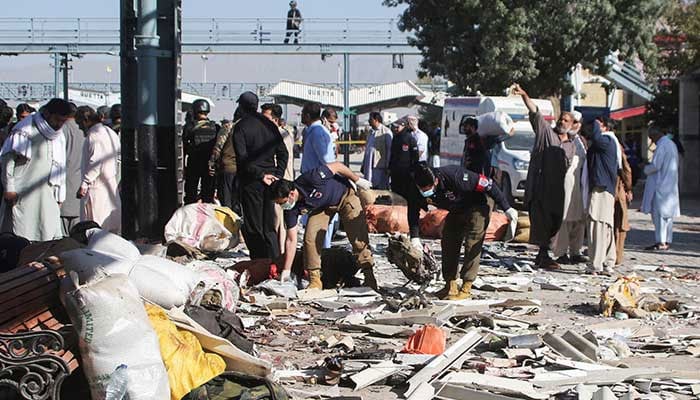
Pakistan these days is the target of a virtual onslaught of terrorism in Khyber Pakhtunkhwa and Balochistan. Hardly a day passes without a terrorist attack of some sort taking its toll in terms of loss of precious human lives, both civil and military, and enormous material destruction in these two provinces.
There is an urgent need for the identification of the root causes of this menace and concerted action to rid the country of this scourge. Our failure to do so carries the risk of undermining the unity and stability of the country.
The causes of terrorism in KP and Balochistan, despite some similarities, fundamentally vary. In the case of KP, the factors behind acts of terrorism can be traced to the Soviet invasion of Afghanistan and the subsequent radicalisation of our society because of our support of the Afghan jihad in the 1980s and the Taliban in the 1990s.
During most of the US military occupation of Afghanistan lasting about two decades, Pakistan’s declared policy was to support the Afghan governments of Karzai and Ashraf Ghani which essentially had been installed by the US in Afghanistan behind the façade of democracy.
The TTP, which is behind most of the acts of terrorism in KP in their current phase, was a protest movement against the reversal of our pro-Taliban policy by Musharraf under the US ultimatum in the aftermath of 9/11. In fact, it wouldn’t be incorrect to stress that the Afghan Taliban and the TTP are two sides of the same coin. It is not surprising, therefore, that now that the Taliban have regained power in Afghanistan, the TTP has found a ready sanctuary in that country for its terrorist activities in Pakistan’s tribal areas where it enjoys close ethnic, tribal, cultural, and ideological links.
The close links between the Afghan Taliban and the TTP make the task of persuading the former to prevent the TTP and other terrorist groups such as the Hafiz Gul Bahadur Group from undertaking terrorist activities in Pakistan that much more difficult. Further, the absence of support for Pakistan among many sections of the Afghan people because of the reversals of our policy concerning the Taliban over the past three decades ranging from active support to active opposition — thus, alienating non-Pashtuns and Pashtuns successively — has provided India with a fertile ground to incite the TTP and other anti-Pakistan groups in Afghanistan to carry out terrorist activities in KP.
The resurgence of terrorism in Balochistan as demonstrated dramatically by the hijacking of the Jaffar Express passenger train on March 11 can be traced to the political, economic and social grievances of the Baloch in the province. Politically, there is a widespread feeling among the people of Balochistan that the federation has usurped their legitimate political rights, and consequently they are not masters of their own affairs.
On the economic front, the grievance is that other provinces have unduly benefited from the resources of Balochistan at the expense of its people. Socially, there are complaints of victimisation of common citizens by sardars and other members of the Balochi elite, sectarian grievances of the Hazara Shia community against the dominant Sunnis, vast inequalities of income and wealth, widespread poverty, lack of economic progress, under-developed infrastructure, and inadequate health and education facilities.
Unfortunately, the state has not handled wisely the worsening situation in Balochistan. Historically, instead of responding positively to the grievances of the people of Balochistan by finding sensible solutions through dialogue, it has mostly relied on military operations and the use of force to suppress the voice of the people of the province. This approach has merely served to aggravate the situation by encouraging extremism and separatist tendencies in Balochistan. India has fully exploited this toxic mix to fan separatist and terrorist movements in Balochistan. It is well known that the Balochistan Liberation Army, its suicide wing—-the Majeed Brigade, and Balochistan Liberation Front have been supported and financed by India.
The resurgence of terrorism in KP and Balochistan calls for multi-pronged approaches adjusted to suit the peculiar circumstances of the two provinces. In the case of KP, the comeback of the TTP with the reported support of the Afghan Taliban poses serious ideological and security challenges because of its obscurantist character and resort to terrorism. Pakistan’s policy of opposition to the TTP should cover both counterterrorism and ideological measures. The government should involve various political parties, religious groups and tribal notables to evolve consensus on countering the TTP’s acts of terrorism and retrogressive agenda.
The plan of action that emerges out of such consultations should be implemented in earnest. Ideally, short-term measures to counter the TTP’s terrorism through the use of force with broad-based political support at local and national levels should be combined with long-term efforts to minimise the support for the TTP by spreading Islam’s message of moderation, tolerance and enlightenment through appropriate educational, social, economic and political reforms. Special attention would be required for the reform of the madrassah system to enable its students to deal effectively with the challenges of the modern world while remaining within the bounds of the fundamental principles of Islam.
Simultaneously, a stern message should be conveyed to the Taliban government in Afghanistan to refrain from any interference in Pakistan’s internal affairs and deny the TTP any support for terrorism in Pakistan. It is doubtful that it would produce any immediate positive results because of the close links between the Afghan Taliban and the TTP. But the effort on the part of the government of Pakistan with the support of Pakistani political and religious groups with influence in Afghanistan must continue on a long-term basis.
For obvious strategic, cultural, ethnic and economic reasons, we should always keep in our mind the imperative of a friendly and cooperative relationship with Afghanistan rooted in long-term considerations rather than an adversarial approach guided by flawed and short-term thinking.
In the case of Balochistan, our focus should be on launching a major political initiative with the involvement and support of all the major political parties in the country and all the important parties and groups in the province for corrective measures in political, economic and social fields to remove the legitimate grievances of our brethren in Balochistan.
The people of Balochistan must feel confident that they will have the freedom to manage their own affairs within the framework of the constitution, measures will be taken to accelerate development in the province, the issue of missing persons will be resolved expeditiously, social oppression will end, and the people of the province will have the first right on its resources.
At the same time, stern action needs to be taken against the BLA and other similar groups that have taken up arms and committed acts of terrorism against innocent people at the behest of India and other anti-Pakistan powers.
However, even in the case of such elements, amnesty may be declared for those who have taken up arms if they agree to lay down their arms and join Pakistan’s political mainstream. Our motto should be to engage the moderates in dialogue to isolate and weaken the extremist elements.
The writer is a retired ambassador and author of ‘Pakistan and a World in Disorder – A Grand Strategy for the Twenty-First Century’. He can be reached at: javid.husain@gmail.com


