
The poverty forecast
Cuts in public sector development spending programme are also likely to further affect quality of essential services
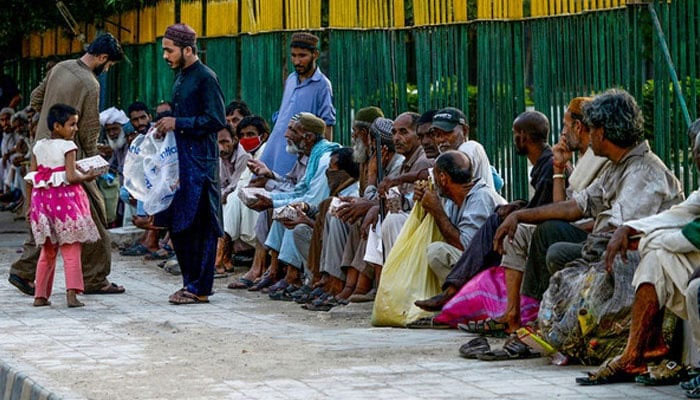
In just three years, poverty in Pakistan has almost doubled. According to the World Bank, using the poverty threshold of $3.2 (Rs900) per day for lower-middle-income countries, 39.2 per cent of the country’s population is living in poverty in FY2024-25.
In September 2021, a little over three years ago, the then-government had said that 22 per cent of the population was living below the poverty line – which means that in three years the percentage of people living in poverty increased by over 78 per cent.
And there is considerable anecdotal evidence to suggest this — in the past three years, prices of several essential items used by a large chunk of the population have significantly increased. For instance, the price of electricity in Pakistan since 2021 has increased by around 150 per cent which is a staggering increase. Since most households in the country use electricity, the proportion of monthly expenditure spent on electricity is far higher for low-income and even middle-income households than for those in the upper-income bracket.
This means that a rise in the cost of electricity is going to impact those with low and middle incomes far more than those who earn more – and hence it has the potential to push a large chunk of the population that may be surviving just above poverty below the poverty line.
The significant jump in the cost of electricity isn’t the only government policy move that has drastically increased poverty in Pakistan so much so that during the current fiscal year almost two in every five citizens is living below the poverty line. Other measures include the jump in the price of basically all food items in the past three to four years as well as the increase in the income tax rate.
As for the latter, it could be argued that the income tax rate increase would more affect those in higher income brackets, but the lower threshold of taxable income has been increased, and rates have been hiked for all income slabs, so those in the middle-income bracket have likely been adversely impacted.
That said, the same multilateral agencies that have reported a significant jump in poverty in Pakistan have of late said that the country’s macroeconomy has stabilised and they have also noted that GDP growth for 2024-25 may be higher than the 2.5 per cent initially forecast.
Generally speaking, a sustained increase in real GDP, which reflects an increase in people’s real income (that is what they earn nominally minus the rate of inflation), effectively lifts people out of poverty. That is what happened during much of Pakistan’s history except in the last two decades, where politically polarised and fickle economic policymaking and implementation and outright corruption all worked together to actually increase the percentage of the population living below the poverty line.
If there is a sustained effort to reverse this, then not only measures that increase people’s real incomes and wealth need to be taken, but also policies that enable a more equitable and balanced distribution of income.
This is where the Gini coefficient comes in, which measures the level of income distribution or income inequality in a country. The closer the coefficient is to zero, the more equal is the distribution of income, zero means perfect equality. On the other end, close to one means higher income inequality, with one being perfect inequality.
Pakistan’s Gini coefficient is in the range of 0.29 as estimated by the World Bank for 2024. It is faring better than India, Bangladesh, Nepal and Sri Lanka on this measure, which is a pleasant surprise because the general impression one would have is that Pakistan probably has the highest unequal distribution of income in the region.
Of course, one argument for the lowering of the Gini coefficient could also be that it’s not caused as such by any policy that seeks to effectively redistribute income from the rich to the poor but rather that policies – such as higher income tax rates for the rich – have reduced their real income without raising the real incomes for those in the low-income bracket.
In other words, the policies are not in themselves redistributive but rather their primary aim is to generate increased tax revenue for the government and not necessarily to redistribute that increased revenue towards the poor – which could be done by using this to finance subsidies targeting the poor.
Pakistan’s IMF programme specifically prohibits subsidies and the only government scheme that it does endorse to target the poor is the tried and tested Benazir Income Support Programme. Recently revealed cuts in the public sector development spending programme, which is the flagship scheme for social sector uplift, are also likely to further affect the quality of essential services like provision of health, education, water supply, sanitation, waste collection, and so on.
All of the above are going to exacerbate poverty in Pakistan and it would be safe to say that any benefits of increased real GDP growth are not going to trickle down to those living in poverty or on the brink anytime soon.
The writer is a journalist based in Karachi. He tweets/posts @omar_quraishi and can be reached at: omarrquraishi@gmail.com







-
 Is X Down Globally? Thousands Of Users Report Problems
 -
 Trump’s China Trip Rescheduled For May Amid Conflict With Iran
 -
 AI Music Tools Surge As Industry Faces Shift In Creation
 -
 Shaquille O'Neal Addresses Claims He Sent Explicit DMs To Sabrina Carpenter
 -
 24 Dead In Bangladesh After Bus Plunges Into River During Ferry Boarding
 -
 Dana Carvey Recalls Doing 'SNL' Creator Lorne Michaels' Impersonation: 'My First Reaction Is Terror'
 -
 Everything We Know About Taylor Swift And Travis Kelce Honeymoon Plans
 -
 Metformin’s Hidden Brain Pathway Uncovered After 60 Years
 -
 How Dogs Became Man’s Best Friend 15,800 Years Ago: New Study Reveals
 -
 Prince Harry And Meghan Markle Respond To Major Meta And YouTube Ruling
 -
 Why Josh Duhamel Believes His Fans Will Be 'alienated' If He Talks Politics
 -
 Melania Trump Appears With Humanoid Robot At White House
 -
 ‘Addictive By Design’: Meta, YouTube Found Liable In Historic Verdict
 -
 Bruce Willis' Mom Marlene Makes Another Family Amid Son's Battle With Dementia
 -
 Roblox Safety Warning For Parents: Developer Says Kids Need 24/7 Monitoring
 -
 Chelsea Handler Explains Why She Dates Younger Men