
Women MPs shape nearly half of parliament’s agenda in 2024-25: Fafen
In 2024-25, NA addresses 67% of women-sponsored agenda items, down from 69% in 2022–23 and 81% in 2021–22
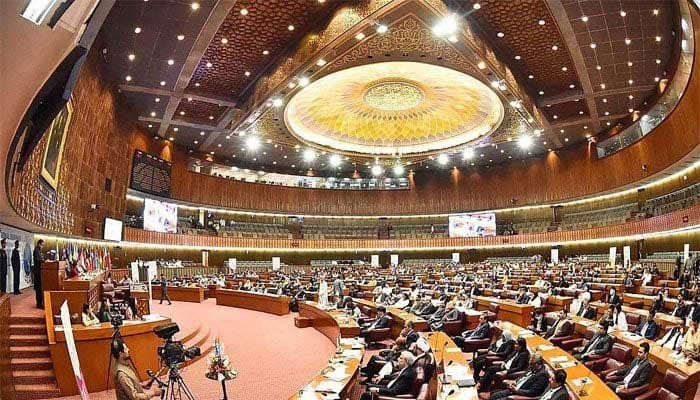
ISLAMABAD: Women parliamentarians demonstrated remarkable commitment and productivity in shaping legislative priorities and influencing policy discourse and parliamentary actions during 2024–2025, according to Free and Fair Election Network’s (Fafen) Women Parliamentarians Performance Report.
According to the Fafen report, despite constituting only 17 percent of parliament’s current membership (69), women legislators contributed nearly half (49 percent) of the parliamentary agenda -- a historic high since 2015-16.
Women Members of the National Assembly (MNAs) initiated 55 percent of the agenda in the lower house, while women Senators accounted for 31 percent in the Upper House.
Women legislators championed a diverse range of public concerns, including institutional accountability, climate resilience, economic inequality, and infrastructural challenges such as energy pricing and internet accessibility.
Their legislative priorities centred on strengthening human rights protections for marginalised groups, advancing healthcare reforms, safeguarding labour rights, and modernizing governance.
Prominently, women legislators proposed amendments to criminal laws to reinforce safeguards for women, children, and minorities, alongside procedural reforms aimed at enhancing inclusivity in parliamentary processes.
Collectively, these efforts reflect a nuanced understanding of governance that intertwines social justice with institutional efficacy, positioning women legislators as pivotal architects of Pakistan’s legislative future.
While women legislators contributed to a significantly high share of parliamentary business, the rate at which their agenda items were addressed declined compared to previous years.
In 2024-25, the National Assembly addressed 67 percent of women-sponsored agenda items, down from 69 percent in 2022–23 and 81 percent in 2021–22.
Similarly, the Senate addressed 77 percent of women’s agenda items, a decline from 85 percent in 2022-23 and 94 percent in 2021-22.
However, this trend reflects a broader stagnation in parliamentary efficiency rather than gender-based disparities, as items sponsored by their male counterparts experienced a comparable decline.
In the National Assembly, 83 percent of jointly-sponsored items were addressed, compared to 67 percent of those initiated by women lawmakers and 66 percent by men.
The Senate exhibited a similar pattern, addressing 80 percent of jointly-sponsored business and 77 percent of both women- and men-sponsored agenda items were addressed. Women legislators individually contributed more agenda items than their male counterparts.
Each female MNA introduced an average 17 agenda items – over five times the male average of three per legislator. In the Senate, women proposed 11 items each, nearly double the male average of six. Notably, all except five female MNAs and one female Senator actively participated in parliamentary proceedings by contributing agenda and/or engaging in debates.
The parliamentarians’ attendance patterns in the plenary proceedings of both Houses further highlighted women dedication to the legislative work.
Female MNAs maintained consistently higher participation rates than their male counterparts, attending 70 sittings (75 percent of 93 sittings) on average compared to 59 sittings (63 percent of 93 sittings) by male MNAs across 13 sessions held during the reporting year.
In the Senate, women’s attendance fluctuated slightly, surpassing or matching male colleagues in six of 11 sessions and trailing in five. Despite these variations, female Senators averaged 41 sittings (67 percent of 61 sittings), marginally exceeding the 39 sittings (64 percent of 61 sittings) recorded by their men counterparts.
Parliamentary agenda submitted by women parliamentarians accounted for nearly 49 percent of the parliamentary agenda (both in the Senate and National Assembly collectively) during the year – 47 percent on their own and two percent in collaboration with their male colleagues.
They sponsored 44 percent Private Members’ Bills (69 out of 156), 49 percent Private Members’ Resolutions (27 out of 55), 44 percent Calling Attention Notices (CANs) (76 out of 137), 42 percent Motions for Discussion on Public Interest Issues (25 out of 60), 68 percent proposals for Amendments to the Rules of Procedure in their respective Houses (13 out of 19), and nearly half (49 percent or 872 out of 1,784) of all parliamentary Questions.
Female Members of the National Assembly contributed 55 percent agenda of the Lower House – 52 percent independently and three percent in collaboration with male counterparts.
Similarly, female Senators contributed 34 percent agenda of the Upper House - 31 percent on their own and one percent in collaboration with male colleagues. In addition to their contribution to the agenda, women legislators also actively participated in the debates on scheduled business, and in raising Points of Order.
The women contribution to the National Assembly business (55 percent) was significantly higher as compared to recent years but was still lower than their highest-recorded contribution of 65 percent in 2016-207.
In the Senate, women contribution to the House agenda has been the highest since Fafen started issuing this performance report.
Women MPs also made efforts to introduce amendments to the existing rules and procedures of the House focusing on improving the framework for their participation in the plenary and committees’ proceedings.
Of 48 female MNAs, 34 (65 percent) both sponsored agenda items and participated in debates, while 13 (25 percent) only sponsored agenda items. One female MNA (two percent) participated solely in debates, and five did not engage in the proceedings during the reporting period.
Compared to their male counterparts, female MNAs demonstrated higher participation levels.
Of the 15 female Senators, 13 (87 percent) actively contributed to both agenda items and debates, while two (13 percent) only submitted agenda items.
One Senator from Pakistan Tehreek-e-Insaf did not attend any sittings, resulting in absolutely no participation.
A total of 59 MNAs (54 male and 5 female) did not attend any sittings, while four senators (three male and one female) did not participate in any parliamentary business.
Among MNAs with zero participation, the average attendance was 54 sittings, whereas female MNAs with no participation attended an average of 45 sittings out of 93.
This suggests that some MNAs were physically present in the House but did not engage in any proceedings, making their role passive. Additionally, the attendance of non-participating senators was also notably low.
During the reporting period, the National Assembly convened for thirteen sessions spanning over 93 sittings, while the Senate held ten sessions comprising 62 sittings.
In the National Assembly, female members consistently demonstrated higher attendance rates compared to their male counterparts throughout 13 sessions.
Unlike the National Assembly, the attendance patterns in the Senate varied throughout the year.
Female senators had a higher attendance rate than male senators in five sessions, while matched the male senators’ attendance rate in one session.
In the remaining five sessions, they had a lower attendance rate than male colleagues.
An analysis of agenda transaction rates in the National Assembly and Senate suggests that while there is no significant difference in the treatment of agenda initiated by female lawmakers and agenda initiated by male lawmakers in either House, the agenda jointly sponsored by the two genders is far more likely to be addressed.
Overall, the National Assembly addressed 83 percent of the jointly-sponsored agenda items, 67 percent of female-sponsored agenda items and 66 percent of male-sponsored agenda items during the reporting year.
Around one-third agenda items sponsored by women were either not read out during the proceedings or were deferred due to absence of mover or minister concerned.
Of the women sponsored agenda in the National Assembly, 67 percent Calling Attention Notices (CANs), 94 percent legislative proposals, 100 percent motions for public interest discussions, 40 percent resolutions, 68 percent questions and 31 percent amendments proposed to the Assembly’s Rules of Procedure were addressed.
Similarly, the Senate addressed 80 percent of the jointly-sponsored agenda items, and 77 percent each of female-sponsored agenda items and male-sponsored agenda items during the reporting year. Nearly 23 percent of women-sponsored agenda in the Senate remained unaddressed.
Of the women sponsored agenda, the House addressed 78 percent CANs, 75 percent of legislative proposals, 33 percent motions for public interest discussions, 100 percent private members’ resolutions, and 79 percent questions.
Shahistan Khan of the PML-N from Khyber Pakhtunkhwa tops in attending the NA session as she attended 99 percent of sessions , asked 24 questions, 2 calling attention notice and one resolution.
Aasia Ishaq Khan of MQM-Pakistan was second in attending the NA session as she attended 97 percent of the session, asked 8 questions, 2 Calling attention notices, 2 motions on public interest discussions, 3 legislations and 5 resolutions.
Nuzhat Sadiq of the PML-N attended 86 percent of NA sessions, 13 questions, 11 calling attention notices, one legislation and 2 resolutions.
Aseefa Bhutto Zardari attended 42 percent of sessions of the National Assembly, asked 2 questions, and one calling attention notices.
Nafeesa Shah of the PPP-P attended 82 percent of NA sessions, 33 questions, 3 calling attention notices, 2 bills for legislation, 3 proposals for amendment to parliamentary rules and one resolution.
Shazia Marri of the PPP- P attended 69 percent of NA session, 21 questions, 4 calling attention notices, 2 motions of public interest discussion motion, 3 legislation and 5 resolutions.
Minister for Information Technology Shaza Fatima Khawaja attended 56 percent of NA sessions. Shahndana Gulzar Khan of SIC attended 76 percent of NA sessions, asked only 1 question.
Aniqa Mehdi of SIC attended 55 percent of NA sessions asked only 2 questions.
Syeda Nosheen Iftikhar attended 74 percent of NA sessions, submitted only 2 calling attention notices.
While in the Senate, Senator Husna Bano of the PPPP tops the list of attendance as she attended 90 percent of Senate sittings and moved 2 resolutions.
Senator Falak Naz of the PTI attended 85 percent of Senate sittings and moved 3 resolutions. Senator Palwasha Khan of the PPPP also shared the second spot in attendance as he also attended 85 percent of Senate sittings and asked 8 questions, one calling attention notices, 4 legislations and 4 resolutions.
Senator Sadia Abbasi of the PML-N shared the third spot in attending the Senate session as she attended 84 percent of Senate sittings. Senator Sherry Rehman of the PPP attended 80 percent of Senate sittings, moved 2 calling attention notices, one motion for public interest and 7 resolutions.







-
 Vanessa Trump Remains Loyal To Tiger Woods After DUI Arrest: Report
 -
 Colorado Avalanche Injury Update: Cale Makar To Miss Time With Upper-body Injury Ahead Of Playoffs
 -
 Beatrice, Eugenie To Miss Easter Service Because Of Prince William, Kate?
 -
 Pink Moon 2026: When To See April’s Full Moon And Why It Won’t Look Pink In The Sky
 -
 King Charles In ‘pain’ As Beatrice, Eugenie Miss Royal Easter Gathering
 -
 Reese's Peanut Butter Cups To Return To Classic Chocolate Recipe Following Public Backlash
 -
 Why Howie Mandel Regrets Apologizing To Kelly Ripa For Tense On-air Exchange
 -
 TDSB Vice Principal Jobs Cut As Board Removes 40 Roles Amid Funding Loss, Enrolment Decline
 -
 Earthquakes Hit Indonesia Off Ternate, Triggering Tsunami Warning That Is Now Lifted
 -
 Lori Loughlin 'ready To Date Again' After Mossimo Giannulli Split
 -
 NASA Artemis II Rocket Launch: Canada’s Jeremy Hansen Makes History In First Lunar Mission In Decades
 -
 Donald Trump Claims US Is Nearing End Of Its Military Campaign In Iran
 -
 Former Royal Butler Exposes King Charles, Queen Elizabeth's Secret Pranks
 -
 Chuck Norris Family Breaks Silence On Misleading Reports About Actor's Death
 -
 Prince Harry's Old Flirty Chat With Reporter Comes To Light During Privacy Lawsuit
 -
 Machine Gun Kelly Melts Hearts With Daughter Saga's Unseen Snaps