
Gwadar key to prosperity: Zardari
President stresses need to revitalise historic trade routes to further strengthen economic ties across region
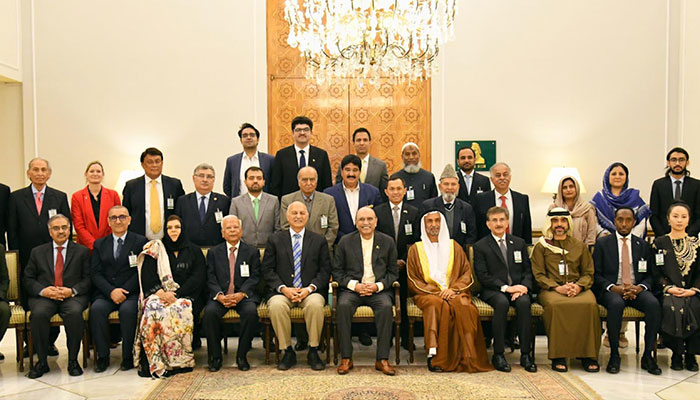
ISLAMABAD: President Asif Ali Zardari has reiterated Pakistan’s commitment to strengthening regional connectivity and economic cooperation, saying that the China-Pakistan Economic Corridor (CPEC) and Gwadar Port would play a significant role in promoting regional trade and prosperity.
He said that Pakistan’s strategic location offered significant opportunities to enhance regional trade, terming the country a “natural trade corridor” linking China, Central Asia, and the Middle East. The president expressed these views while speaking at the closing session of the International Conference on “Regional Connectivity & Pakistan: Emerging Opportunities”, organised by the Pakistan-China Institute at Aiwan-e-Sadr on Tuesday.
Addressing the conference, President Asif Ali Zardari said that he envisioned Gwadar Port, during his long years of imprisonment, as a shared economic hub with friendly nations, including China, to facilitate regional trade and connectivity. He said that CPEC and Gwadar would bring dividends for our future generations. The president also noted that Pakistan was exploring options to bring water from Tajikistan to Balochistan and, in this regard, a feasibility study had been completed with the support of the UAE government. He emphasised the importance of revitalizing historic trade routes to further strengthen economic and cultural ties across the region.
Speaking on the occasion, Chief Minister Balochistan Sarfraz Bugti, appreciated the role of President Asif Ali Zardari in the conception, initiation and implementation of CPEC.
In his introductory remarks, Senator Mushahid Hussain Sayed, Chairman of the Pakistan-China Institute, underscored Pakistan’s pivotal role as a regional connectivity hub, linking South Asia, China, Central Asia, and the Gulf.
President of the UAE-based Global Council of Tolerance and Peace, Ahmed Jarwan Al Mohammed, lauded Pakistan’s efforts at promoting regional connectivity. He urged the need to build bridges and work together to promote tolerance, education, and business cooperation.
Mustafa Hyder Sayed, Executive Director, Pakistan-China Institute highlighted Pakistan’s resilience in a turbulent neighborhood. He emphasized that despite enduring significant economic erosion, key indicators suggest the country is steadily regaining its trajectory toward progress. The session also featured Ali Pervez Malik, Minister of State for Finance, as the Keynote Speaker.
Ms. Yan Rui, Secretary General of the Europe-Asia Centre based in Xinjiang, China emphasized the significance of cultural and ecological cooperation in reshaping regional connections between Europe and Asia.
Ambassador of Kazakhstan, Yerzhan Kistafin highlighted Central Asia as a land of opportunities, stressing the need for enhanced regional connectivity. Ambassador Robin Raphel, former US Assistant Secretary of State for South and Central Asian Affairs, highlighted America’s interest in strengthening and securing supply chains across Asia and Europe.






-
 24 Dead In Bangladesh After Bus Plunges Into River During Ferry Boarding
 -
 Dana Carvey Recalls Doing 'SNL' Creator Lorne Michaels' Impersonation: 'My First Reaction Is Terror'
 -
 Everything We Know About Taylor Swift And Travis Kelce Honeymoon Plans
 -
 Metformin’s Hidden Brain Pathway Uncovered After 60 Years
 -
 How Dogs Became Man’s Best Friend 15,800 Years Ago: New Study Reveals
 -
 Prince Harry And Meghan Markle Respond To Major Meta And YouTube Ruling
 -
 Why Josh Duhamel Believes His Fans Will Be 'alienated' If He Talks Politics
 -
 Melania Trump Appears With Humanoid Robot At White House
 -
 ‘Addictive By Design’: Meta, YouTube Found Liable In Historic Verdict
 -
 Bruce Willis' Mom Marlene Makes Another Family Amid Son's Battle With Dementia
 -
 Roblox Safety Warning For Parents: Developer Says Kids Need 24/7 Monitoring
 -
 Chelsea Handler Explains Why She Dates Younger Men
 -
 Chappell Roan's Security Guard Takes 'full Responsibility' For His Interaction With Jorginho's Daughter?
 -
 Rosalía Cuts Concert Short Over Sudden Illness, Fans Shocked
 -
 'Buffy' Star Nicholas Brendon's Death Case Takes Massive Turn
 -
 FKA Twigs Takes Legal Stand Against Ex Shia LaBeouf