
SC notice to Pervez Elahi in Punjab Assembly ruling case
During Monday’s hearing, Justice Amin-ud-Din Khan questioned if matter had become infructuous
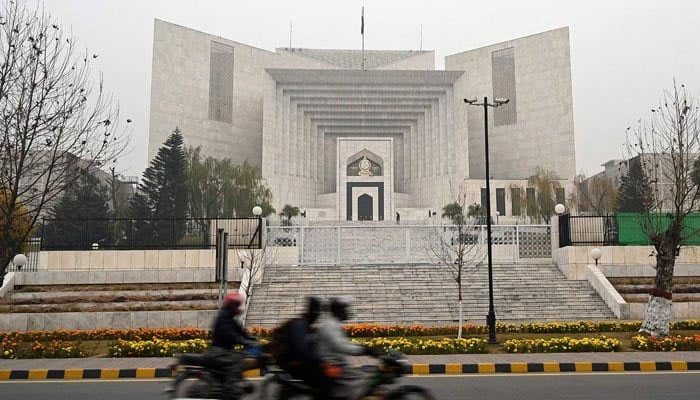
ISLAMABAD: The Supreme Court on Monday issued a notice to former Punjab chief minister Chaudhry Pervez Elahi in a case related to the ruling of the former deputy speaker of the Punjab Assembly.
A seven-member constitutional bench, headed by Justice Amin-ud-Din Khan, heard the review petition filed by former chief minister Hamza Shehbaz Sharif. The petition challenges the apex court’s earlier judgment on Article 63-A of the Constitution that overturned the ruling of the Punjab Assembly’s former deputy speaker.
The bench included Justice Jamal Khan Mandokhel, Justice Muhammad Ali Mazhar, Justice Syed Hassan Azhar Rizvi, Justice Musarat Hilali, Justice Naeem Akhtar Afghan, and Justice Shahid Bilal Hassan.
In August 2022, Hamza Shehbaz Sharif had filed a review petition against the apex court’s judgment delivered on July 26, 2022. This judgment had nullified the Punjab Assembly deputy speaker’s ruling that discarded 10 votes of the Pakistan Muslim League-Quaid (PMLQ), leading to Hamza’s victory as the provincial chief executive. The Supreme Court, however, had declared Chaudhry Pervez Elahi as the chief minister of Punjab, overturning the deputy speaker’s decision.
During Monday’s hearing, Justice Amin-ud-Din Khan questioned if the matter had become infructuous. However, Hamza Shehbaz’s lawyer argued otherwise and said that notices had already been issued to the parties concerned in a previous hearing.
Justice Muhammad Ali Mazhar inquired who would represent Chaudhry Pervez Elahi, saying that he was also a party to the case. The bench adjourned the matter for a later date. In a separate hearing, the bench sought a report from the federal government regarding its slum area policy within two weeks.
Justice Amin-ud-Din Khan remarked that the regulation of slums falls under the jurisdiction of provincial and local governments. Justice Jamal Khan Mandokhel questioned the federal government’s authority to legislate on matters under provincial jurisdiction. He said that the definition of a slum should first be clarified, saying that many houses in Balochistan qualify as slums.
Justice Syed Hassan Azhar Rizvi highlighted that slums are often built by occupying groups along riverbanks and later turn into residential plots. He questioned what measures the government had taken to prevent such encroachments.
The counsel for the Capital Development Authority (CDA) said that 10 slums had been identified but emphasised the need for a clear definition of slums. Justice Jamal Khan Mandokhel observed that laws already exist to address illegal encroachments, and any injunctions against repossession should be reconsidered.
The hearing was later adjourned. The bench also heard a petition seeking the compulsory teaching of the Holy Quran in schools. The petitioner, Aneeq Ali Kattana, appeared in person, urging the court to direct the federal government to legislate under Articles 31 and 5 of the Constitution. He called for uniform implementation across the country to ensure that students understand the Quran’s meaning.
Kattana argued that the Quran should be taught as a separate subject and included in the national curriculum. He also emphasised the need to secure online Quranic scripts from unauthorised alterations and proposed establishing a regulatory body for monitoring.
Justice Muhammad Ali Mazhar suggested that any incorrect translations on websites should be blocked and asked the petitioner to provide details at the next hearing. The court adjourned the case for an indefinite period.
The bench also adjourned the hearing of a case regarding the regularisation of Lady Health Visitors (LHVs) due to the unavailability of counsel. One petitioner, Bushra Araian, requested the court to hear her case as she had been appearing in person. However, Justice Amin-ud-Din Khan said that all related cases would be consolidated and heard collectively.







-
 'Euphoria' Star Eric Made Deliberate Decision To Go Public With His ALS Diagnosis: 'Life Isn't About Me Anymore'
 -
 Toy Story 5 Trailer Out: Woody And Buzz Faces Digital Age
 -
 Andrew’s Predicament Grows As Royal Lodge Lands In The Middle Of The Epstein Investigation
 -
 Rebecca Gayheart Unveils What Actually Happened When Ex-husband Eric Dane Called Her To Reveal His ALS Diagnosis
 -
 What We Know About Chris Cornell's Final Hours
 -
 Scientists Uncover Surprising Link Between 2.7 Million-year-old Climate Tipping Point & Human Evolution
 -
 NASA Takes Next Step Towards Moon Mission As Artemis II Moves To Launch Pad Operations Following Successful Fuel Test
 -
 GTA 6 Price Leaked Online Ahead Of Rockstar Announcement
 -
 Eric Dane Got Honest About His Struggle With ALS In Final Public Appearance: 'No Reason To Be In A Good Spirit'
 -
 Google AI Overviews And Mental Health: Why Experts Say It’s ‘very Dangerous’
 -
 Prince Harry Issues A Statement For His 'incredible' WellChild Children
 -
 5 Famous Celebrities Who Beat Cancer
 -
 Spinosaurus Mirabilis: New Species Ready To Take Center Stage At Chicago Children’s Museum In Surprising Discovery
 -
 ByteDance Expands Artificial Intelligence Operations In US
 -
 Angelina Jolie’s Breast Cancer Surgeon Appreciates Her For Calling Scars 'a Choice': 'They Are Choices To Survive'
 -
 Detective Chief Inspector Reveals How Andrew Got Treated In Police Custody