
Behind a potential Honda and Nissan tie-up, the existential threat posed by Chinese EVs
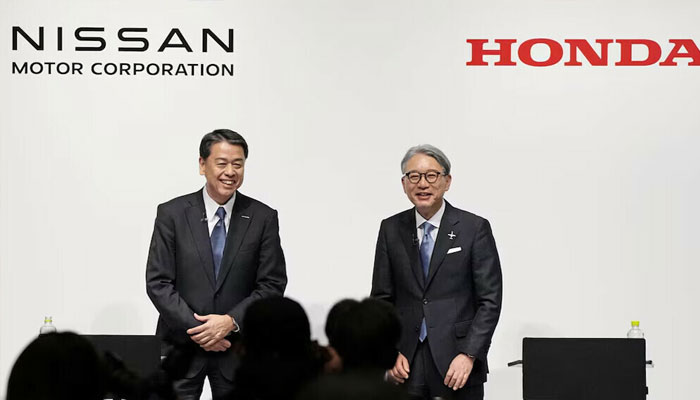
TOKYO: Some unions are born of necessity, others from convenience. In the case of Honda and Nissan’s potential merger, it is mostly defensive as Chinese rivals take the world by storm.
While the challenge from China’s seemingly boundless EV expertise looms large for all traditional automakers, for Japan it represents a threat to the vast car-manufacturing supply chain that has been the country’s economic engine for years.
Honda, Japan’s second-largest car company, and Nissan, its third-largest, are in talks to deepen ties, including the possibility of setting up a holding company, two people familiar with the matter said on Wednesday. The automakers are discussing a potential merger, one of the people said.
Like other foreign carmakers, both Honda and Nissan have lost ground in China, the world’s biggest auto market, as BYD and other domestic brands win over consumers with EVs and hybrids loaded with innovative software.
Honda reported a 15 per cent drop in quarterly profit last month, hit by the decline in China and has been scaling back its workforce there. Nissan -- a long-struggling company -- plans to cut 9,000 jobs globally and manufacturing capacity by 20 per cent due to slumping sales in China and the US.
Sanshiro Fukao, an executive fellow at the Itochu Research Institute in Tokyo, warns that the speed at which Chinese EV makers have been able to innovate means that Honda and Nissan have “no time” to pursue business as usual.
“We’re no longer in the age where carmakers would join together, churn out profits through economies of scale and then reinvest them in a five-year restructuring plan.”Others note that any steep decline for Japan’s auto industry would be particularly painful. It’s the strongest sector in the world’s fourth-largest economy and Japan’s position in other key industries such as consumer electronics and chips has waned over the years.
“For Japan, it’s ultimately all about cars. If the auto industry doesn’t improve, then the whole of Japanese manufacturing will not get better,” said Takumi Tsunoda, a senior economist at Shinkin Central Bank Research Institute.
THE DIGITAL SHIFT
Japan’s automotive supply chain totalled around 60,000 companies as of May this year, according to a survey by research firm Teikoku Databank. Total business transactions were estimated at 42 trillion yen ($270 billion), equivalent to 7.0 per cent of nominal GDP in the 2023 fiscal year.
Broadly, the industry employs more than 5 million people, representing 8.0 per cent of the entire workforce, according to the Japan Automobile Manufacturers Association.Consolidation through mergers can help by slashing costs and pooling resources but it remains to be seen whether Japan’s auto industry -- like the US or German auto industry -- can sufficiently compete in EVs.
Japan’s automakers have been steeped in the country’s traditions of ‘monozukuri’ or manufacturing craftmanship, and have been influenced by market leader Toyota which revolutionised modern manufacturing with its system of lean production and just-in-time delivery of components.
Those methods helped develop a culture of incremental improvement and production-line efficiency that powered the Japanese auto industry’s rise from the late 1970s.However, the shift to battery-powered smart cars has seen much of the consumer’s interest focus on software-reliant self-driving features and their digital experience inside the vehicle -- areas where the Chinese excel.
Among Japan’s automakers, Toyota has been the most vocal about the potential harm from a dramatic shift to EVs, with Chairman Akio Toyoda warning in October that an EV-only future would lead to many job losses in the industry, especially at suppliers and those working on engines.
Toyota has long championed what it calls a ‘multi-pathway’ strategy that includes producing hybrids, hydrogen cars as well as EVs.Eikei Suzuki, a lawmaker from the ruling Liberal Democratic Party who represents Mie prefecture -- home to a Honda plant and its Suzuka Circuit race course -- said he hoped if Honda and Nissan were to integrate, it would increase their global competitiveness.
But he added that if the merger were to adversely impact local manufacturing and employment, that would go against the policies of Prime Minister Shigeru Ishiba, who has pledged to revitalise Japan’s provincial economies.“We hope that consideration will be given to regional employment in Japan,” he said.







-
 Lawyer Of Epstein Victims Speaks Out Directly To King Charles, Prince William, Kate Middleton
 -
 Microsoft CEO Shares How Gates Doubted $1bn OpenAI Investment
 -
 Milo Ventimiglia Calls Fatherhood 'pretty Wild Experience' As He Expects Second Baby With Wife Jarah Mariano
 -
 Chinese Scientists Unveil Advanced AI Model To Support Deep-space Exploration
 -
 Anthropic’s New AI Tool Wipes Billions Off Cybersecurity Stocks
 -
 Trump Announces He Is Sending A Hospital Ship To Greenland Amid Rising Diplomatic Tensions
 -
 'Never Have I Ever' Star Maitreyi Ramakrishnan Lifts The Lid On How She Avoids Drama At Coffee Shops Due To Her Name
 -
 Inside Prince William’s Plans For Prince Harry: What Will Happen To Duke Once He’s King
 -
 Chyler Leigh Pays Moving Homage To 'Grey’s Anatomy' Co-star Eric Dane: 'He Was Amazing'
 -
 Did You Know Tech CEOs Limit Screen Time For Their Own Kids?
 -
 Matthew Lillard Admits Fashion Trends Are Not His 'forte'
 -
 SpaceX Launches Another Batch Of Satellites From Cape Canaveral During Late-night Mission On Saturday
 -
 Princess Beatrice, Eugenie Get Pulled Into Parents’ Epstein Row: ‘At Least Stop Clinging!’
 -
 Inside Kim Kardashian's Brain Aneurysm Diagnosis
 -
 Farmers Turn Down Millions As AI Data Centres Target Rural Land
 -
 Trump Announces A Rise In Global Tariffs To 15% In Response To Court Ruling, As Trade Tensions Intensify