
WHO celebrates completion of healthcare infrastructure revitalisation project
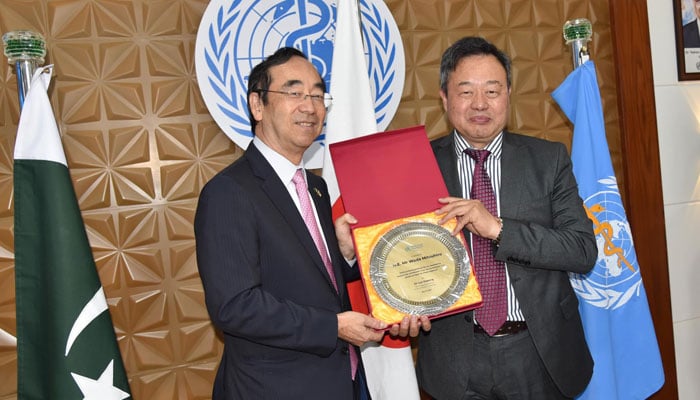
Islamabad: The World Health Organisation's Pakistan Mission celebrated the successful completion of the 'Rebuilding Together' project with a ceremony here on Friday, appreciating the Japanese support for revitalising healthcare infrastructure in the country's flood-stricken areas.
The WHO's representatives highlighted the importance of international partnerships in building resilient healthcare systems. Dr Luo Dapeng, WHO Head of Mission in Pakistan, praised the government and people of Japan for the "remarkable" support to the project.
“We are extremely grateful for the invaluable support from the Government and people of Japan. Their generous contribution has been instrumental in restoring access to essential healthcare for vulnerable communities affected by the floods. This collaborative effort exemplifies the importance of international partnerships in building resilient healthcare systems,” he said.
He said the WHO was committed to working with the Pakistani government and other stakeholders to further strengthen the country's healthcare infrastructure. Japan's ambassador Wada Mitsuhiro reaffirmed his country's commitment to universal health coverage and sustainable development.
"We [the government of Japan] are committed to 'leave no one’s health behind' to achieve universal health coverage. Global health is central to Japan’s development cooperation, and we consider it to be the fundamental pillar of sustainable development,” he said.
In 2022, Pakistan faced catastrophic monsoon rains that caused widespread flooding, affecting millions of people in all provinces of Balochistan, Khyber Pakhtunkhwa, Punjab, and Sindh, according to officials.
They said the disaster led to the displacement of over 600,000 individuals, damage to 1.9 million homes, and significant agricultural losses. The officials added that the flooding also severely impacted the healthcare infrastructure, with more than 2,000 health facilities damaged.
The WHO's representatives said thanks to the financial support from the Japanese government and people, the WHO was able to respond promptly to disease outbreaks and improve access to essential healthcare by revitalising damaged facilities.
They said through a collaborative effort, the WHO has renovated 462 healthcare facilities, providing essential equipment and supplies, with 240 facilities rehabilitated through Japanese assistance.
"These facilities are now managed by government health authorities, ensuring continued service provision. Additionally, we have invested in building the capacity of local healthcare professionals, enabling them to provide sustainable healthcare services, including disease surveillance and outbreak response," a WHO representative said.







-
 Prince William Warned His Future Reign Will Be Affected By Andrew Scandal
 -
 Amy Madigan Reflects On Husband Ed Harris' Support After Oscar Nomination
 -
 Is Studying Medicine Useless? Elon Musk’s Claim That AI Will Outperform Surgeons Sparks Debate
 -
 Margot Robbie Gushes Over 'Wuthering Heights' Director: 'I'd Follow Her Anywhere'
 -
 'The Muppet Show' Star Miss Piggy Gives Fans THIS Advice
 -
 Sarah Ferguson Concerned For Princess Eugenie, Beatrice Amid Epstein Scandal
 -
 Uber Enters Seven New European Markets In Major Food-delivery Expansion
 -
 Hollywood Fights Back Against Super-realistic AI Video Tool
 -
 Pentagon Threatens To Cut Ties With Anthropic Over AI Safeguards Dispute
 -
 Meghan Markle's Father Shares Fresh Health Update
 -
 Samsung Galaxy Unpacked 2026: What To Expect On February 25
 -
 Travis Kelce Takes Hilarious Jab At Taylor Swift In Valentine’s Day Post
 -
 NASA Confirms Arrival Of SpaceX Crew-12 Astronauts At The International Space Station
 -
 Can AI Bully Humans? Bot Publicly Criticises Engineer After Code Rejection
 -
 Search For Savannah Guthrie’s Abducted Mom Enters Unthinkable Phase
 -
 Imagine Dragons Star, Dan Reynolds Recalls 'frustrating' Diagnosis