
G7 finance chiefs back plan to leverage frozen Russian assets to fund Ukraine
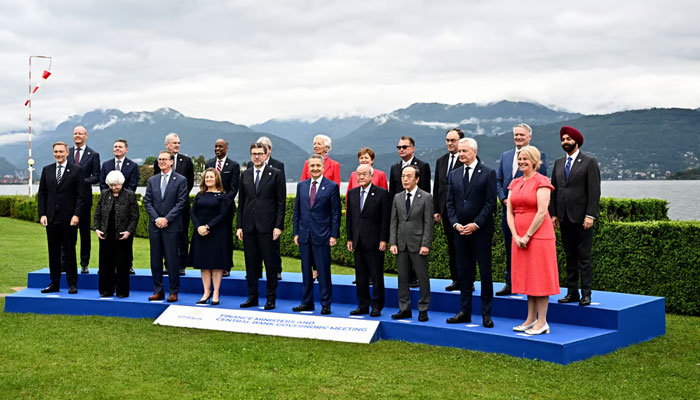
Stresa: G7 finance ministers have backed the idea of issuing a loan to Ukraine, secured by profits on frozen Russian assets, in an effort to secure financing for Kyiv beyond 2024.
Ministers’ discussions were based on a US proposal that circulated ahead of the gathering in Stresa, Italy, to issue a loan of about $50bn to be repaid with profits from around €190bn Russian central bank assets. The Russian assets are stuck in Belgian central securities depository Euroclear.
On Saturday, ministers said they were “making progress” on options to “bring forward” the profits, according to a draft communique seen by the Financial Times. They added that G7 leaders would be presented with options for how to construct the loan ahead of a summit in June.
The finance chiefs also vowed to continue to press China to cut industrial subsidies that they said put western rivals out of business, and said implementing the most significant global tax deal for more than a century was “a top priority”. They raised concerns, too, over Israel’s plans to block Palestinian banks’ access to Israeli lenders — a measure the US and allies believe could destroy the West Bank’s economy.
The G7 — a grouping of advanced economies that includes all of Ukraine’s big western allies — wants to future-proof funding for Kyiv beyond this year, when critical elections take place on both sides of the Atlantic.
Since Russia’s invasion, Ukraine has relied heavily on western aid for military support and to fund crucial public services.
Ukraine’s finance minister Serhiy Marchenko, who attended the G7 meeting, estimated Ukraine’s budget gap in 2025 would be “more than $10bn” for social and humanitarian needs, adding that “that gap would be much broader” if military needs were included.
He welcomed progress on a loan backed by profits, but said that for Ukraine this was only a “temporary solution for right now”. He added: “The general solution should be confiscation” of the Russian assets themselves.
Janet Yellen, US Treasury secretary, said on Saturday that she did not “want to declare victory here prematurely”, but it was “generally viewed as promising”.
“We will put in a lot of work over the next several weeks,” she said, adding that the proposal had to be “fleshed out” before leaders could consider it.
Yellen said that officials would not be swayed by Russian President Vladimir Putin’s threat to confiscate US citizens’ assets in response. “We’re all very supportive of Ukraine, we’re not going to be deterred.”
Many details of the loan are yet to be agreed, including the amount, who would issue it and how it would be guaranteed if Ukraine defaulted on its debt or if the profits failed to materialise, according to people familiar with the discussions.
Europeans are particularly concerned with “fair-risk sharing”, an official said. They are worried Europe would bear the brunt of the financial and legal risks and retaliatory action by Russia because the majority of the assets are held on the continent.
“The proposal will clearly be a G7-branded proposal and that is why burden-sharing needs to be balanced,” Giancarlo Giorgetti, Italy’s finance minister who chaired the talks, said.
The US also pushed the rest of the G7 to beef up their rhetoric on trade tensions with Beijing.
China’s manufacturing subsidies undermined “our workers, industries, and economic resilience”, the draft communique said, adding that the grouping would “continue to monitor the potential negative impacts of overcapacity and will consider taking steps to ensure a level playing field”.
However, there is discord on what those next steps might be.
While the Biden Administration has already quadrupled tariffs on Chinese electric vehicles, and introduced sharper levies on other clean tech imports to protect green manufacturing jobs in the US, the European Commission has favoured investigations into Chinese subsidies for solar panels, railways and electric vehicles. Beijing retaliated against both US and European imports of chemicals.
EU members, which are more reliant on export trade with Beijing, signalled greater reluctance to impose levies for fear of escalating a trade war.
While ministers said turning the global two-tiered tax deal agreed in 2021 by more than 135 countries into a reality was a “top priority”, an end-of-June deadline to sign a treaty underpinning one part was unlikely to be met.
Ministers, including Yellen, said opposition from India was delaying progress on the so-called Pillar One, which reallocates part of countries’ right to tax multinational companies to the places where they make sales.
“We are unfortunately at an almost dead point” on Pillar One, Giorgetti said, adding the deadline “risks being missed”.







-
 'The Muppet Show' Star Miss Piggy Gives Fans THIS Advice
 -
 Sarah Ferguson Concerned For Princess Eugenie, Beatrice Amid Epstein Scandal
 -
 Uber Enters Seven New European Markets In Major Food-delivery Expansion
 -
 Hollywood Fights Back Against Super-realistic AI Video Tool
 -
 Meghan Markle's Father Shares Fresh Health Update
 -
 Pentagon Threatens To Cut Ties With Anthropic Over AI Safeguards Dispute
 -
 Samsung Galaxy Unpacked 2026: What To Expect On February 25
 -
 Travis Kelce Takes Hilarious Jab At Taylor Swift In Valentine’s Day Post
 -
 NASA Confirms Arrival Of SpaceX Crew-12 Astronauts At The International Space Station
 -
 Can AI Bully Humans? Bot Publicly Criticises Engineer After Code Rejection
 -
 Search For Savannah Guthrie’s Abducted Mom Enters Unthinkable Phase
 -
 Imagine Dragons Star, Dan Reynolds Recalls 'frustrating' Diagnosis
 -
 Steve Jobs Once Called Google Over Single Shade Of Yellow: Here’s Why
 -
 Barack Obama Addresses UFO Mystery: Aliens Are ‘real’ But Debunks Area 51 Conspiracy Theories
 -
 Selma Blair Explains Why Multiple Sclerosis 'isn't So Scary'
 -
 Will Smith Surprises Wife Jada Pinkett With Unusual Gift On Valentine's Day