
Indian court bans madrassas in Uttar Pradesh before elections
The BJP’s Tripathi responded that Muslim BJP leaders had nothing to fear as their community equally benefits from various government welfare programmes
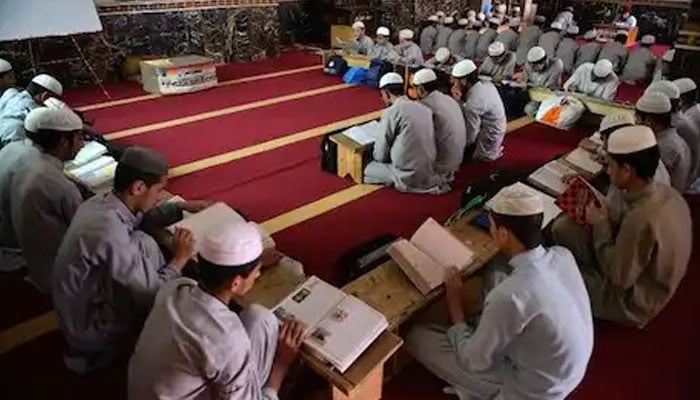
NEW DELHI: A court in India has essentially banned Islamic schools in the country’s most populous state of Uttar Pradesh, a move that could further distance Muslims from Prime Minister Narendra Modi’s Hindu nationalist government ahead of general elections, foreign media reported.
The ruling scraps a 2004 law governing madrassas in Uttar Pradesh (UP), claiming it violates India’s constitutional secularism and ordering that students be moved to conventional schools. The Allahabad High Court order affects 2.7 million students and 10,000 teachers in 25,000 madrassas, said Iftikhar Ahmed Javed, head of the board of madrassa education in UP, where one-fifth of the 240m people are Muslims.
“The state government shall also ensure that children between the ages of 6 to 14 years are not left without admission in duly recognised institutions,” Judges Subhash Vidyarthi and Vivek Chaudhary wrote in their order, which was made based on an appeal by lawyer Anshuman Singh Rathore. Rathore could not be contacted nor it was determined if he is connected to any political group.
India holds a general election between April and June that Modi’s Bharatiya Janata Party (BJP) is widely expected to win. Muslims and rights groups have accused some BJP members and affiliates of promoting anti-Islamic hate speech and vigilantism, and demolishing Muslim-owned properties.
Modi denies religious discrimination exists in India. The BJP says the government is undoing historical wrongs, including recently inaugurating a Hindu temple on the site of a 16th-century mosque razed in 1992. Many Hindus believe the mosque was built where God-king Ram was born and over a temple demolished under the Mughal ruler Babur.
Rakesh Tripathi, a spokesperson for BJP Uttar Pradesh, which runs the state government, said it was not against madrassas and expressed concern about the education of Muslim students. “We are not against any madrassa but we are against discriminatory practices. We are against illegal funding, and the government will decide on further action after going through the court’s order.”
Prime Minister Modi’s office did not immediately respond to an email on Saturday seeking comment on the court ruling.
Arguing for the federal government, which was a respondent in the case, Sudhanshu Chauhan told the court that “religious education and religious instructions of a single religion cannot be included in school education and the state government has no power to create statutory education boards permitting religious education”.
He added that the government was not planning to revive a federal policy stopped in March 2022 that had provided funds to madrassas to teach subjects like mathematics and science.
Madrassa official Javed, national secretary of the BJP’s minority wing, said that as a Muslim, he is often caught between the priorities of his party and members of his community. He said he has been fielding numerous calls from fellow Muslims since the order, which came during the holy month of Ramazan.
“Sometimes it becomes very difficult,” he said. “I have to balance a lot because, being a Muslim, the party sends me to the community to convince them to vote for us and join the party. I am scared and I walk with personal security whenever I go to any public event or programme.”
The BJP’s Tripathi responded that Muslim BJP leaders had nothing to fear as their community equally benefits from various government welfare programmes. “I am Hindu and I visit the Muslim community often and get good support from them,” he said. “The fact is that the BJP and the government are very serious about education and it’s doing its best.”
The BJP’s de facto parent organisation has been installing Muslims loyal to it in leadership positions at India’s Muslim universities as part of a push to garner Muslim votes. The UP government halted a funding programme for madrassas in January, rendering 21,000 teachers jobless. The order applies to all madrassas in the state, whether funded privately or by the government, Javed said.
The court did not give a timeline for its order, but Javed said that the madrassas are unlikely to be closed right away. The northeastern state of Assam, also ruled by the BJP, has been converting hundreds of madrassas into conventional schools.







-
 Prince William Warned His Future Reign Will Be Affected By Andrew Scandal
 -
 Amy Madigan Reflects On Husband Ed Harris' Support After Oscar Nomination
 -
 Is Studying Medicine Useless? Elon Musk’s Claim That AI Will Outperform Surgeons Sparks Debate
 -
 Margot Robbie Gushes Over 'Wuthering Heights' Director: 'I'd Follow Her Anywhere'
 -
 'The Muppet Show' Star Miss Piggy Gives Fans THIS Advice
 -
 Sarah Ferguson Concerned For Princess Eugenie, Beatrice Amid Epstein Scandal
 -
 Uber Enters Seven New European Markets In Major Food-delivery Expansion
 -
 Hollywood Fights Back Against Super-realistic AI Video Tool
 -
 Pentagon Threatens To Cut Ties With Anthropic Over AI Safeguards Dispute
 -
 Meghan Markle's Father Shares Fresh Health Update
 -
 Samsung Galaxy Unpacked 2026: What To Expect On February 25
 -
 Travis Kelce Takes Hilarious Jab At Taylor Swift In Valentine’s Day Post
 -
 NASA Confirms Arrival Of SpaceX Crew-12 Astronauts At The International Space Station
 -
 Can AI Bully Humans? Bot Publicly Criticises Engineer After Code Rejection
 -
 Search For Savannah Guthrie’s Abducted Mom Enters Unthinkable Phase
 -
 Imagine Dragons Star, Dan Reynolds Recalls 'frustrating' Diagnosis