
Hubble finds water vapor in small planet’s atmosphere
At around twice Earth's diameter, planet GJ 9827d orbits red dwarf star 97 light-years away, NASA, ESA says
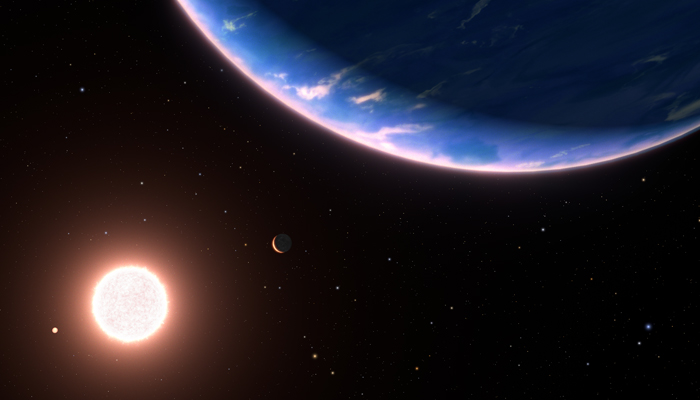
WASHINGTON: The Hubble Space Telescope has observed the smallest planet outside our solar system to contain water vapor in its atmosphere, a “landmark discovery” that brings astronomy a step closer to characterizing Earth-like worlds.
At around twice Earth´s diameter, planet GJ 9827d orbits a red dwarf star 97 light-years away in the constellation Pisces, NASA and the European Space Agency (ESA) said in statements on Thursday.
The team behind the finding are examining two scenarios: either the planet is a “mini-Neptune” with a hydrogen-rich atmosphere laced with water, or it´s a warmer version of Jupiter´s moon Europa, which contains twice as much water as Earth under its crust.
“The planet GJ 9827d could be half water, half rock,” said Bjorn Benneke of the Universite de Montreal, who co-led the research. “And there would be a lot of water vapor on top of some smaller rocky body.”
“Until now, we had not been able to directly detect the atmosphere of such a small planet. And we´re slowly getting in this regime now,” he added.
Over a period of three years, Hubble observed the planet during 11 transients, or events in which it crossed in front of its star.
During transients, starlight is filtered through the planet´s atmosphere, allowing astronomers to use Hubble´s instruments to analyze the patterns of colors (wavelengths), which revealed the telltale signature of water molecules.






-
 'The Muppet Show' Star Miss Piggy Gives Fans THIS Advice
 -
 Sarah Ferguson Concerned For Princess Eugenie, Beatrice Amid Epstein Scandal
 -
 Uber Enters Seven New European Markets In Major Food-delivery Expansion
 -
 Hollywood Fights Back Against Super-realistic AI Video Tool
 -
 Meghan Markle's Father Shares Fresh Health Update
 -
 Pentagon Threatens To Cut Ties With Anthropic Over AI Safeguards Dispute
 -
 Samsung Galaxy Unpacked 2026: What To Expect On February 25
 -
 Travis Kelce Takes Hilarious Jab At Taylor Swift In Valentine’s Day Post
 -
 NASA Confirms Arrival Of SpaceX Crew-12 Astronauts At The International Space Station
 -
 Can AI Bully Humans? Bot Publicly Criticises Engineer After Code Rejection
 -
 Search For Savannah Guthrie’s Abducted Mom Enters Unthinkable Phase
 -
 Imagine Dragons Star, Dan Reynolds Recalls 'frustrating' Diagnosis
 -
 Steve Jobs Once Called Google Over Single Shade Of Yellow: Here’s Why
 -
 Barack Obama Addresses UFO Mystery: Aliens Are ‘real’ But Debunks Area 51 Conspiracy Theories
 -
 Selma Blair Explains Why Multiple Sclerosis 'isn't So Scary'
 -
 Will Smith Surprises Wife Jada Pinkett With Unusual Gift On Valentine's Day