
Supreme Court forms larger bench to hear presidential reference
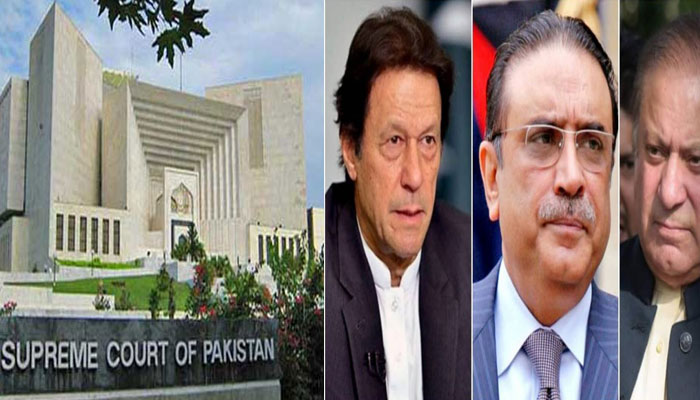
ISLAMABAD: The Supreme Court of Pakistan has constituted a larger bench to hear a presidential reference as well as a petition of the Supreme Court Bar Association for restraining political parties from holding public meetings in Islamabad before voting on a no-confidence motion against the prime minister.
A five-member bench headed by Chief Justice of Pakistan Umer Ata Bandial and comprising Justice Ijazul Ahsen, Justice Mazhar Alam Khan Miankhel, Justice Munib Akhtar and Justice Jamal Khan Mandokhel will conduct hearing on both the matters on March 24. The hearing on the presidential reference will be of much importance as the SC judgment regarding lifetime disqualification is in fieled, authored by Justice Umer Ata Bandial in 2018.
The president has referred to an apex court judgment, authored by Justice Shafiur Rehman in the case of Khawaja Ahmad Tariq Rahim vs Federation of Pakistan, PLD 1992 SC 646, holding that on account of cancerous vice of floor crossing, Pakistan has been unable to achieve stability in the polity of the country. The reference has asked what other measures and steps can be undertaken within the existing constitutional and legal framework to deter the cancerous practice of defection, floor crossing and vote buying?
The reference stated that a robust interpretation of Articles 62 and 63A of the Constitution by the court at this critical juncture would not only salvage the representative institutions but also the democratic process and restore the faith of people in democracy.
It is interesting to note that in the case of Samiullah Baloch vs Abdul Karim Nausherwani 2018 PLD SC 405, the judgment authored by Justice Umer Ata Bandial had held that the incapacity created for failing to meet the qualifications under Article 62(1) (f) of the Constitution imposes a permanent bar which remains in effect so long as the declaratory judgment supporting the conclusion of one of the delinquent kinds of conduct under Article 62(1) (f) of the Constitution remains in effect.
The majority judgment 4-1 with Justice Azmat Saeed Sheikh not agreeing with reasoning had been delivered on petitions in the fake degrees case. The judicial mechanism in Article 62(1)(f) of the Constitution grants a fair opportunity and adequate remedy for relief to a candidate under challenge to vindicate himself, the judgment had held.
“As a result, we are inclined to hold that the incapacity created for failing to meet qualifications under Article 62(1)(f) of the Constitution imposes a permanent bar which remains in effect so long as the declaratory judgment supporting the conclusion of one of the delinquent kinds of conduct under Article 62(1)(f) of the Constitution remains in effect,” the judgment had held.






-
 Can App Stores Really Keep Kids Off Social Media? Here’s What Experts Says
 -
 Margot Robbie Fears Being Dubbed A 'dumb Blonde' Due To Major Reasons: 'Hates The Idea'
 -
 How Kate Middleton's Hyperemesis Gravidarum Left Her 'not The Happiest'
 -
 USA Beats Canada For First Olympic Hockey Gold In 46 Years; Donald Trump, Barack Obama & Others Hail Historic Victory
 -
 Claressa Shields Defeats Franchon Crews-Dezurn In Heavyweight Title Rematch
 -
 Sam Altman Calls Elon Musk’s Space Data Center Plan ‘ridiculous’
 -
 Kara Braxton, WNBA All-Star And Champion, Dies At 43
 -
 Anthropic Lead Engineer Predicts ‘software Engineer’ Role Can Disappear By 2026
 -
 Sharon Details Late Husband Ozzy's Final Days During His Sickness
 -
 Magic Vs Clippers: Clippers Announce Kawhi Leonard Status After Exit
 -
 BTC Price Today: Bitcoin Sinks Below $65K On Trade Uncertainty
 -
 'A Knight Of The Seven Kingdoms': All You Need To Know About The Finale
 -
 NYC Travel Ban: Mamdani Shuts Down Roads Amid Blizzard Conditions
 -
 Alicia Keys Celebrates 25 Years Of Breakout Single ‘Fallin’’
 -
 Akinola Davies Jr. Gives His Immigrant Parents A Shoutout In 2026 BAFTAs Acceptance Speech
 -
 Princess Beatrice, Eugenie Told 'first Thing They Should Do' After Andrew Arrest