
Diplomats briefed on implementation of IMF-backed economic agenda
In significant engagement with diplomatic community, Leghari and Kayani jointly addressed distinguished gathering
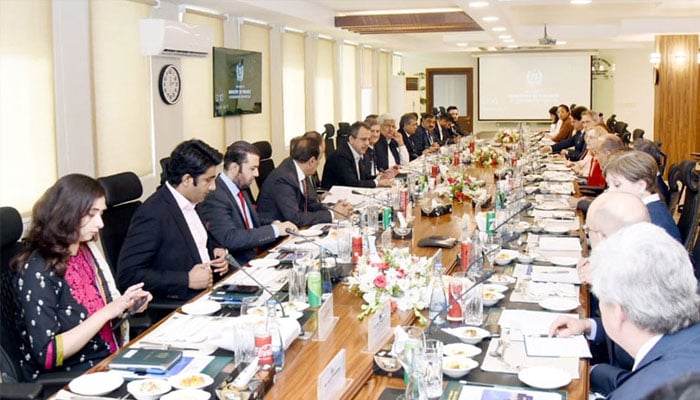
ISLAMABAD: Pakistan has assured the diplomatic corps of implementing IMF-backed reform agenda, highlighting a shift from stabilisation to sustained reform and growth.
Ahead of possibly striking a trade deal with the US, Pakistan’s two key ministers held an engagement with the diplomatic community to apprise them of the steps for implementing the reforms under the IMF programme.
In a significant engagement with the diplomatic community, Federal Minister for Power Sardar Awais Ahmad Khan Leghari and Minister of State for Finance Bilal Azhar Kayani jointly addressed a distinguished gathering of ambassadors, high commissioners, and senior diplomats from countries including the US, UK, European Union, Italy, Germany, Canada, Australia, Switzerland, Japan, the Netherlands, and Saudi Arabia at the Finance Division on Tuesday.
According to the Finance Ministry’s announcement, as a recurrent theme during their separate presentations, both the ministers reaffirmed Pakistan’s commitment to responsible economic management and modernising key public sectors in line with global standards.
“They emphasized that these reforms are part of a strategic, forward-looking national agenda designed to enhance competitiveness, transparency, and resilience. The diplomatic participants welcomed the comprehensive and candid briefing and acknowledged the government’s resolve to deliver meaningful and sustainable reform.”
The Minister for Power also drew the attention of the diplomatic audience to the significant investment potential within Pakistan’s power sector, estimating opportunities worth $2 to $3 billion across various segments of the energy value chain. He invited global power utility companies, investors, and industry leaders to explore these prospects, particularly in areas such as grid modernisation, renewable energy integration, distribution efficiency, and energy services. Emphasising the government’s commitment to regulatory reforms and institutional transparency, Awais Leghari told the diplomats that Pakistan welcomes strategic partnerships that can contribute to a more resilient and forward-looking energy ecosystem.
He also shared the progress on the privatisation of the electricity distribution companies, with the first batch of three being restructured to be privatised by early 2026, where he called for potential global investors across the utility chains to come forward and participate.
The high-level strategic briefing presented an overview of Pakistan’s recent economic achievements, tax reform agenda, and key developments in the country’s power sector.
Minister Kayani offered a data-backed assessment of Pakistan’s macroeconomic landscape, highlighting a shift from stabilisation to sustained reform.
The chairman FBR elaborated on the FBR Transformation Plan, a comprehensive reform framework based on three pillars—people, process, and technology. The reform agenda includes digitization of invoicing, production monitoring systems, AI-based audit tools, national goods tracking, improved taxpayer services, and strengthened integration with financial data sources. These measures aim to broaden the tax base, increase transparency, and simplify compliance.
The audience was also briefed on efforts to improve the performance of electricity distribution companies, where infrastructure upgrades and strengthened governance are helping reduce technical and commercial losses.







-
 Kylie Kelce Explains Why She Avoids Raising Kids With 'silver Spoon'
 -
 Meghan Markle Is Above Royal Family ‘empty Threats,’ Says Insider
 -
 Anne Hathaway Opens Up About 'defeated' Feeling As Working Mom
 -
 Shamed Andrew Should Testify In Epstein Case As ‘act Of Service’
 -
 What Really Happened Before Nicholas Brendon Was Found Dead At Home?
 -
 Sarah Ferguson Branded ‘most Famous Missing Person’ In UK Right Now
 -
 Why King Charles Does Not Need A Driving License? Expert Reveals
 -
 Did Graham Norton Really Sign NDAs For Taylor Swift’s Wedding?
 -
 ‘Polite’ King Charles Treats Staff Better Than ‘boorish’ Andrew
 -
 Princess Beatrice's Husband Raises Eyebrows With Deleted Instagram Post
 -
 Dua Lipa 'snubs' Priyanka Chopra
 -
 Will Taylor Frankie Paul Still Get Her 'Bachelorette' Salary?
 -
 'Harry Potter' Returns: First Glimpse Of HBO's New Series
 -
 Ryan Gosling Credits His Kids For Key Detail In New Role
 -
 Prince William, Kate Middleton Mark 'historic Moment'
 -
 Why Roberts Pattinson Says Couples 'ruin' Their Big Day Amid Suki Waterhouse Wedding Rumors?