
CJP, MWL’s chief discuss Islamic justice system, global challenges
Meeting focused on the foundational principles of Islamic justice and the global challenges to its adherence
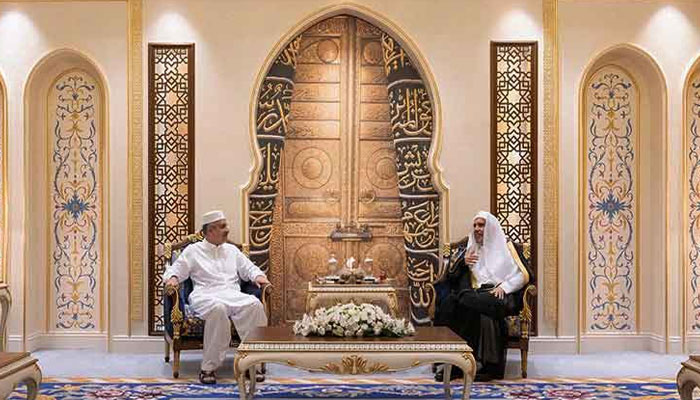
ISLAMABAD: Chief Justice of Pakistan Justice Yahya Afridi on Tuesday called on Sheikh Dr. Mohammed Alissa, Secretary-General of the Muslim World League and Chairman of the Organisation of Muslim Scholars to discuss the Islamic justice system and global challenges.
Sheikh Dr. Mohammed Alissa received the Chief Justice in Makkah after the completion of his Hajj pilgrimage. The high-level meeting focused on the foundational principles of Islamic justice and the global challenges to its adherence.
During the discussions, the two leaders recognised the centrality of the role of justice in Islam for societal stability, human dignity and global peace. They highlighted the urgent need to uphold fairness, equity and the rule of law in accordance with Islamic teachings, particularly in light of growing challenges to justice systems worldwide.
Sheikh Dr. Mohammed Alissa underscored the MWL’s commitment to promoting justice as a universal value rooted in Islamic principles, stating: “Justice is not merely a legal concept but a moral imperative in Islam.
On this occasion, Chief Justice Yahya Afridi expressed his resolve while reaffirming Pakistan’s dedication to judicial integrity and the application of Islamic legal principles in contemporary contexts.
The Chief Justice noted that the teachings of Islam provide a timeless framework for justice, and it is our duty as jurists to ensure these principles are upheld amidst modern complexities.
“Collaboration between scholars and judicial institutions is essential to address systemic injustices”, the CJP maintained adding that having remained associated with the Saudi justice system in various capacities, Pakistan is eager to learn from the expertise of Sheikh Dr. Mohammed Alissa in the domain of orphans and widows’ rights, inheritance rights and contractual obligations.
The meeting also explored avenues for enhanced cooperation between the Muslim World League and the Supreme Court of Pakistan to advance educational and legal initiatives promoting justice and ethical governance.
Both leaders agreed on the necessity of fostering dialogue among Muslim nations to strengthen judicial systems in line with Islamic values.
Meanwhile, on the invitation of the Chief Justice of Pakistan, Sheikh Dr. Mohammed Alissa agreed to visit Pakistan for institutional engagement with the judiciary of Pakistan to generate intellectual dialogue, particularly on Islamophobia and interfaith.







-
 Trump Administration Labeled ‘misogynistic’ Following Dismissal Of Pam Bondi And Kristi Noem
 -
 Trump Mocks Starmer As UK–US Tensions Rise Over Defence
 -
 'Peaky Blinders' Has Major Casting Shakeup For Lead Role In Upcoming Sequel Series
 -
 Quantum Computing Threat: Why Global Cybersecurity Could Collapse Soon
 -
 Jessica Simpson Reveals Rare Approach To Mastering 'Daisy Duke's Glow
 -
 Princess Beatrice’s Real Feelings About Andrew, Fergie: ‘They Ruined Nearly Every Aspect Of Her Life & Marriage’
 -
 AI Cyberattacks Set To Outpace Human Hackers, Experts Warn
 -
 China Tightens Rules On Digital Humans And Addictive Kids’ Content: Here’s Why
 -
 Britney Spears’ Eldest Son Pays Quiet Tribute To Popstar After Latest Reunion
 -
 Prince Harry, Meghan Get Sweet Chance To Reunite With Royal Family In Britain
 -
 US Disrupts Global Malaria And HIV Supply Chains, Sparking Health Crisis Fears
 -
 King Charles Holds Key To Meeting Prince Archie, Princess Lilibet
 -
 Meryl Streep Claps Back At ‘The Devil Wears Prada’ Being A ‘chick Flick’
 -
 Uffizi Galleries Hit By Cyberattack, Valuables Moved To Bank
 -
 Why Google Launched The Gemma 4 AI Model: Here’s Everything To Know
 -
 Royal Family Secret Travel Rules: Why Members Always Pack A Black Outfit